All Robots must pass inspection before competing in the VEX V5 Robotics Competition to ensure compliance with all Robot rules. Inspections typically occur during Team check-in or practice time. Teams should use the rules below to pre-inspect their Robot and confirm it meets all requirements.
Most rules are hard limits (e.g., motor quantity), while others are subject to inspector discretion (e.g., safety concerns). At many events, the lead inspector and Head Referee are the same person; if not, inspectors should consult the Head Referee for judgment calls. Per <R2d> and <R2e>, the Head Referee has final authority on all Robot rules and whether a Robot may compete.
<R1>One Robot per Team. Each Team can only bring one Robot to a given event in the VEX V5 Robotics Competition. Though it is expected that Teams will make changes to their Robot at the competition, a Team is limited to only one Robot at a given event, and a given Robot may only be used by one Team. A VEX Robot, for the purposes of the VEX V5 Robotics Competition, has the following subsystems:
Subsystem 1: Mobile robotic base including wheels, tracks, legs, or any other mechanism that allows the Robot to navigate the majority of the flat playing Field surface. For a stationary Robot, the robotic base without wheels would be considered Subsystem 1.
Subsystem 2: Power and control system that includes a legal VEX battery, a legal VEX control system, and associated motors for the mobile robotic base.
Subsystem 3: Additional mechanisms (and associated motors) that allow manipulation of Scoring Objects and interactions with Field Elements and other Robots.
Given the above definitions, a minimum Robot for use in any VEX V5 Robotics Competition event (including Robot Skills Matches ) must consist of subsystems 1 and 2 above. Thus, if you swap out an entire subsystem 1 or 2, you have created a second Robot and are in Violation this rule.
Teams may not compete with one Robot while a second is being modified or assembled at a competition.
Teams may not have an assembled second Robot on hand at a competition that is used to repair or swap parts with the first Robot.
Multiple Teams may not use the same Robot. Once a Robot has competed under a given Team number at an event, it is “their” Robot ; no other Team may EVER compete with it.
This rule is applied differently for VEX U. See Rule VUR1.
<R2>Robots must pass inspection. Every Robot will be required to pass a full inspection before being cleared to compete. This inspection will ensure that all Robot rules and regulations are met. Noncompliance with any Robot design or construction rule will result in removal from Matches or Disqualification of the Robot at an event until the Robot is brought back into compliance, as described in the following subclauses.
Significant changes to a Robot, such as a partial or full swap of Subsystem 3, must be re-inspected before the Robot may compete again.
All possible functional Robot configurations must be inspected before being used in competition. This especially pertains to modular or swappable mechanisms (per R1 ) and Match starting configurations/sizes (per R3 ).
If a Robot is determined to be in Violation of a Robot rule before a Match begins, the Robot will be removed from the Field. The Robot may remain at the Field so that the Team does not get assessed a “no-show” (per GG2 ).
Robots which have not passed inspection (i.e., that are in Violation of one or more Robot rules) will not be permitted to play in any Matches until they have passed inspection. GG2 will apply to any Matches that occur until the Robot has passed inspection.
If a Robot has passed inspection, but is later confirmed to be in Violation of a Robot rule during or immediately following a Match by a Head Referee, they will be Disqualified from that Match. This is the only Match that will be affected; any prior Matches that have already been completed will not be revisited. <R3d> will apply until the Violation is remedied and the Team is re-inspected.
All inspection rules are to be enforced within the discretion of the Head Referee within a given event. Robot legality at one event does not automatically imply legality at future events. Robots which rely on “edge-case” interpretations of subjective rules, such as whether a decoration is “non-functional” or not, should expect additional scrutiny during inspection.
Events may wish to use “inspection markers” (e.g., zip tie or sticker) to identify Robots that have passed inspection at that event. Inspection markers are functional components and are subject to all Robot rules, including legal materials and Robot size/expansion limits.
Event staff and volunteers are allowed to contact and/or photograph Robots during inspection and/or at other times as needed.
<R3>Robots must fit within an 18” x 18” x 18” volume.
Compliance with this rule may be checked using the official VEX Robotics On-FieldRobot Expansion Sizing Tool.
Event Partners may construct and/or provide any sizing tool that measures the correct dimensions.
Any restraints used to maintain starting size (i.e., zip ties, rubber bands, etc.) must remain attached to the Robot for the duration of the Match, per GG8.
For the purposes of this rule, it can be assumed that Robots will be inspected and begin each Match on a flat standard foam field tile.
This rule is applied differently for VEX U. See Rule VUR1.
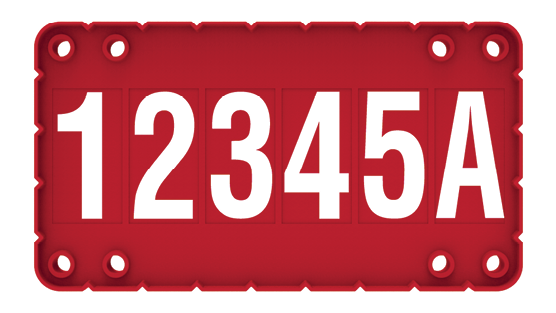
<R4>Officially registered Team numbers must be displayed on Robot license plates. To participate in an official VEX V5 Robotics Competition event, a Team must first register on events.vex.com and receive a VEX V5 Team number. This Team number must be displayed on the Robot using license plates. Teams may choose to use the official VEX V5 License Plate Kit, or may create their own using legal materials.
License plates must be placed in fixed locations on exactly two (2) horizontally opposing sides of the Robot and must remain visible, legible, and attached for the entirety of the Match. The top of a Robot is not considered a “side” for these two license plates.
License plates should be mounted in locations that remain stationary on the Robot during a Match (e.g., not on a rotating intake or flipping manipulator). The function of license plates is to identify Robots for referees, spectators, and other Teams. Identification is harder when a license plate on a Robot moves during a Match.
License plates must be securely attached to the Robot using materials that are legal for Robot construction. VEX IQ pins are not legal for mounting license plates on Robots.
Robots may only include license plates that match their Alliance color for the current Match (i.e., red AllianceRobots must have only red plates installed for the Match ).
License plates are considered functional components, and must meet the requirements of all Robot rules.
Additional license plates cannot be used on the Robot for any purpose.
Team numbers must be in white font, and clearly legible. Number/letter stickers are legal for use on license plates instead of or in addition to those in the VEX V5 License Plate Kit.
Custom license plates used to meet the requirements of <R4a> and <R4f> must be within the following size limits:
Height: between 2.0 (50.8mm) and 2.5 inches (63.5mm)
Width: between 4.0 (101.6mm) and 4.5 inches (114.3mm)
Thickness: up to 0.25” (6.35mm)
Figure R4-1: An example of a license plate made from the VEX V5 License Plate Kit.
Figure R4-2: An example of a legal custom license plate
<R5>Let go of Scoring Objects after the Match.Robots must be designed to permit easy removal of Scoring Objects from any mechanism without requiring the Robot to have power after a Match.
<R6>Robots have one Brain.Robots must ONLY use one (1) VEX V5 Robot Brain (276-4810). Any other microcontrollers or processing devices are not allowed, even as non-functional decorations.
This includes microcontrollers that are part of other VEX product lines, such as VEX Cortex, VEX EXP, VEXpro, VEX CTE, VEX RCR, VEX IQ, VEX GO, VEX AIR, or VEX Robotics by HEXBUG. This also includes devices that are unrelated to VEX, such as Raspberry Pi or Arduino devices.
V5 Robot Brain accessories (short flanges, long flanges, and the magnetic screen protector) are part of the V5 Robot Brain and are only legal for use on Robots as part of the V5 Robot Brain.
At events using a V5 Smart Field Control System, the “Team Number” field in the Robot Brain must be set as the Team’s registered number and letter (with no spaces).
This rule is applied differently for VEX U. See Rules VUR10 and VUR12.
<R7>Keep the power button or battery connection accessible. The on/off button on the V5 Robot Brain and/or the Battery Cable connection on either the V5 Robot Brain or V5 Robot Battery must be accessible without moving or lifting the Robot. The V5 Brain screen should be easily visible during Robot inspection. Keeping the V5 Brain screen visible throughout a Match is recommended but not required.
The minimum version requirement is subject to change over the course of the season.
When the minimum version is updated, Teams have a one week (7 calendar day) grace period from the time the minimum version is changed to update their firmware to the latest minimum version.
VEX reserves the right to deem any firmware update critical, and remove the allowable grace period.
Beta firmware, which includes any firmware version that ends with the letter ‘b’, is not legal for use in competition.
<R9>Use a “Competition Template” for programming. The Robot must be programmed to follow control directions provided by the VEXnet Field Controllers or Smart Field Control system.
This may be tested in inspection, where Robots may be required to pass a functional “enable/disable” test. For more information on this, Teams should consult the help guides produced by the developers of their chosen programming software.
<R10>Motors are limited for Subsystem 2 (see <R1>).Robots may use any combination of V5 Smart Motors, 11W (276-4840) and/or 5.5W (276-4842), within the following criteria:
The combined power of all motors (11W & 5.5W) must not exceed 88W. This limit applies to all motors on the Robot, even those which are not plugged in.
V5 Smart Motors connected to Smart Ports are the only motors that may be used with a V5 Robot Brain. The 3-wire ports may not be used to control motors of any kind.
Example
A
B
C
D
E
Qty of 11W motors
8
7
6
5
0
Qty of 5.5W motors
0
2
4
6
16
This rule is applied differently for VEX U. See Rule VUR11.
<R11>Motors are limited for Subsystem 2 (see <R1>)Robots may use any combination of V5 Smart Motors, 11W (276-4840) and/or 5.5W (276-4842), in Subsystem 2 within the following criteria:
The combined power of all motors in Subsystem 2 must not exceed 55W.
Motors used in Subsystem 2 cannot provide power to any mechanism that is not a part of Subsystem 1.
Motors in Subsystem 2 cannot be toggled, engaged, or configured such that they are capable of providing power to any part of the Robot that is not a part of Subsystem 1
Teams may be required to demonstrate what each motor is capable of powering on their Robot during inspection in order to satisfy this requirement.
<R12>Electrical power comes from VEX batteries only.Robots may use one (1) V5 Robot Battery (276-4811) to power the V5 Robot Brain.
No other sources of electrical power are permitted, unless used as part of a non-functional decoration per <R23e>.
There are no legal power expanders for the V5 Robot Battery.
V5 Robot Batteries may only be charged by a V5 Robot Battery Charger (276-4812 or 276-4841).
V5 Controllers (276-4820) may only be powered by their internal rechargeable battery.
Teams are permitted to have an external power source (such as a rechargeable battery pack) plugged into their V5 Controller during a Match, provided that this power source is connected safely and does not violate any other rules, such as R28.
Some events may choose to provide Field power for V5 Controllers. If this is provided for all Teams at the event, then this is a legal power source for the V5 Controllers.
This rule is applied differently for VEX U. See Rule VUR12.
<R13>Robots use VEXnet.Robots must ONLY utilize VEXnet for all wireless Robot communication.
Electronics from the Cortex, VEX EXP, VEX CTE. VEXpro, VEX RCR, VEXplorer, VEX IQ, VEX GO, or VEX Robotics by HEXBUG product line are prohibited unless otherwise noted in R16.
Teams are permitted to use the Bluetooth® capabilities of the V5 Robot Brain and/or V5 Controller in Team pits, practice Fields, and Robot Skills Matches. However, VEXnet must be used for wireless communication during Head-to-Head Matches.
Teams are permitted to use the Wi-Fi capabilities of the Vision Sensor in Team pits or outside of Matches. However, the Vision Sensor must have its wireless transmitting functionality disabled during Matches.
This rule is applied differently for VEX U. See Rules VUR2, VUR10 and VUR12.
<R14>Give the radio some space. The V5 Radio should be mounted such that no metal surrounds the radio symbol on the V5 Radio. While failure to do so will affect Robot performance, it will not prevent the Robot from passing inspection.
<R15>One or two Controllers per Robot. No more than two (2) VEX V5 Controllers may control a single Robot.
No physical or electrical modification of these Controllers is allowed under any circumstances.
Attachments which assist the Drive Team Member in holding or manipulating buttons/joysticks on the V5 Controller are permitted, provided that they do not involve direct physical or electrical modification of the Controller itself.
No other methods of controlling the Robot (light, sound, etc.) are permissible.
Using sensor feedback to augment driver control (such as motor encoders or the Vision Sensor) is permitted.
<R16>Robots are built from the VEX V5 system.Robots may be built ONLY using official VEX
V5 components, unless otherwise specifically noted within these rules.
Any questions or concerns about legal parts should be directed to the official Q&A System on events.vex.com.
This rule is applied differently for VEX U. See Rule VUR2.
<R17>New VEX parts are legal. Additional VEX components released during the competition season on www.vexrobotics.com are considered legal for use unless otherwise noted.
Some “new” components may have certain restrictions placed on them upon their release. These restrictions will be documented in the official Q&A, in a Game Manual update, or in the VEX V5 Legal Parts List.
<R18>Prohibited Items. The following types of mechanisms and components are NOT allowed.
Those that could pose a potential safety hazard to Drive Team Members, event staff, or other humans.
Products from the VEXpro, VEX EXP, VEX IQ, VEX GO, VEX 123, VEX CTE, VEX AIM, VEX AIR, VEX Robotics by HEXBUG*, or any other VEX product lines, unless specifically allowed by a clause of R16 or listed in the VEX V5 Legal Parts List (See R16 ).
Components obtained from the V5 beta program. All V5 beta hardware can be identified by its lighter gray pre-production color. Robot Brains, Robot Batteries, Controllers, and Vision Sensors from the V5 beta have a “BETA TEST” stamp on them. Smart Motors and Radios do not have this stamp, but can still be identified by color.
Standalone VEX Smart Field Controller Brains (SKU 276-7577).
VEX apparel, competition support materials, packaging, or other non-Robot products.
Field Elements or components of Field Elements that are not otherwise explicitly legal materials (e.g., screws, standoffs, nuts, or non-shattering plastic within the limitations of R24 ).
3D printed Robot parts for any purpose, including non-functional decorations and license plates.
Speakers and other audio devices that create sound.
This rule is applied differently for VEX U. See Rules VUR2, VUR5, VUR6, & VUR13.
* The HEXBUG brand is a registered trademark belonging to Spin Master Corp
<R19>Certain non-VEX components are allowed.Robots are allowed the following additional components from sources other than VEX Robotics:
Any non-aerosol-based grease or lubricating compound, when used in extreme moderation on surfaces and locations that do NOT contact the playing Field walls, foam Field tiles, Scoring Objects, or other Robots. Grease or lubricant applied directly to V5 Smart Motors or Smart Motor cartridges is prohibited.
Anti-static compound, when used in extreme moderation (i.e., such that it does not leave residue on Field Elements, Scoring Objects, or other Robots ).
Hot glue when used to secure cable connections.
An unlimited amount of non-elastic rope/string, no thicker than 1/4” (6.35mm).
Commercially available items used solely for bundling or wrapping of 2-wire, 3-wire, 4-wire, or V5 Smart Cables, and/or pneumatic tubing are allowed. These items must solely be used for the purposes of cable/tubing protection, organization, or management. This includes but is not limited to electrical tape, cable carrier, cable track, etc. It is up to inspectors to determine whether a component is serving a function beyond protecting and managing cables and tubing.
Rubber bands no larger than 7.5” long and 0.25” wide.
Anti-slip drawer liner with similar nominal dimensions to VEX Anti-Slip Mat (275-0120 or 275-0121). The pattern of the matting should be similar to VEX Anti-Slip Mat, and there should be no additional performance gained by using non-VEX anti-slip drawer liner (i.e., no additional elasticity, adhesive backing, etc.). No piece of anti-slip drawer liner can be larger than 12” x 15” and all anti-slip drawer liner must be black in color.
Plastic zip ties no larger than 12” long and 0.25” wide.
Aerosol-based cooling/freeze spray may be used to assist in cooling motors. Teams using freeze spray or similar products in ways that may reasonably be deemed unsafe could be subject to S1Violations.
Cleaners, disinfectants, and/or sanitizers may be used to assist in cleaning Robots, parts, components, etc.
See rules R21 through R25 for additional legal non-VEX components.
<R20>Custom V5 Smart Cables are allowed.Teams who create custom cables acknowledge that incorrect wiring may have undesired results.
Official V5 Smart Cable Stock must be used.
Use of non-VEX 4P4C connectors and 4P4C crimping tools is permissible.
V5 Smart Cables may only be used for connecting legal electronic devices to the V5 Robot Brain.
<R21>A limited amount of tape is allowed.Robots may use a small amount of tape for the following purposes:
To secure any connection between the ends of two (2) VEX cables.
To label wires, motors, Robot Brains, and/or controllers.
To prevent leaks on the threaded portions of pneumatic fittings. This is the only acceptable use of Teflon tape.
In any other application that would be considered a “decoration” per R23.
As an aglet at the end of rope/string to prevent fraying.
<R22>Certain non-VEX fasteners are allowed.Robots may use the following commercially available hardware:
#4, #6, #8, M3, M3.5, or M4 screws up to 2.5” (63.5 mm) long, and M2.5 x 8mm screws.
Shoulder screws with a shoulder length no longer than 0.20” and a diameter no larger than 0.176”.
Any commercially available nut, washer, threaded standoff up to 6” (152.4mm) long, and/or non-threaded spacer up to 2.5” (63.5mm) long which fits these screws.
This rule is applied differently for VEX U. See Rule VUR9.
<R23>Visual decorations are allowed.Teams may add non-functional decorations, provided that they do not affect Robot performance in any significant way or affect the outcome of the Match. These decorations must be in the spirit of the competition. Inspectors and Head Referees will have final say in what is considered “non-functional.” Unless otherwise specified below, non-functional decorations are governed by all standard Robot rules.
To be considered “non-functional,” decorations must be backed by legal materials that provide the same functionality. For example, if a Robot has a giant decal that prevents Scoring Objects from falling out of the Robot, the decal must be backed by VEX material that would also prevent the Scoring Objects from falling out. A simple way to check this is to determine if removing the decoration would impact the performance of the Robot in any way.
Anodizing, painting, dyeing, or otherwise changing the color of any legal VEX part is considered a legal nonfunctional decoration.
Note: For official events held in mainland China, anodizing, painting, dyeing, or otherwise changing the color of any legal VEX part is prohibited.
Small cameras are permitted as non-functional decorations, provided that any transmitting functions or wireless communications are disabled. Unusually large cameras used as ballast are not permitted.
VEX electronics may not be used as non-functional decorations.
Decorations that visually mimic Field Elements or Scoring Objects are not permitted. The inspector and Head Referee will make the final decision on whether a given decoration or mechanism violates this rule.
Decorations cannot be designed to intentionally interfere with opponent Vision or Color Sensors. Teams will be asked to remove these decorations if the inspector or Head Referee determines that it interferes with opponent systems.
Decorations which provide feedback to a Robot (e.g., by influencing legal sensors) would be considered “functional,” and are not permitted.
Decorations that cover or obscure identifying features of electronics and/or pneumatics parts are not legal.
Teams will be asked to either replace the electronics and/or pneumatics part entirely, or remove the decoration if possible.
Identifying features include, but are not limited to, VEX logos, part numbers, and other distinctive colors or features of the part that allow an inspector to easily confirm it is a legal part.
<R24>A limited amount of custom plastic is allowed.Robots may use custom-made pieces cut from certain types of non-shattering plastic, up to 0.070” (1.78mm) thick.
Each Robot is limited to a maximum of 12 individual pieces cut from non-shattering plastic. This includes non-shattering plastic used in non-functional decorations.
Each individual piece of non-shattering plastic cannot be larger than 4” x 8” x 0.070”.
Teams must present and display ALL non-shattering plastic parts during inspection.
Inspectors will verify the total number of plastic pieces. They may use dry-erase markers or other forms of temporary marking to aid in counting.
Inspectors will verify that no non-shattering piece exceeds the size limitation.
Plastic may be mechanically altered by cutting, drilling, bending, etc. It cannot be chemically treated, melted, cast, or bonded to another part. Heating non-shattering plastic to aid in bending is acceptable.
Shattering plastics, such as PMMA (also called plexiglass, acrylic, or perspex), and structurally non-homogeneous plastics, such as woven (e.g., SRPP) and/or fiber-reinforced sheets, are prohibited.
Plastic sheets sold by VEX (such as the 276-8340 PET Sheets) are considered custom plastic in the context of this rule, and are subject to the same limitations as other plastic parts.
This rule does not apply to 3D printed plastic parts. 3D printed Robot parts are not permitted in the VEX V5 Robotics Competition for any purpose, including non-functional decorations.
Note: Teams are strongly encouraged to provide inspectors with 1:1 scale drawings, identical spares, or 1:1 scale tracings of their non-shattering plastic pieces to aid in inspection. Drawings and tracings should accurately reflect ALL shapes and dimensions of each piece. Complex bent/cut parts, and parts that are cut diagonally across a 4”x8” sheet to gain length may require more evidence.
This rule is applied differently for VEX U. See Rules VUR3 & VUR4.
<R25>Pneumatics are limited. A Robot’s pneumatic subsystem must satisfy all of the following criteria:
Teams may use a maximum of two (2) VEX Air Tanks (276-8749) on a Robot.
Pneumatic devices may be charged to a maximum of 100 psi.
The compressed air contained inside a pneumatic subsystem can only be used to actuate legal pneumatic devices (e.g., cylinders).
This rule is applied differently for VEX U. See Rule VUR14.
<R26>The VEX Pressure Gauge (276-8748) is a required part if a Robot includes pneumatics.
The gauge must be plumbed to the high pressure side of the system if the Team is using a regulator.
The pressure gauge must be visible and readable by referees and inspectors without moving or removing other Robot components or mechanisms.
The pressure gauge will be used to verify that the pneumatics system is charged to no more than 100psi, per R25.
The VEX Pressure Gauge on the Robot will take precedence over any off-board measurement.
<R27>Most modifications to non-electrical components are allowed. Physical modifications, such as bending or cutting, of legal metal structure or plastic components are permitted.
Modifying the arm of limit switches (by bending or trimming) or removing the rubber cap of bumper switches is permitted.
Metallurgical modifications that change fundamental material properties, such as heat treating or melting, are not permitted.
Pneumatic tubing may be cut to desired lengths.
Fusing/melting the end of legal nylon rope/string (see <R19d>) to prevent fraying is permitted.
Welding, soldering, brazing, gluing, or attaching parts to each other in any way that is not provided within the VEX platform is not permitted. Rule <R19c> is an exception to this rule.
Mechanical fasteners may be secured using Loctite or a similar thread-locking product. This may ONLY be used for securing hardware, such as screws and nuts.
This rule is applied differently for VEX U. See Rules VUR3, VUR12& VUR13.
<R28>No modifications to electronic or pneumatic components are allowed. Motors (including the V5 Smart Motor firmware), microcontrollers (including V5 Robot Brain firmware), cables, sensors, controllers, battery packs, reservoirs, solenoids, pneumatic cylinders, and any other electrical or pneumatics component of the VEX platform may NOT be altered from their original state in ANY way.
Teams may make the following modifications to the V5 Smart Motor (11W)’s user-serviceable features. This list is all-inclusive; no other modifications are permitted. Where applicable, the components listed below (in the specific applications listed below) are permissible exceptions to R19.
Replacing the gear cartridge with other official cartridges.
Removing or replacing the screws from the V5 Smart Motor Cap (276-6780).
Removing or replacing the threaded mounting inserts (276-6781).
V5 Smart Motors (11W) must use an official VEX V5 gear cartridge. For the purposes of this rule, the gear cartridges found within the V5 Smart Motor are considered “part of the motor.” Therefore, any physical or functional modifications to official gear cartridges is not permitted. V5 Smart Motors (11W) may only use official VEX motor cartridges
For the purposes of this rule, the V5 Smart Motor Cap is not considered “part of the motor.” Therefore, R27 applies.
External wires on VEX 2-wire or 3-wire electrical components may be repaired by soldering or using twist/crimp connectors, electrical tape, or shrink tubing such that the original functionality and length are not modified in any way.
Wire used in repairs must be identical to VEX wire.
Teams make these repairs at their own risk; incorrect wiring may have undesired results.
V5 Robot Brain accessories (short flanges, long flanges, and the magnetic screen protector) are considered “part of the V5 Robot Brain” and cannot be modified.