


Compare "Section 6 - VEX U": v2.0 → v2.1
Introduction
Section titled “Introduction”While many colleges and universities already use the VEX V5 system in their academic classes, many more have extensive manufacturing capabilities beyond the standard “VEX metal” library. Fabrication techniques like machining and 3D printing are more common than ever in collegiate engineering programs, and we can’t wait to see what VEX U Robotics Competition Teams from around the world are able to create under these more advanced rules.
As in past years, the season will include a culminating VEX U event at the VEX Robotics World Championship, along with regional Tournaments across the world. Participating schools will get the chance to prove their abilities in front of thousands of future engineers and show off what truly makes their school remarkable. The VEX U Robotics Competition is the perfect project-based supplement to many university level engineering programs, and gives Students the unique opportunity to demonstrate their real-world skills to potential employers, such as our event sponsors.
Game, Robot, and Tournament Rules
Section titled “Game, Robot, and Tournament Rules”The VEX U Robotics Competition uses the VEX V5 Robotics Competition Override Field with some minor modifications. Anyone that has a VEX V5 Override Field can use it for a VEX U event or Team. Please consult earlier sections of this game manual for the basic set of competition rules and details. All of the standard rules apply, except for the modifications listed in this section. In the event of a conflict between rules, the rules listed in this Section of the game manual and any rulings on the official VEX U Q&A take precedence.
VURC Definitions
Section titled “VURC Definitions”Additional Electronics - Any Sensor, processor, or other electronic component used in Robot construction, and connected to the V5 Robot Brain, that is not sold by VEX Robotics. Examples include commercially-available devices (e.g., Raspberry Pi) or custom devices designed and fabricated by the Team. See VUR12 and VUR13 for more details.
Alliance - A grouping of two (2) Robots from the same Team that have been chosen by the Students to play together during a given Match.
Electromechanical Assembly - A complex system composed of multiple off-the-shelf components, which may include Sensors, mechanical parts, and actuators.
External Processor - A computing device or microcontroller that independently processes Sensor data before sending it to the VEX V5 Brain.
Fabricated Part - Any component used in Robot construction that is fabricated by Team members. See VUR3 through VUR7 for more details.
Raw Stock - Stock materials purchased from third-party vendors that may be used to create Fabricated Parts. See VUR4 and VUR5.
Sensor - A device that detects and responds to changes in the environment, providing data to the Robot’s control system.
Rule Modifications: Field Setup
Section titled “Rule Modifications: Field Setup”The VURC playing Field is set up differently than a Head-to-Head VEX V5 Robotics Competition Override Match, with the following modifications:
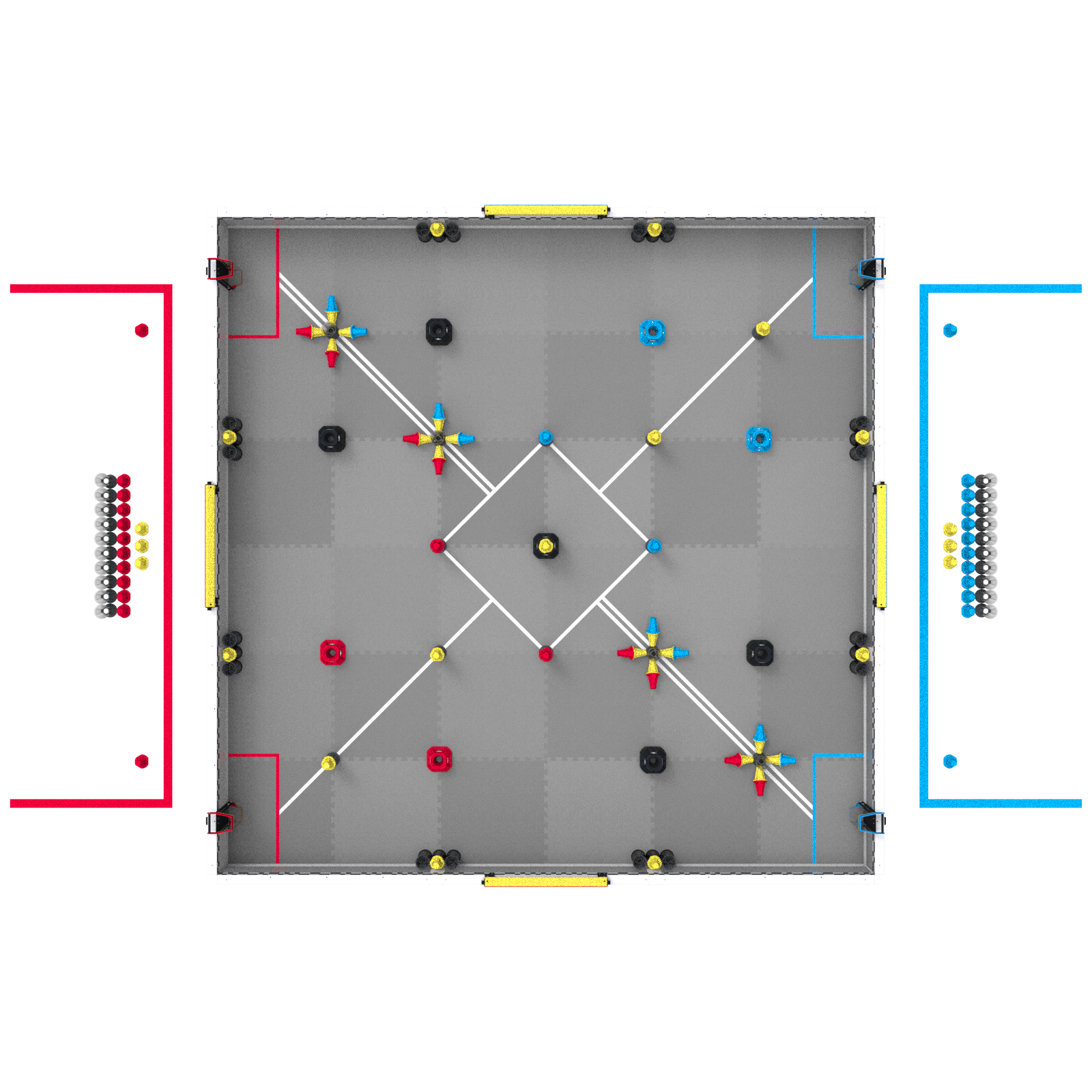
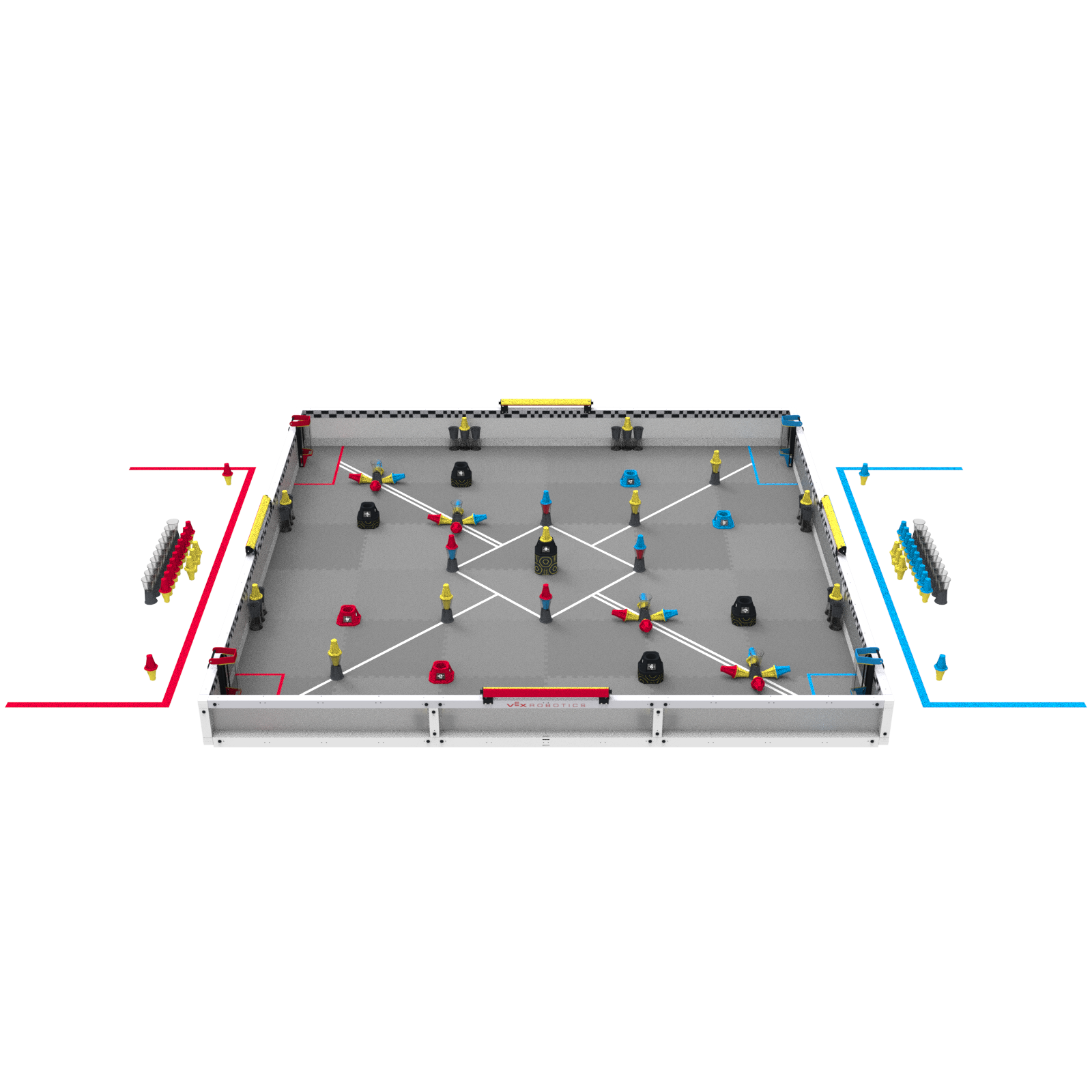
- The VEX GPS code strip must be installed on the Field.
- Modified Field layout. Only the Midfield Goal should begin the Match with a yellow/yellow Pin Placed in it.
- Modified Match Loads. Each Alliance gains an additional two yellow/yellow Pins that begin off the Field as Match Loads.
- Red Alliance Match Loads : 10 Cups, 10 red/yellow Pins, and 3 yellow/yellow Pins
- Blue Alliance Match Loads : 10 Cups, 10 blue/yellow Pins, and 3 yellow/yellow Pins
Rule Modifications: Game
Section titled “Rule Modifications: Game”<VUG2> Different Robot placement than rule <GG10>. The red Team has the right to place one Robot on the Field first, followed by both blue Robots, and ending with the 2nd red Robot. This applies in Qualification Matches and Elimination Matches. If this right is used, once a Team has placed a Robot on the Field, its position cannot be readjusted prior to the Match.
<VUG3> Some electronic devices may be in motion or moving at the beginning of the Match. This includes active cooling fans, spinning LIDAR modules, and/or other similar sensors or Additional Electronics. These electronic devices should not initiate any form of motion for the entire Robot or any of its subsystems, and may not directly interact with Scoring Objects and/or other Robots.
Removed: Version 2.0 (Old)
<VUG4> Different availability of Loaders. Drive Team Members may introduce Match Loads through their Alliance-colored Loaders during both the Autonomous Period and the Driver Controlled Period of the Match.
Added: Version 2.1 (New)
<VUG4> Different availability of Loaders. Drive Team Members may introduce Match Loads through their Alliance-colored Loaders, and may operate those Loaders, during both the Autonomous Period and Driver Controlled Period of the Match.
<VUG5> Different scoring during the Autonomous Period. For the purpose of determining the Autonomous Bonus winner, the following are included in Autonomous Period scoring calculations:
Removed: Version 2.0 (Old)
Added: Version 2.1 (New)
- Ownership and Scoring of yellow Pin Halves in the Midfield
- For Pins Placed in the Midfield Goal, the yellow Pin Halves are Owned by the Alliance that ends the Autonomous Period with a greater number of Robots in the Midfield.
<VUG6> Different Autonomous Win Point criteria. For all VEX U events, an Autonomous Win Point is awarded to any Alliance that ends the Autonomous Period with all of the following tasks completed, and that has committed no Violations during the Autonomous Period :
Removed: Version 2.0 (Old)
- At least twelve (12) Pins Scored for your Alliance. (Does not include Pins Placed in Quadrants on the opposing side of the Autonomous Line ).
- At least four (4) Goals each contain at least two (2) Pins Scored for your Alliance. (Does not include Goals in Quadrants on the opposing side of the Autonomous Line ).
Added: Version 2.1 (New)
- At least twelve (12) Pin Halves Scored for your Alliance. (Does not include Pin Halves Scored in Quadrants on the opposing side of the Autonomous Line.)
- At least four (4) Goals each contain at least two (2) Pin Halves Scored for your Alliance. (Does not include Goals in Quadrants on the opposing side of the Autonomous Line ).
- Neither Robot is contacting the Field Perimeter.
- At least one (1) Robot is at least partially within the Midfield.
Rule Modifications: Robot Skills Challenge
Section titled “Rule Modifications: Robot Skills Challenge”All rules apply from VEX V5 Section 3: Robot Skills Challenge, with no modifications other than those noted below.
<VURS1> VEX U Robot Skills Matches are set up differently than VEX V5 Robotics Competition Robot Skills Matches, with the following modification:
- Modified Match Loads. Four (4) red/yellow Pins, six (6) blue/yellow Pins, and ten (10) Cups begin off the Field as Match Loads. See figure VURS1.
<VURS2> Teams are permitted to use both Robots in their VEX U Robot Skills Matches, per VUT1 and VUR1.
<VURS3> Both Robots must start the Robot Skills Match in legal starting positions for the red Alliance. All other portions of rule SG1 apply. Each Robot must use one red/yellow Pin as a Preload in accordance with SG5.
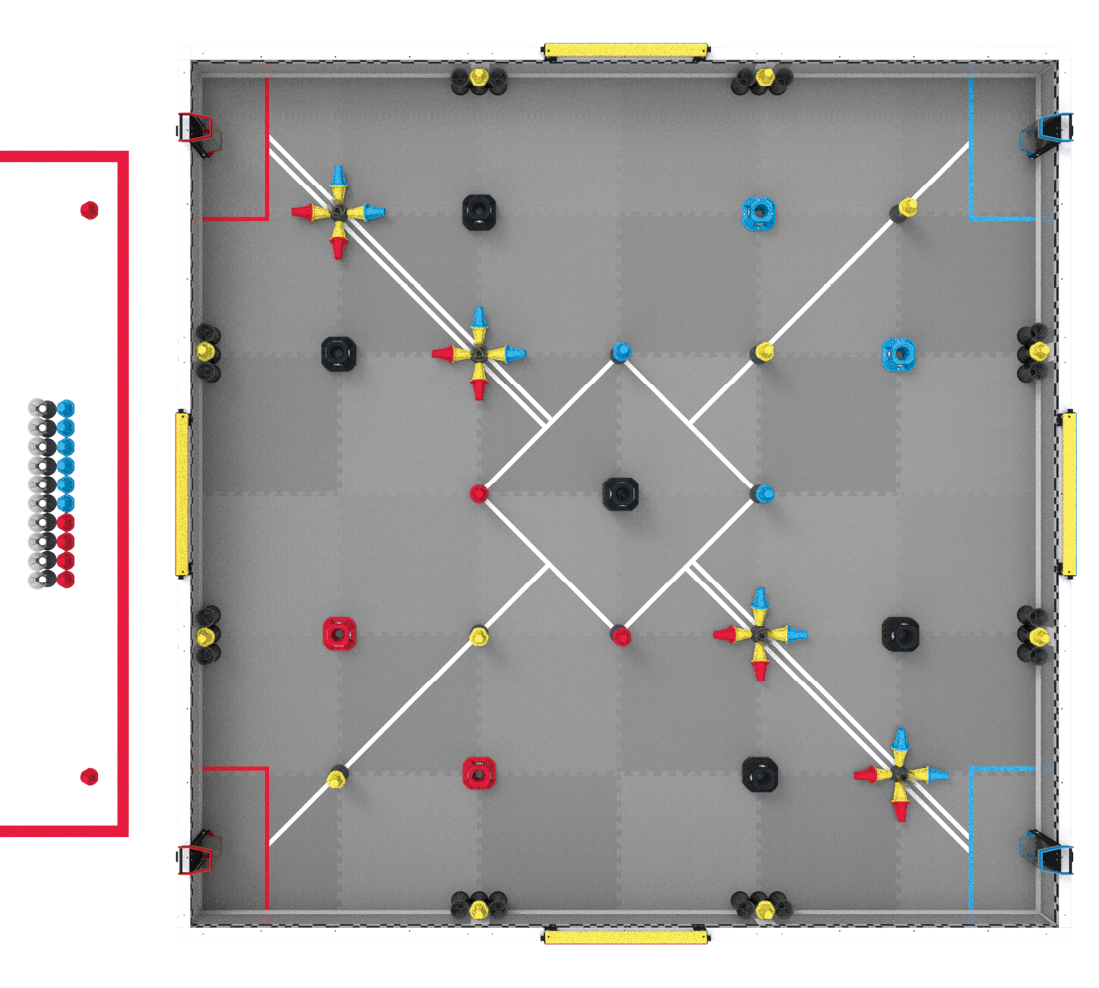
Figure VURS1: The Field setup for a VEX U Robot Skills Match.
Rule Modifications: Tournament
Section titled “Rule Modifications: Tournament”<VUT1> Instead of a 2-Team Alliance format, VURC Head-to-Head Matches will be played 1-Team vs. 1-Team. Each Team will use two (2) Robots in each Match.
<VUT2> Qualification Matches will be conducted in the same manner as in a VEX V5 tournament, but in the revised 1v1 format described in VUT1.
<VUT3> Elimination Matches will be conducted in the same manner as in a VEX V5 tournament, but without an Alliance Selection. At the end of the competition, one Team will emerge as the Tournament champion.
<VUT4> The Autonomous Period at the beginning of each Head-to-Head Match will be 30 seconds.
- Human interaction with Robots during the Autonomous Period is strictly prohibited.
- If both Teams complete their routines before 30 seconds have elapsed, they have the option to signal that they wish to end the Autonomous Period early. Both Teams and the Head Referee must all agree on the “early stop.” This is not a requirement, and the option must have been established for all Teams at the event, such as during the event meeting.
<VUT5> The Driver Controlled Period is shortened to 90 seconds and immediately follows the Autonomous Period.
<VUT6> VURC tournaments have fewer Teams in Eliminations. The number of Teams in Elimination Matches for a given event is determined as follows, except in extraordinary circumstances with the permission of VEX Robotics. A number of Teams below 16 will result in one or more Byes for highest-ranking Teams.
Rule Modifications: Robot
Section titled “Rule Modifications: Robot”- Both Robots may only be built from the following materials:
- Official VEX Robotics products (see VUR2 )
- Fabricated Parts made by the Team (see VUR3 through VUR7 )
- Commercially-available springs, fasteners, and bearings (see VUR8, VUR9, and VUR15 )
- A legal electronics system (see VUR10 and VUR11 )
- Any legal Additional Electronics (see VUR12 )
- A legal pneumatics system (see VUR14 )
- Unmodified legal Raw Stock (see VUR4 and VUR5 )
- One Robot must be no larger than 24” (609.6 mm) x 24” (609.6 mm) x 24” (609.6 mm) at the start of the Match.
- One Robot must be no larger than 15” (381 mm) x 15” (381 mm) x 15” (381 mm) at the start of the Match.
<VUR2> Teams may use any official VEX Robotics products, other than the exceptions listed in the tables below, to construct their Robot. This includes those from the VEXpro, VEX EXP, VEX IQ, VEX GO, VEX 123, VEX CTE, and VEX Robotics by HEXBUG* product lines. Rule R28 applies, but most modifications to non-electrical components are allowed.
This rule takes precedence over all other rules regarding Raw Stock and/or Fabricated Parts, such as VUR5.
* The HEXBUG brand is a registered trademark belonging to Spin Master Corp
| SKU | Description |
|---|---|
| 217-8080 | Talon SRX |
| 217-9191 | Victor SPX |
| 217-9090 | Victor SP |
| 217-4243 | Pneumatic Control Module |
| 217-4244 | Power Distribution Panel |
| 217-4245 | Voltage Regulator Module |
| 217-4347 | 775pro |
| 217-2000 | CIM Motor |
| 217-3371 | Mini CIM Motor |
| 217-3351 | BAG Motor |
| 217-6515 | Falcon 500 |
<VUR3> Fabricated Parts may be made by applying the following manufacturing processes to legal Raw Stock :
- Additive manufacturing processes, such as 3D printing.
- Subtractive manufacturing processes, such as cutting, drilling, routing, or machining.
- Bending, such as sheet metal braking or thermoforming.
- Attaching materials to one another, such as welding or chemically bonding (e.g., epoxy).
- Molding of non-metals, such as injecting polyurethane into a 3D printed mold.
<VUR4> Fabricated Parts must be made from legal Raw Stock. To be considered Raw Stock, the material must be obtained in one of the following forms before undergoing the fabrication processes listed in VUR3 :
| Type | Shape / Profile | Examples | |
|---|---|---|---|
| 1 | Sheet | Flat Plane | * Sheet metal * ⅛” polycarbonate sheet * Plywood |
| 2 | Solid Billet | “Thick” rectangular beam / block | * 4” x 4” x 6” solid aluminum billet * 2” x 2” x 2” acetal block |
| 3 | Solid Bar | “Thin” rectangular beam | * 2x4 wood planks * ¼” x 3” aluminum bars |
| 4 | Hollow Bar | Hollow rectangular beam | * 1” x 1”, 1/32” wall aluminum box tube |
| 5 | Solid Rod | Cylinder, Hexagonal or Rounded Hexagonal Stock | * ¼” steel rod * ¼” acetal rod * VEXpro Hex Shaft |
| 6 | Hollow Rod / Tube | Hollow Cylinder, Drilled/Threaded Hexagonal or Rounded Hexagonal Stock | * Copper tubing * PVC pipe * VEXpro ThunderHex Stock |
| 7 | Angle | 90° “L” shape | * 1” x 1”, 1/16” thickness aluminum angle |
| 8 | U- / C-Channel | “U” or “C”. | * 1/4” High x 1” Wide Aluminum U-Channel |
| 9 | Non-Metal 3D Printer Filament | Thin cylinder | * PLA or TPU filament * Composite nylon filament (e.g. Markforged OnyxTM) |
| 10 | Synthetic Polymer used for Molding | Liquid | * Polyurethane * Silicone |
| 11 | Solid Sphere | Solid (not hollow) uniformly rounded stock | * Steel ball bearing * Shaped wood finial |
<VUR5> The following material types are not considered Raw Stock, and are therefore not permitted:
| Type | Examples | |
|---|---|---|
| 1 | Any otherwise-legal Raw Stock that has been post-processed by drilling, machining, or otherwise removing material | * Angle aluminum with regularly-spaced holes or slots * Perforated sheet metal |
| 2 | Extrusions that do not fall under one of the categories listed in VUR4 | * Non-rectangular aluminum extrusions, such as 80/20, T-slot, or Octanorm * Gear stock |
| 3 | Assembled items (or pre-arranged kits of unassembled items) that form a single, more complex component | * Gearboxes * Claw mechanisms * Swerve drive modules |
| 4 | Commercial Off-the-Shelf items that are intended to be used with minimal modification | * Wheels * Gears * Timing belts and pulleys |
| 5 | Materials that are intended to be cast or sintered | * Resin / powdered-bed 3D printing * Molten aluminum used for sand casting |
Note: VUR2 takes precedence over this rule. Materials purchased from VEX Robotics that fall under one of these categories (e.g., VersaFrame pre-drilled extrusion) are permitted.
<VUR6> Fabricated Parts cannot be made from Raw Stock which poses a safety or damage risk to the event, other Teams, or Field Elements. Examples of prohibited materials include, but are not limited to:
- Any material intended to produce flames or pyrotechnic effects.
- Any material that is liquid at the time of the Match. Examples include hydraulic fluids, oils, greases, liquid mercury, and tire sealant.
- This does not include fabrication processes that involve the use of liquids, such as milling coolant or epoxy.
- Any matter that shatters or otherwise presents an excessive Field /safety hazard upon failure. Examples include fiberglass, acrylic, and carbon fiber sheet/tube stock.
- This rule refers specifically to material legality itself. Any potentially unsafe mechanisms made from legal Raw Stock may still be addressed by S1 and R19.
- 3D printer filaments that include carbon fiber (or similar) additives or carbon fiber (or similar) inlay are exempt from this exception, and are considered legal for use in Fabricated Parts.
<VUR7> Fabricated Parts must be made by Team members. Any Fabricated Parts must be accompanied by documentation that demonstrates the Team’s design and construction process for that Fabricated Part.
- The minimum acceptable form of documentation is an engineering drawing with multiple views for the part in question. These drawings may be included in a Team’s Engineering Notebook or in a standalone appendix to the Engineering Notebook.
- Any Fabricated Part must have been entirely designed and produced by Team members. For example, parts ordered by the Team and 3D printed by a third party would be prohibited.
- Teams will be required to provide this documentation as requested by inspectors, Head Referees, or judges at any time at an event. Failure to provide acceptable documentation will result in the part being deemed illegal for use; therefore, R2, <G5>, and/or G1 will apply.
<VUR8> Teams may use commercially-available springs on their Robots. For the purposes of this rule, a “spring” is any device used for storing and releasing elastic potential energy. Examples include, but are not limited to:
- Compression, tension, torsion, constant force, or conical springs made from spring steel.
- Springs made from elastic thread or rubber, such as surgical tubing, bungee cords, or stretchable braided rope.
- Closed-loop (pneumatic) gas shocks.
Note: Gas shocks are not considered pneumatic devices in the context of VUR14. Gas shocks may not be modified in any way.>
<VUR9> Teams may use commercially available fastener hardware on their Robot. Examples include (but are not limited to):
- Screws, nuts, rivets, and heatset inserts
- Hinges, pins, rod ends, threaded rods, and hose clamps
- Ancillary fastener accessories, such as washers or spacers
- Adhesives such as epoxy, glue, or tape (only when used to join together two parts)
If the primary function of the part is not “fastening”, then VUR5, VUR6, and/or VUR7 take precedence over this rule. Illegal examples include (but are not limited to):
- A prefabricated non-VEX wheel, even though it may technically connect tread to a shaft
- 80/20 extrusion; other items get “fastened to it”, it is not the part doing the “fastening”
- Using grip tape to improve wheel traction
<VUR10> Each Robot must utilize exactly one (1) V5 Robot Brain and at least one (1) V5 Robot Radio connected to a V5 Controller.
<VUR11> There is no restriction on the number of V5 Smart Motors, 11W (276-4840) and/or 5.5W (276-4842) that Robots may use. No other motors, servos, or electronic actuators are permitted, including those sold by VEX (e.g., the 2-Wire 393 Motor).
Note 1: Rule R28 still applies in VEX U. Teams may not modify Smart Motors, and must use official/unmodified gear cartridges.
Note 2: Commercially available pneumatic actuators and pneumatic solenoids are permitted within the guidelines of VUR14.
Note 3: Legal Additional Electronics may include their own motor, servo, or actuator, per VUR12.
Note 4: The 55W drivetrain limit specified in R11 does not apply for VEX U.
<VUR12> There is no restriction on commercially available Sensors, External Processors, or Additional Electronics that Robots may use for sensing and processing, except as follows:
- Sensors and External Processors MUST be connected to the V5 Robot Brain via any of the externally accessible ports (i.e., without any modification to the commercially available electronics). A Sensor may be connected to an External Processor which then connects to the V5 Robot Brain.
- Sensors, External Processors, and Additional Electronics CANNOT directly electrically interface with VEX motors and/or solenoids.
- Sensors and Additional Electronics may only receive power from any of the following:
- Directly from the V5 Robot Brain via any externally accessible port.
- From an additional lithium ion, lithium iron, or nickel metal hydride battery pack (only one (1) additional battery can be used for Sensor/processing power). This additional battery pack must operate at a maximum of less than 13 volts.
- Directly from an External Processor
- Only the V5 Battery can power the V5 Brain.
- Sensors, External Processors, and/or Additional Electronics which include a low-powered motor as an integral part of their primary sensing/processing function, such as an External Processor’s cooling fan or a spinning Sensor, are permissible.
- Standalone motors which serve no additional sensing or processing functionality (e.g., using a commercially-available brushless motor in a drivetrain) are not considered legal Additional Electronics, and would be considered a Violation of VUR11.
- Pneumatic solenoids are the only types of solenoids that are permitted as Additional Electronics. Solenoids used for any purpose other than opening and closing a pneumatic valve are considered an actuator and therefore prohibited, per VUR11.
- R28 still applies in VEX U, Teams may not alter or modify electronic parts from the VEX product lines. It is legal to rotate the blocks of the V5 Optical Sensor and V5 Distance Sensor relative to their bases, and to manufacture custom back plates for these sensors.
- For the purposes of this rule, any system that integrates Sensors with other mechanical parts that are fabricated by anyone other than Team members and which serve more use than the basic definition of a Sensor would be considered an Electromechanical Assembly, and is therefore not legal.
- Examples may include but are not limited to: odometry pods.
- Commercially available Sensors with simple plastic housings that do not have any use beyond protecting internal components and aiding in mounting of the Sensor are not considered Electromechanical Assemblies.
<VUR14> Teams may utilize an unlimited amount of the following commercially available pneumatic components: cylinders, actuators, valves, gauges, storage tanks, regulators, manifolds, tubing, and solenoids.
- Pneumatic devices may only be charged to a maximum of 100 psi.
- Compressors or any other forms of “on-Robot ” charging are not permitted.
- All commercial components must be rated for 100 psi or higher. Teams should be prepared to provide documentation that verifies these ratings to inspectors if requested.
- Components must not be modified from their original state, other than the following exceptions:
- Cutting pneumatic tubing or wiring to length; assembling components using pre-existing threads, brackets, or fittings; or minor cosmetic labels
- If commercially available 12V solenoids are used, these are considered Additional Electronics and must therefore satisfy all conditions listed in VUR12. 12V solenoids may be either powered by an additional power source (per <VUR12d>), or by a 5V-12V step-up converter from the V5 Robot Brain. If an external power source (or other Additional Electronics device) is used to interface with the solenoid, Teams MUST be able to demonstrate that there is no way for the solenoid to receive power while the Robot is receiving a Disabled state from the field controller.
<VUR15> Teams may use commercially available bearings on their Robot. For the purpose of this rule, a ‘bearing’ is a part that supports external loads, reduces friction, and improves efficiency by facilitating smooth dynamic motion between components. Legal examples include (but are not limited to):
- Parts supporting rotational motion: radial bearings, roller bearings, thrust bearings, needle bearings, one-way bearings, bushings, etc.
- Parts supporting linear motion: linear bearings, linear slides, drawer slides, etc.
Team Composition
Section titled “Team Composition”We want to see Universities face off in a global head-to-head competition. Schools are not limited to one Team, and a Team may consist of multiple colleges, but we hope that each Team identifies with and proudly represents one (1) post-secondary institution. (e.g., “Clarkson University” vs. “UC Santa Barbara”). Of course, university-level “club” Teams and mixed composition Teams are encouraged to join! However, as noted in the Student Eligibility Policy, Students who have not yet graduated secondary school are not eligible to participate in VEX U, even if they are “dual-enrolled” or taking post-secondary courses. A Student cannot be a member of a VEX V5 and a VURC Team simultaneously, regardless of eligibility.