


Compare "Section 4 - The Robot": v2.0 → v2.1
Overview
Section titled “Overview”Every Robot must pass a full inspection before being cleared to participate in the VEX IQ Robotics Competition. This inspection ensures that all Robot rules and regulations are met. Initial inspections will typically take place during Team check-in / practice time. Every Team should use the rules below as a guide to pre-inspect their Robot and ensure that it meets all requirements.
Most of these rules are “hard limits,” such as the maximum number of motors permitted. However, some are “at inspector discretion,” such as determining a mechanism’s potential safety risk. At many events, the lead inspector and the Head Referee are the same person; if they are not, then the volunteer inspector should work with the Head Referee to make any judgment calls. The Head Referee has final authority regarding all Robot rules, since it is ultimately their decision whether a Robot takes the Field for a Match after inspection has concluded (per R2D and R2E).
Comprehensive lists of legal and illegal VEX IQ Robotics Competition parts can be found in the VEX IQ Robotics Competition Legal Parts and VEX IQ Robotics Competition Illegal Parts Lists. These documents are updated as needed if/when new VEX IQ parts are released, and may not coincide with scheduled Game Manual updates.
Robot Summary
Section titled “Robot Summary”This summary checklist is not a replacement for the full Robot rules. Teams must still understand the rules in this section.
General requirements:
Required parts:
Optional parts:
Illegal parts:
- Modified parts (with 4 specific exceptions) R17
- Anything that could damage a person, Robot, Field, or game part R13
- Tape, stickers, etc. that aren’t a non-functional decoration
- Any part that isn’t specifically made legal by another rule
- Electronics from other VEX product lines
- 3D printed parts or decorations
- Everything listed in the illegal parts appendix
Robot Rules
Section titled “Robot Rules”<R1> One Robot per Team. Each Team can only bring one Robot to a given event. Though it is expected that Teams will make changes to their Robots at the event, a Team is limited to only one Robot, and a given Robot may only be used by one Team. The VEX IQ system is intended to be a mobile robotics design platform. As such, a VEX IQ Robotics Competition Robot, for the purposes of the VEX IQ Robotics Competition, has the following subsystems:
- Subsystem 1: Mobile robotic base including wheels, tracks, or any other mechanism that allows the Robot to navigate the majority of the flat playing Field surface. For a stationary Robot, the robotic base without wheels would be considered Subsystem 1.
- Subsystem 2: Power and control system that includes a VEX IQ legal battery, a VEX IQ control system, and associated Smart Motors for the mobile robotic base. Also includes the VEX IQ pneumatic air pump and solenoids if used on the Robot.
- Subsystem 3: Additional mechanisms (and associated Smart Motors) that allow manipulation of Scoring Objects or navigation/manipulation of Field Elements.
Given the above definitions, a minimum Robot for use in any VEX IQ Robotics Competition event (including Robot Skills Matches) must consist of subsystems 1 and 2 above. Thus, if you swap out an entire subsystem 1 or 2, you have now created a second Robot and are no longer legal.
- Teams may not compete with one Robot while a second is being modified or assembled at a competition.
- Teams may not have an assembled second Robot on hand at a competition that is used to repair or swap parts with the first Robot.
- Teams may not switch back and forth between multiple Robots during a competition. This includes using different Robots for Robot Skills Matches, Qualification Matches, and/or Finals Matches.
- Multiple Teams may not use the same Robot. Once a Robot has competed under a given Team number at an event, it is “their” Robot; no other Teams may EVER compete with it.
Added: Version 2.1 (New)
<R2> Robots must pass inspection. The Team’s Robot must pass inspection before being allowed to participate in any Matches. Noncompliance with any Robot design or construction rule will result in removal from Matches or Disqualification of the Robot at an event until the Robot is brought back into compliance, as described in the following subclauses.
- Significant changes to a Robot, such as a partial or full swap of Subsystem 3, must be re-inspected before the Robot may compete again.
- All possible functional Robot configurations must be inspected before being used in competition. This especially pertains to modular or swappable mechanisms (per R1) and Match starting configurations/sizes (per R3).
- Teams may be asked to submit to spot inspections by Head Referees. Refusal to submit will result in Disqualification.
- If a Robot is determined to not be legal before a Match begins and cannot be brought into compliance before the scheduled Match start time, the Robot will be removed from the Field. The Robot may remain at the Field so that the Team does not get assessed a “no-show” (per GG2).
- Robots which have not passed inspection (i.e., that are in Violation of one or more Robot rules) will not be permitted to play in any Matches until they have done so. GG2 will apply to any Matches that occur until the Robot has passed inspection.
- If a Robot has passed inspection, but is later found to be in Violation of a Robot rule during or immediately following a Match, then they will be Disqualified from that Match and R2D/GG3 will apply until the Violation is remedied and the Team is re-inspected. This is the only Match that will be affected; any prior Matches that have already been completed will not be revisited. R2D will apply until the Violation is remedied and the Team is re-inspected.
- All Robot Rules are to be enforced at the discretion of the Head Referee within a given event. Robot legality at one event does not automatically imply legality at future events. Robots which rely on “edge-case” interpretations of subjective rules, such as whether a decoration is “non-functional” or not, should expect additional scrutiny during inspection.
- Event staff and volunteers are allowed to contact and/or photograph Robots during inspection and/or at other times as needed.
<R3> Robots must fit within an 11” x 20” x 15” (279.4mm x 508mm x 381.0mm) volume during inspection and at the start of each Match.
- Teams using more than one possible Robot configuration must tell the inspector(s) and have the Robot inspected in all configurations. Rule R2C will apply if a Robot is placed in an uninspected configuration (i.e., will not be permitted to play until re-inspected, but will not be considered a “no-show”).
A Team may NOT have its Robot inspected in one configuration and then place it in an uninspected configuration at the start of a Match.
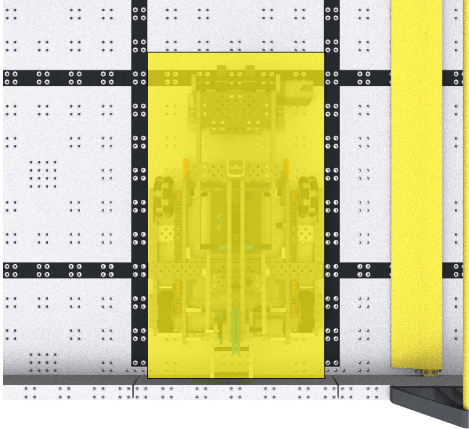
Figure R3-1: The approximate size limit for a Robot at the start of a Match (highlighted in yellow).
<R4> License Plates. Officially registered Team numbers must be legibly displayed on exactly two Robot License Plates that are mounted on opposing sides of the Robot. Teams may use the official VEX IQ Robotics Competition License Plate (VEX Part Number 228-7401) or a plain paper version of matching size (3.5” x 1.5” / 88.9mm x 38.1mm).
- License Plates are considered functional components, and must meet the requirements of all other Robot rules.
- License Plates must be clearly visible at all times. For example, License Plates must not be in a position that would be easily obstructed by a Robot mechanism during standard Match play.
- Additional License Plates cannot be used on the Robot for any purpose.
Violation Notes:
- A Team that circumvents a Robot rule for a competitive advantage should receive an immediate Disqualification for the current Match.
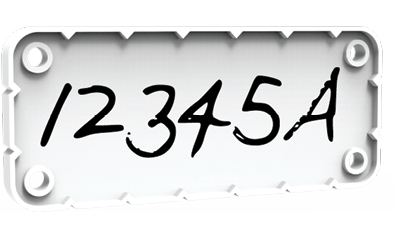
Figure R4-1: A VEX IQ Robotics Competition License Plate with a VEX IQ Robotics Competition Team number written upon it.
<R5> Let it go after the Match is over. Robots must be designed to permit easy removal of Scoring Objects from their Robot without requiring that the Robot have power or remote control after the Match is over.
<R6> Robots have one Brain. Robots are limited to one VEX IQ Robot Brain. Any other microcontrollers or processing devices are not allowed, even as non-functional decorations.
This includes microcontrollers that are part of other VEX product lines, such as VEX Cortex, VEX EXP, VEXpro, VEX CTE, VEX RCR, VEX V5, VEX GO, or VEX Robotics by HEXBUG*. This also includes devices that are unrelated to VEX, such as Raspberry Pi or Arduino devices.
- If using a first generation VEX IQ Brain, Robots must use one VEX IQ 900 MHz radio, VEX IQ 2.4 GHz radio, or VEX IQ Smart Radio in conjunction with their VEX IQ Robot Brain. The VEX IQ Brain and VEX IQ Controller may not be physically connected during a Match, and may only communicate through the radio.
- Additional Robot Brains cannot be used on the Robot (even Robot Brains that are not connected).
<R7> Design for easy troubleshooting. Teams are encouraged to design their Robots such that the Robot Brain’s screen and status light are visible, and that the power button and Robot Battery are accessible, without disassembling any part of the Robot.
Keeping these key components visible and accessible makes it easier to diagnose and troubleshoot issues quickly, minimizing downtime and ensuring a smooth competition experience.
This rule is intentionally a recommendation, not a requirement. There is no inspection criterion or Match penalty associated with this rule.
<R8> Firmware. Teams must use VEXos version 2.2.1 or newer on Gen1 Brains, or VEXos version 1.0.8 or newer on Gen2 Brains. The latest firmware can be found at https://link.vex.com/firmware. Custom firmware modifications are not permitted.
- The minimum version requirement is subject to change over the course of the season.
- When the minimum version is updated, Teams have a two week (14 calendar day) grace period from the time the minimum version is changed to update their firmware to the latest minimum version.
- VEX Robotics reserves the right to deem any firmware update critical, and remove the allowable grace period.
- Additional motors cannot be used on the Robot (even motors that aren’t connected).
<R10> Batteries. The only allowable sources of electrical power for a VEX IQ Robotics Competition Robot are one VEX IQ Robot Battery (first or second generation) or six AA batteries via the Robot AA Battery Holder (228-3493).
- Additional batteries cannot be used on the Robot (even batteries that aren’t connected).
- Teams are permitted to have an external power source (such as a rechargeable battery pack) plugged into their VEX IQ Controller during a Match, provided that this power source is connected safely and does not violate any other rules (such as GG1)
- No physical or electrical modification of the Controller is allowed under any circumstances.
- Attachments which assist the Drivers in holding or manipulating buttons/joysticks on the IQ Controller (including 3D-printed controller attachments) are permitted, provided that they do not involve direct physical or electrical modification of the Controller itself.
- No other methods of controlling the Robot (light, sound, etc.) are permissible.
<R12> Robots are built from the VEX IQ product line. Robots may be built ONLY from official Robot components from the VEX IQ product line, unless otherwise specifically noted within these rules.
- Official VEX IQ products are ONLY available from VEX Robotics. To determine whether or not a product is “official” and legal for competition use, consult the following sources:
- If an inspector or Head Referee questions whether something is an official VEX IQ component, the Team will be required to provide documentation that proves the component’s source. Such documentation may include receipts, part numbers, or other printed documentation.
- Only VEX IQ components specifically designed for use in Robot construction are allowed. Using additional components outside their typical purpose is against the intent of the rule (i.e., please don’t try using VEX IQ apparel, Team or event support materials, packaging, Field Elements, or other non-Robot products on a VEX IQ Robotics Competition Robot).
- Official robotics components from the VEX IQ product line that have been discontinued are still legal for Robot use. However, Teams must be aware of R12B.
- Additional VEX IQ products that are released during the season are legal for use, unless otherwise noted on their product pages.
- VEX IQ Smart Cables may only be used for connecting legal electronic devices to the VEX IQ Robot Brain.
<R13> Prohibited items. The following types of mechanisms and components are NOT allowed:
- Those that could potentially damage Field Elements or Scoring Objects.
- Those that could potentially damage or entangle other Robots.
- Tape and/or any other material that adheres to or changes a legal part, other than for labeling hardware as permitted by R14H or non-functional decorations as permitted by R15.
- Products from the VEX 123, VEX V5, VEX CTE, VEX EXP, Cortex, or VEXpro product lines, unless specifically allowed by a clause of R14.
- Electrical components from the VEX Robotics by HEXBUG* product line.
- Electrical components from the VEX GO product line.
- 3D printed parts for any purpose, including License Plates, License Plate holders, and non-functional decorations.
- Additional illegal parts are listed in the VEX IQ Robotics Competition Legal / Illegal Parts List, at https://link.vex.com/docs/viqrc/illegal-parts. This Appendix is updated as needed, and may not coincide with scheduled Game Manual updates.
<R14> Legal Non-VEX IQ components. Robots are allowed to use the following additional components from sources other than VEX Robotics:
- Rubber bands no larger than 7.5” long and 0.25” wide.
- ⅛” metal shafts from the VEX V5 product line.
- Other products from the VEX V5 product line that are also cross-listed as part of the VEX IQ product line are legal. A “cross-listed” product is one which can be found in both the VEX IQ and VEX V5 sections of the VEX Robotics website.
- Mechanical/structural components from the VEX Robotics by HEXBUG* product line are legal for Robot construction.
- Mechanical/structural components from the VEX GO product line are legal for Robot construction.
- Aerosol-based cooling/freeze spray may be used to assist in cooling motors. Teams using freeze spray or similar products in ways that may reasonably be deemed unsafe could be subject to S1 Violations.
- Cleaners, disinfectants, and/or sanitizers may be used to assist in cleaning Robots, parts, components, etc. VEX Robotics recommends these procedures for cleaning/disinfecting/sanitizing Robot parts.
- A limited amount of tape is allowed for the sole purpose of labeling motors, Robot Brains, and/or controllers.
- Food-safe lubricants (grease, oils, or other lubricants) may be used on Robots, provided they are used in moderation and cannot contaminate the Field, other Robots, Field Elements, and/or Scoring Objects.
<R15> Decorations are allowed. Teams may add non-functional decorations, provided that they do not affect Robot performance in any significant way or affect the outcome of the Match. These decorations must be in the spirit of the competition. Inspectors and Head Referees will have final say in what is considered “non-functional.” Unless otherwise specified below, non-functional decorations are governed by all standard Robot rules.
- Decorations must be in the spirit of an educational competition.
- To be considered “non-functional,” any decorations must be backed by legal materials that provide the same functionality. For example, a giant decal cannot be used to prevent Scoring Objects from falling out of the Robot unless it is backed by VEX IQ material. A simple way to check this is to determine if removing the decoration would impact the performance of the Robot in any way.
- The use of non-toxic paint is considered a legal non-functional decoration. However, any paint used as an adhesive or to impact how tightly parts fit together would be classified as functional. Teams should be mindful of any non-functional decorations which could risk “distracting” an Alliance partner Robot’s Vision Sensor or other sensors.
<R16> Pneumatics. Robots using parts from the VEX IQ Pneumatics Kit (228-8795) must satisfy all of the following criteria:
- No more than two Air Tanks, including any that aren’t connected.
- No more than one Air Pump, including any that aren’t connected.
- No additional parts that are not included in the VEX IQ Pneumatics Kit (e.g., unofficial tubing or fittings).
- Teams may not use other elements for the purposes of storing or generating air pressure, and cannot use Pneumatic Cylinders or additional tubing solely for additional air storage. Robots are limited to the air pressure stored in two Air Tanks, as well as the normal working air pressure contained in any Pneumatic Cylinders and tubing on the Robot.
- Teams can only use Pneumatic Cylinders and/or tubing as part of an actual pneumatic system (e.g., Air Tanks and/or an Air Pump).
There is no limit on the number of Pneumatic Cylinders or Pneumatic Solenoids that may be used, provided that no other rules are violated. There are no restrictions on running the Air Pump prior to (or during) Matches.
<R17> Modifications of parts. Parts may NOT be modified unless specifically listed as an exception in this rule. Examples of illegal modifications include, but are not limited to, bending, cutting, sanding, gluing, taping, and melting. The following exceptions are the only legal modifications of parts:
- Cutting metal VEX IQ or VEX V5 shafts to custom lengths.
- Bending parts which are intended to be flexible, such as string, rubber bands, or thin plastic sheets.
- Cutting VEX IQ pneumatic tubing to custom lengths.
- Tying knots to shorten or connect string or rubber bands.