Added bullet points to T6 allowing 0x2 or 0x3 pins to mark Bean Bag locations, and repairing of damaged Bean Bags and Pyramid Goal plastic sheets as permissible Field modifications
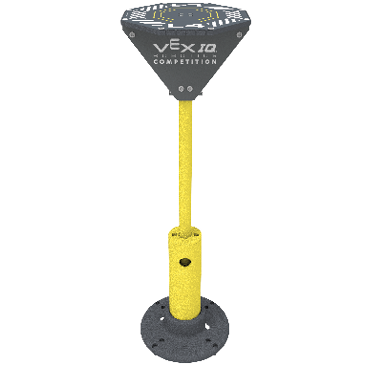
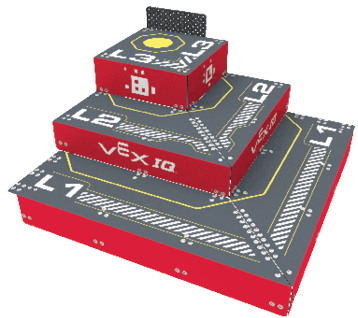
Revised the definitions of Pyramid Goal, and L1, L2, L3 & L4 Goal for clarity
Minor typo / formatting fixes
Version 0.2 - June 4, 2026
Updated Figure SG-1 to correctly show the approximate Robot starting position
Updated SG6 and its blue box to provide clarity regarding Plowing
Updated Figure RSC3-1 to include a Robot in the correct starting position
Updated the Robot Summary in section 4 to provide clarity
The VEX IQ Robotics Competition Game Manual is the most authoritative source of information for the VEX IQ Robotics Competition. Contained within this document are all of the rules, boundaries, constraints, and other relevant information you will need to properly understand and play this year’s game.
This manual is:
A technical reference document for gameplay, Robot construction, and event operation
A binding set of rules for Teams, coaches, referees, Event Partners, and all other volunteers and participants to adhere to
The primary source of truth for all things related to the VEX IQ Robotics Competition
The rules in this game manual are intended to work together to create a system of constraints. These rules are not intended to be understood independently of one another or in isolation from other information contained in this document. Many situations may require Teams, referees, or other volunteers to use logic from multiple places in the manual to properly form an interpretation. It is critical that the entire manual is read and understood, not just parts.
Information in the game manual is presented in the following ways:
Definitions in Appendix C establish the meaning of a term with regards to this document. Sometimes, these definitions may not perfectly match a more commonly accepted dictionary definition. In that case, the VEX definition takes precedence. If there is no VEX definition for a term, it can be reasonably assumed that a dictionary definition can be used.
General Rules establish the baseline rules for competition that Teams must adhere to at all times. These include, but are not limited to, conduct at an event, roster eligibility, competition integrity, and authority and enforcement.
General Game Rules begin to outline the rules that Teams must follow in every VEX game, not just the rules specific to this season’s game. Many of these rules do not change from year to year, and help prevent the game from devolving into immediate chaos.
Scoring Rules define how points are earned and evaluated.
Specific Game Rules describe what Robots and Drive Team Members may and may not do during a Match, specifically for this season’s game. These rules are subject to change from year to year, depending on how the game is designed and meant to be played.
Robot Rules define how Robots may be built and configured.
Tournament Rules describe how competitions are run, and how Teams are ranked at events.
Some rules also reference Violation Notes that are located in Appendix D. These notes provide additional guidance on enforcement, escalation, or special circumstances. If a rule doesn’t include a cross-reference to Violation Notes, standard Violation definitions apply. See Appendix D for information about rule Violations and penalties.
This manual will have a series of “major” and “minor” updates over the course of the season. Each version is official and must be used in official VEX IQ Robotics Competition events until the release of the next version, upon which the previous version becomes void.
Minor typographical errors or formatting issues found in the initial release, with very few rule changes expected
July 2, 2026
July 9, 2026
Version 1.0
May include gameplay or rule changes inspired by input from the official Q&A system and the VEX community
August 6, 2026
August 13, 2026
Version 1.1
Clarification / minor update
September 3, 2026
September 10, 2026
Version 2.0
May include gameplay or rule changes inspired by early-season events
October 8, 2026
October 15, 2026
Version 2.1
Clarification / minor update
December 3, 2026
December 10, 2026
Version 2.2
Clarification / minor update
January 28, 2027
February 4, 2027
Version 3.0
May include gameplay or rule changes inspired by early-season events
March 25, 2027
April 1, 2027
Version 4.0
May include gameplay or rule changes pertaining specifically to the VEX Robotics World Championship
In addition to these known major updates, there may also be unscheduled updates released throughout the season if deemed critical by the Game Design Committee.
Any scheduled or unscheduled updates will always be released on a Thursday, no later than 5:00 PM CST (11:00 PM GMT). These updates will be announced via the VEX Forum, automatically pushed to the VEX IQ Hub app, and shared via VEX Robotics social media & email marketing channels. Once announced, the new version of the Game Manual will be immediately available at the link above.
Generally, Level Up Game Manual updates, scheduled or unscheduled, will include a grace period before the updated rules go into effect for competitions. See the release table above for specific dates. This grace period does not apply to the Version 0.1 Release, which serves as the initial rule set for the season.
Any events that begin before the 7-day grace period has ended must continue using the rules from the previous Game Manual release. This policy ensures fairness and consistency, allowing Teams to adapt their strategies and gameplay accordingly before the changes are enforced in official competitions.
The Game Design Committee reserves the right to enforce critical updates to the Game Manual as effective immediately upon release, if we feel that the changes are critical for competitive integrity, safety, and/or other extenuating circumstances.
Multi-week league events (or similar) that cross over a grace period should use the version of the Game Manual that is in effect at the beginning of each league session. Leagues should update to new versions of the Game Manual between sessions as appropriate.
When first reviewing a new robotics game, it is natural to have questions about situations which may not be immediately clear. Navigating the Game Manual and seeking out answers to these questions is an important part of learning a new game. In many cases, the answer may just be in a different place than you first thought—or, if there is no rule explicitly prohibiting a gameplay strategy, then that usually means it is legal!
However, if a Team is still unable to find an answer to their question after closely reviewing the relevant rules, then every Team has the opportunity to ask for official rules interpretations in the VEX Robotics Question & Answer System. These questions may be posted by an Adult via the events.vex.com account that is associated with that Team.
All responses in this Q&A system should be treated as official rulings from the VEX Robotics Game Design Committee, and they represent the correct and official interpretation of the VEX Robotics Competition Rules. The Q&A system is the only source besides the Game Manual for official rulings and clarifications, and is functionally an extension of the Game Manual. Q&A rulings are effective immediately upon release.
The VEX IQ Robotics Competition Question & Answer System will open on May 14th, 2026. Before posting on the Q&A system, be sure to review the Q&A Usage Guidelines:
If there are any conflicts between the English-language PDF of the Game Manual and other supplemental or translated materials (e.g., referee training materials, the VEX IQ Robotics Competition Hub app, the game reveal video, a trans- lated game manual, etc.), the most current version of the English-language PDF of the Game Manual takes precedence.
Similarly, it can never be assumed that definitions, rules, or other materials from previous seasons apply to the current game. Q&A responses from previous seasons are not considered official rulings for the current game. Any relevant clarifications that are needed should always be re-asked in the current season’s Q&A.
This Game Manual is the authoritative source for all gameplay, Robot, and event rules. For these matters, official information ranks as follows:
The current version of this Game Manual, including all published updates
The official Q&A system
Other VEX Robotics or Global Robotics and Science Foundation supplementary documents and training materials
Q&A answers are official rulings, effective when posted. An answer that conflicts with this Manual takes precedence until a Manual update addresses it. Answers not addressed by an update remain in effect.
The following companion documents are authoritative within their own scopes and take precedence over any summary or restatement of their content in this Manual:
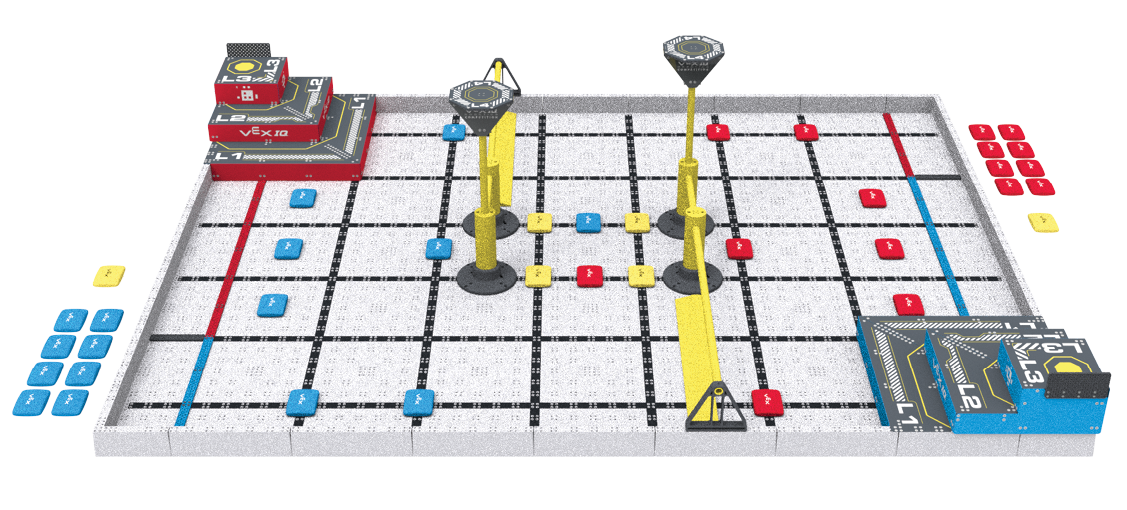
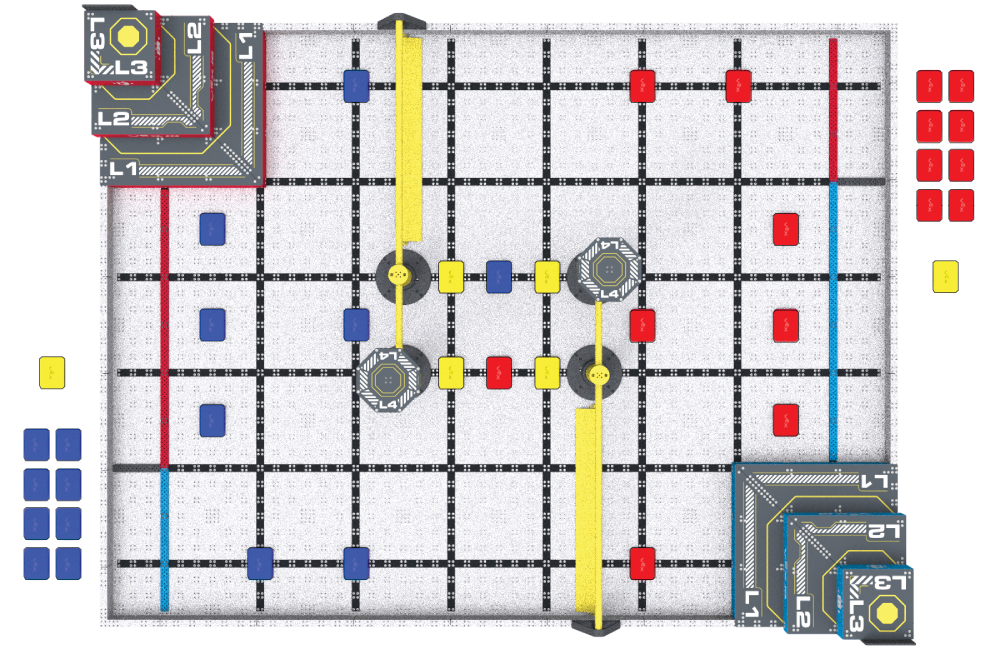
VEX IQ Robotics Competition Level Up is played on a 6’x8’ rectangular Field, set up as illustrated in the figures throughout this game manual.
The primary objective of the game is to score Bean Bags into Goals. Higher Goals earn more points. A Robot can only carry one Bean Bag at a time, and most Bean Bags have to travel across the entire Field to reach their Goals. Teams have to decide whether to drive a long path or design their Robot to fit through the narrow shortcuts on the Field.
Teams may also compete in Robot Skills Matches, where one Robot tries to score as many points as possible with a slightly different set of rules. See Section 3 for more information.
We as the Game Design Committee want to explain how this game was designed and how we expect it to be played. We will also point out parts of the game we will watch during the season in case changes are needed.
This section is not a list of rules. It is here to help you understand what the game is about and what we as designers had in mind.
Level Up is a game where Robots move around the Field again and again to score. You can only move one Bean Bag at a time. Because of this, Teams will need to score often and move quickly. The game rewards Robots that can repeat actions and follow a plan.
Navigation and Route Choice
The Field is designed to give Teams choices about how their Robot moves.
Some paths are longer but more open and easier to use. Other paths are shorter but tighter and harder to move through. Teams will need to decide which path works best for their Robot.
Robot Design Tradeoffs
The way your Robot is built will affect how it moves on the Field.
Smaller Robots may be able to use shortcuts. Larger Robots may be more stable or easier to control. Teams will need to make choices about what is most important for their design.
There is no one “best” design. Different Robots can succeed in different ways.
Scoring Strategy
There are Goals with different heights and point values on the Level Up Field. This gives Teams choices about how they want to work with their partner and score.
Some Teams may try to score higher points each time. Others may focus on scoring faster. The best strategies will balance how many points you score, how quickly you score, and how often your Robot can repeat the action.
Commitment to Teams
The Game Design Committee will watch how Matches are played during the season. We want to make sure the game stays fun, fair, and interesting!
If needed, we may make updates to keep the focus on movement, scoring, and teamwork.
Referees should avoid contacting or moving Robots and/or Scoring Objects as much as possible while evaluating scoring statuses. If an object must be moved to evaluate the status of another object, its status must be agreed upon by all Teams and the Head Referee, and noted or recorded, before it is moved.
<SC2>All scoring statuses are evaluated visually by a Head Referee, to the best of their ability within the context of a given Match/event.
Referees and other event staff are not allowed to review any videos or pictures from the Match. See T3.
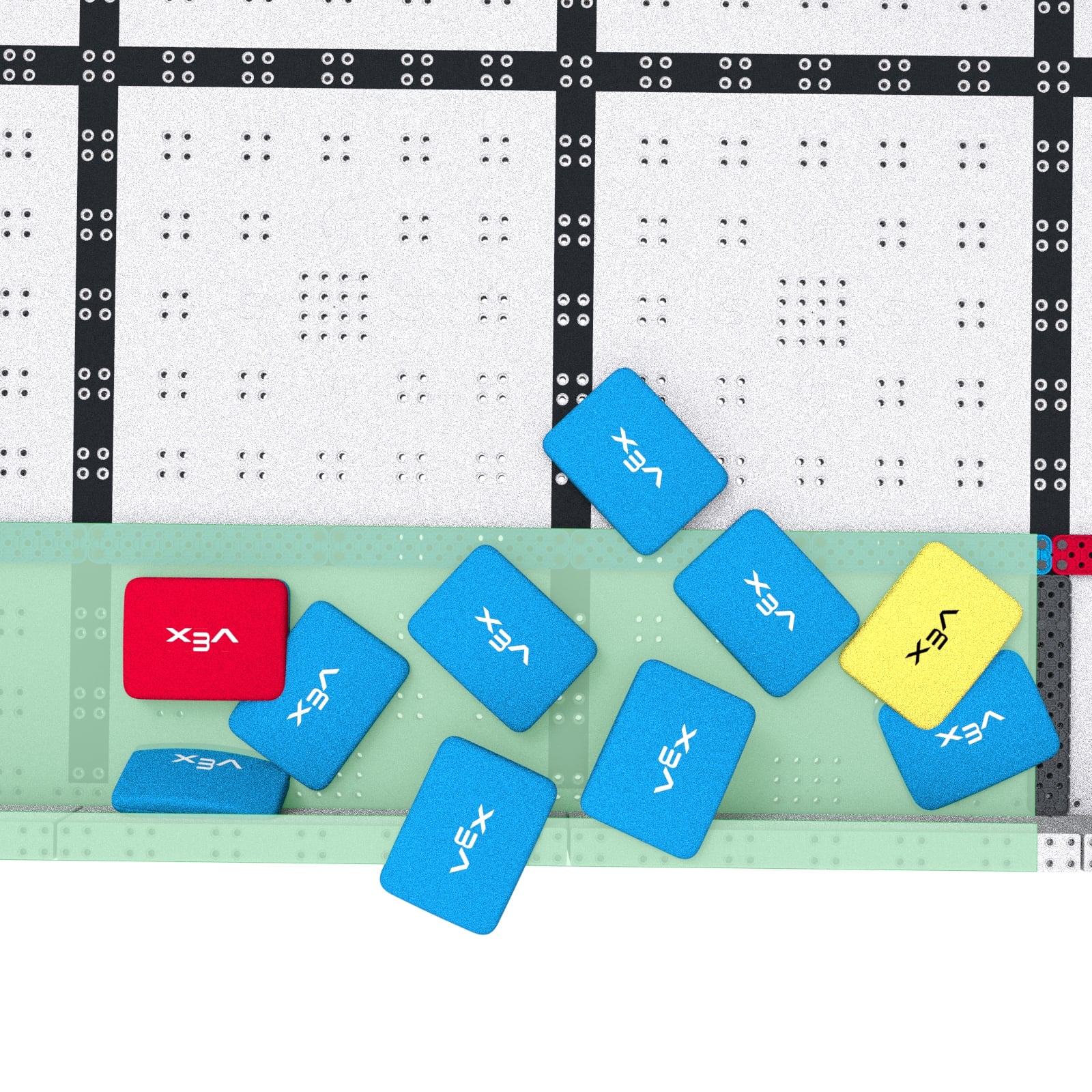
Figure SC3-1:Bean Bags in the blue Floor Goal.
The red Bean Bag would not be considered scored since it does not match the color of the Floor Goal. The yellow Bean Bag would be considered scored since it can be scored in either color Floor Goal and is entirely within the Floor Goal. The blue Bean Bags with check marks would be considered scored since they match the color of the Floor Goal and are entirely within the Floor Goal. The blue Bean Bags with X’s would not be considered scored since parts of those Bean Bags extend beyond the boundaries of the Floor Goal (i.e., they are not entirely within the Floor Goal).
<SC4> A Bean Bag is scored on an L1, L2, or L3 Goal if it meets all of the following criteria:
The Bean Bag is in contact with the horizontal surface that defines the L1, L2, or L3 Goal, or is directly or indirectly supported by another Bean Bag that is in contact with that horizontal surface.
The Bean Bag is not in contact with anything outside the Field.
If a Bean Bag counts as scored on multiple levels (e.g., in contact with L3 while also supported by a stack of Bean Bags in L2), it should only receive points for the higher level.
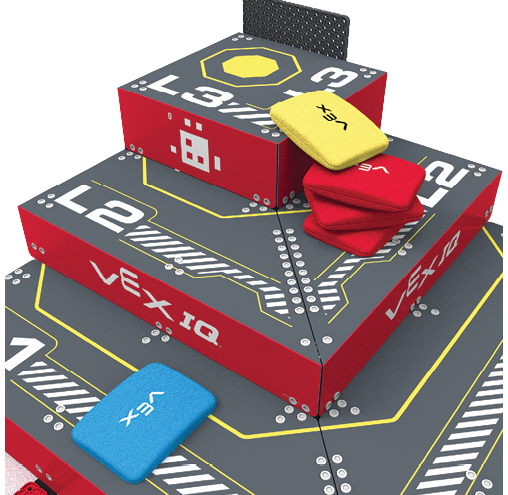
The blue Bean Bag would not be considered scored, as it does not match the color of the L1 Goal it is resting on.
The three (3) red Bean Bags would all be considered as scored on the L2 Goal, as they match the color of the Goal, and are all either in contact with the L2 Goal or supported by another Bean Bag in contact with the L2 Goal.
The yellow Bean Bag is contacting the L3 Goal and is also supported by a stack of Bean Bags on the L2 Goal. This means the yellow Bean Bag is considered scored on multiple levels (L2 and L3), in which case it should only receive points for the higher level (L3).
<SC5> A Bean Bag is scored on a L4 Goal if it meets all of the following criteria:
The Bean Bag is in contact with the horizontal surface that defines the L4 Goal, or is directly or indirectly supported by another Bean Bag that is in contact with that horizontal surface.
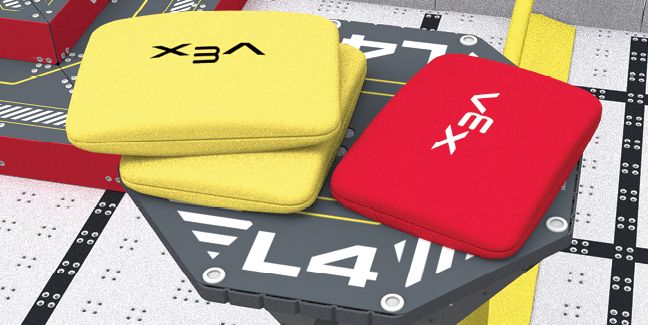
Both yellow Bean Bags would be considered as scored on the L4 Goal, as both are either in contact with the L4 Goal or supported by another Bean Bag in contact with the L4 Goal.
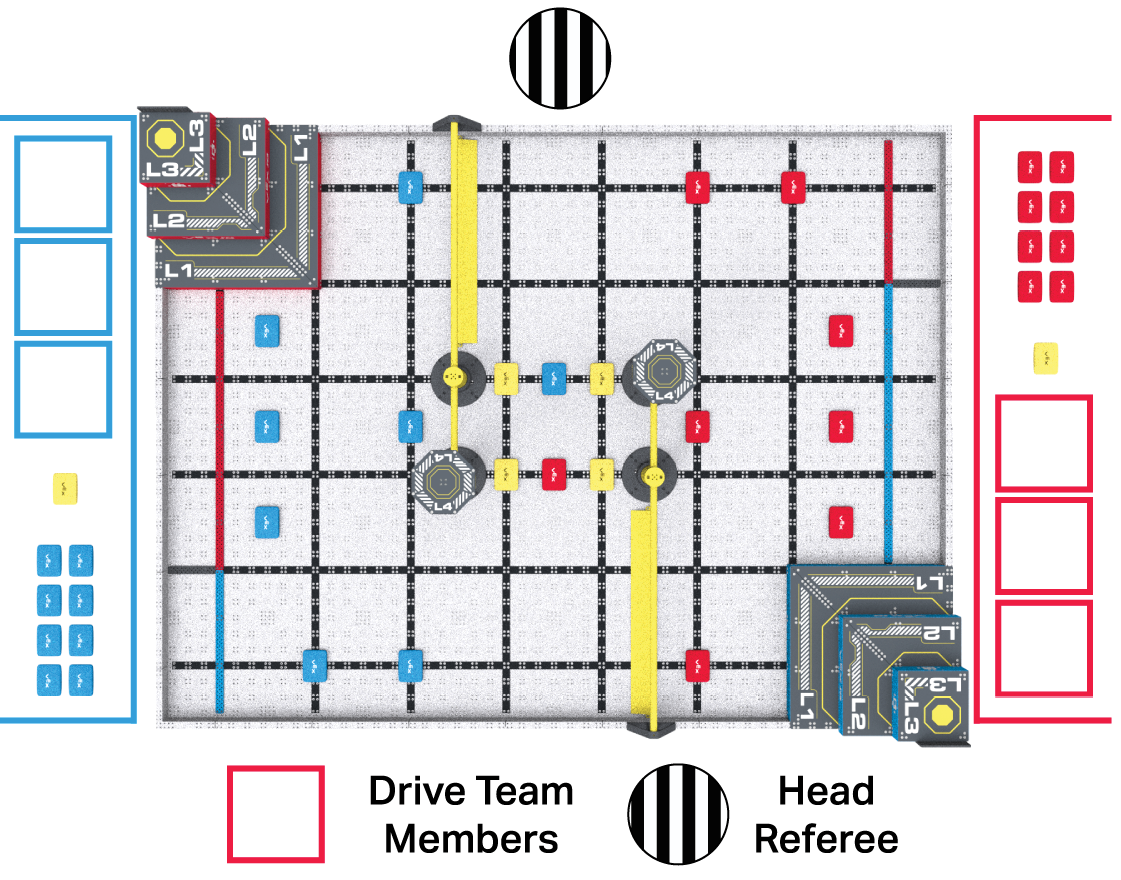
For Teamwork Challenge Matches, the Team listed as Team 1 (printed Match list), listed as red Team (events.vex.com), or listed first (VEXvia) must place their Robot in the starting position that shares a wall with the blue Pyramid Goal.
For Teamwork Challenge Matches, the Team listed as Team 2 (printed Match list), listed as blue Team (events.vex.com), or listed second (VEXvia) must place their Robot in the starting position that shares a wall with the red Pyramid Goal.
Completely stationary (i.e., no motors or other mechanisms in motion) until the Match timer starts. Pre-charging a pneumatic system (e.g., having the Pneumatic Pump running prior to the Match) is the only permitted exception to this rule.
The starting configuration of the Robot at the beginning of a Match must be the same as a Robot configuration that was checked during Robot inspection.
Violation Notes:
The Match will not begin with any conditions in this rule unmet. If a Robot cannot meet these conditions in a timely manner, the Robot will be removed from the Field and rules R2D and GG3 will apply until the situation is corrected. In most cases, they will not receive a Disqualification, but should receive a Minor Violation and will not be permitted to play in the Match.
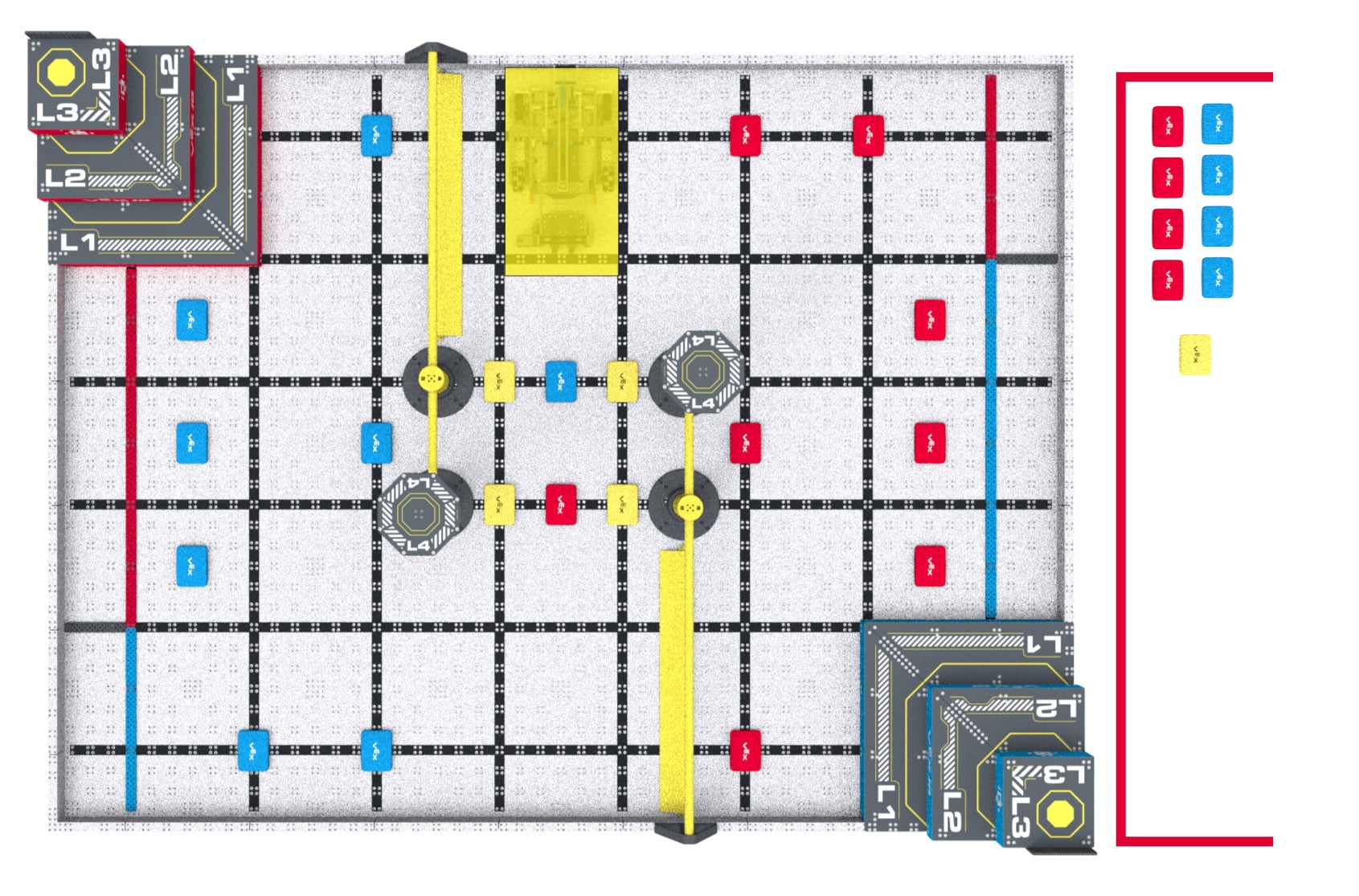
Figure SG-1:Robots in legal pre-Match starting positions (highlighted in red / blue).
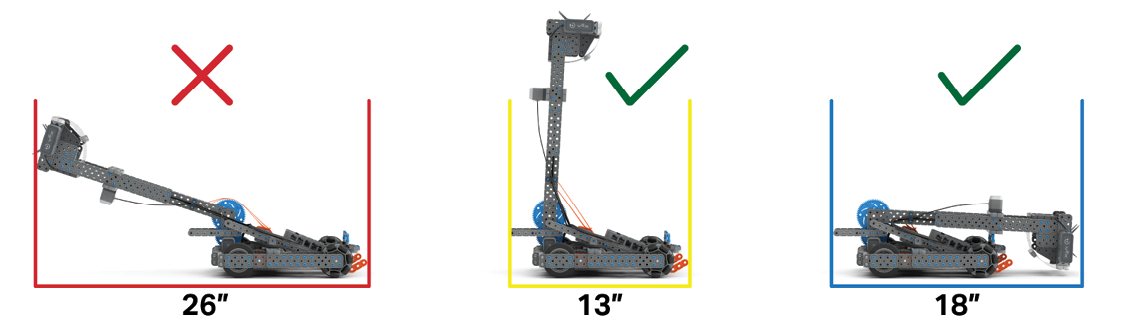
<SG2>Horizontal expansion is limited. Once the Match begins, Robots may expand horizontally up to a length of 24”. The Robot can never be larger than 11”x24” at any point during the Match (must fit within an 11”x24” rectangular horizontal footprint).”
Figure SG2-1: A demonstration of how the size of the Robot may change horizontally through the course of a vertical expansion. The Robot on the far left is extended beyond 24”, and would be in Violation of SG2.
<SG3>Vertical expansion is unlimited. Once the Match begins, Robots may expand vertically beyond the 15” starting size limit with no limits.
<SG4>Keep Scoring Objects in the Field.Scoring Objects that leave the Field during a Match will not be returned to the Field, and cannot be reintroduced by the Loaders.
If a Scoring Object is removed from a Robot during a GG10 interaction, it is considered “out of the Field” as soon as it is no longer in contact with any Robots.
<SG5>Each Robot gets one yellow Bean Bag as a Preload. Prior to the start of each Match, each Preload must be placed such that it meets all of the following criteria:
<SG6>A Robot may Possess or Plow a maximum of one (1) Bean Bag at a time.Robots in Violation of this rule must immediately stop all Robot actions except for attempting to remove the excess Bean Bag(s).
<SG7>Using the Load Zone.Bean Bags may be Loaded one at a time through the Load Zone during the Match, and must meet all of the following criteria.
The Bean Bag must be placed in contact with the Floor and entirely within the Load Zone (i.e., no part of the Bean Bag extends beyond the defined boundaries of the Load Zone).
Once a Bean Bag is placed into a Load Zone and released, it may no longer be contacted by a Loader unless the Head Referee determines it was misloaded and must be retrieved as described in clause F.
If a Bean Bag is Loaded improperly (e.g., while another Bean Bag is in contact with the Load Zone), it must be retrieved by the Loader and reintroduced if the Head Referee instructs the Loader to do so.
A LoadedBean Bag must be placed in a stationary position, and must remain in contact with the Floor after it is released by the Loader until it is contacted by a Robot.
<S2>Students must be accompanied by an Adult. Every Student at a VEX IQ Robotics Competition event must be supervised by a responsible Adult. The Adult must obey all rules and be careful to not violate Student-centered policies, but must be present for the full duration of the event in the case of an emergency. Violations of this rule may result in removal from the event and additional penalties.
<S3>Each Student Team member must have a completed participant release form on file for the event and season. A StudentTeam member cannot participate in an event without a completed release form on file.
<G1>Participants must follow the Code of Conduct. All event attendees must abide by the guidelines set forth in the Code of Conduct.
Violation Notes:
Any Violation of G1 may be considered a Major Violation and should be addressed on a case-by-case basis. Teams at risk of a G1Major Violation due to multiple disrespectful or uncivil behaviors will usually receive a “final warning”, although the Head Referee is not required to provide one).
<G2>Participants must follow the Student Centered Policy. All event attendees must abide by the guidelines set forth in the Student Centered Policy.
Violation Notes:
Potential Violations of this rule will be reviewed on a case-by-case basis. By definition, all Violations of this rule become Score Affecting as soon as a Robot which was built or programmed by an Adult scores points in a Match.
<G3>Use common sense. When reading and applying the various rules in this document, please remember that common sense always applies in the VEX IQ Robotics Competition.
<G4>Students must meet the Student Eligibility Policy requirements. All Student participants must fall within the eligibility requirements set forth in the Student Eligibility Policy for their respective program
Violation Notes:
Teams believed to be in Violation of this rule should be reported to the Judge Advisor, Head Referee, or Event Partner for further investigation in coordination with VEX Robotics. Based on the investigation the Team may be removed from further Matches, have their Robot Skills Match scores removed, and/or be removed from consideration from judged awards.
Violations of this rule will be evaluated on a case-by-case basis, as noted in G1 and G2.
<G5>There is a difference between accidentally and willfully violating a Robot rule. Any Violation of Robot rules, accidental or intentional, will result in a Team being unable to play until they pass inspection (per R2D).
However, Teams who intentionally and/or knowingly circumvent or violate rules to gain an advantage over their fellow competitors are in Violation of the spirit and ethos of the competition.
Using any sort of communication device in the Driver Station. Non-headphone devices with communication features turned off (e.g., a phone in airplane mode, a walkie talkie turned off, smart glasses with communication features disabled) are allowed. Communication features can be enabled for translation apps during post-Match discussions.
Standing or sitting on any sort of object during a Match, regardless of whether the Field is on the Floor or elevated, except as required by an officially approved accommodation request.
Bringing/using additional materials to simplify the game challenge during a Match (e.g., device to align or add Scoring Objects to the Loader).
To ensure that Drive Team Members are aware of verbal calls during a Match (as an application of rules T1, G1, S1, and G3), powered headphones, earbuds, passive earpieces connected to electronic devices, or other personal accessories/devices that transmit audio cannot be worn/used in the Driver Station except as required by an officially approved accommodation request.
The Team listed as Team 1 on a printed Match list, listed as red Team on events.vex.com, or listed first in VEXvia will use the red Driver Station and participate as the red Team in that Match.
The Team listed as Team 2 on a printed Match list, listed as blue Team on events.vex.com, or listed second in VEXvia will use the blue Driver Station and participate as the blue Team in that Match.
Individuals who are not Drive Team Members for a Match cannot provide directions, commands, or advice to the Drive Team Members during that Match. They’re welcome to provide cheerful, positive encouragement, but should not affect Match play or strategy.
<GG2>A Team’s Robot should attend every Match. The Team’sRobot must be in the Driver Station or on the Field for the Team’s assigned Match, even if the Robot is not functional. If the Robot is not at the Field for the entire duration of the Match, that Team will be considered a “no show” and will receive zero (0) points. The other Team in the Alliance will still play and receive points for the Match.
<GG3>Robots on the field must be ready to play. When a Team puts their Robot on the Field, it must be prepared to play (i.e., battery charged, sized within the starting size constraint, etc.).
Robots must be placed on the Field promptly. Repeated failure to do so could result in a Violation of G1 and/or removal of the Robot from the current Match at the Head Referee’s discretion.
If a Robot is delaying the scheduled start of a Match, it may be removed from the Field at the discretion of the Head Referee and Event Partner. The Robot may remain at the Field so that the Team does not get assessed a “no-show” (per GG2).
If a Robot is not placed on the Field prior to the start of a Match, it cannot be placed on the Field during that Match.
Drive Team Members are not permitted to reach into the 3-dimensional volume of the Field Perimeter at any time during the Match, apart from the actions described above. Rule S1 applies.
<GG5>Match Replays are allowed, but rare.Match replays (i.e., playing a Match over again from its start) must be agreed upon by both the Event Partner and Head Referee, and will only be issued in the most extreme circumstances. Some examples that may warrant a Match replay are as follows (note that this is not an exhaustive list):
<GG7>Time-outs. There are no time-outs in
VEX IQ Robotics Competition Tournaments.
<GG8>Keep your Robot together.Robots may not intentionally detach parts or leave mechanisms on the Field during any Match.
Parts that become unintentionally detached from the Robot are no longer considered to be part of the Robot and can be either left on the Field or collected by a Drive Team Member during a Robot reset using GG10.
<GG9>Don’t damage the Field.Robot interactions which damage the Field or any Field Elements are prohibited. For the purpose of this rule, “damage” is defined as anything which requires repair in order to begin the next Match, such as causing part of a Goal to detach from the Field.
Violation Notes:
In most cases, accidental Field damage should only be considered a Minor Violation.
<GG10>Handling the Robot mid-Match is allowed under certain circumstances. If a Robot goes completely outside the playing Field, gets stuck, tips over, or otherwise requires assistance, the Drive Team Members may retrieve & reset their Robot with the Head Referee’s permission. To do so, the Team must do the following:
Signal the Referee by placing their VEX IQ Controller on the ground. The Head Referee may ask the Driver to demonstrate the problem using the Robot controller before approving the Robot reset (e.g., confirming that the Robot is broken, undriveable, or stuck on an obstacle) if the issue with the Robot isn’t obvious.
Any Scoring Objects being controlled by the Robot while being handled must be removed from the Field, will not be returned to the Field, and cannot be reintroduced by the Loaders. No other Scoring Objects should be adjusted.
In the context of this rule, “controlled” implies that the Robot was manipulating the Scoring Object, and not simply touching it. For example, if the Scoring Object would move with the Robot either vertically or while turning, then the Robot is “controlling” that Scoring Object.
The Robot must be placed back into a legal position that meets the criteria listed in clauses a,b, c, & d of SG1. If any Scoring Objects are preventing the Robot from being legally placed, they should be removed from the Field, will not be returned to the Field, and cannot be reintroduced by the Loaders. The Robot does not get a new Preload during this reset.
Swapping one set of parts for another, or adding new pieces to a Robot mid-Match during a GG10 or RSC5 interaction is considered a Violation of the intent and spirit of this rule. Repairing a Robot, or reattaching parts of the Robot that unintentionally break off during a Match, is allowed.
<GG11>A Team’s two Drivers switch Controllers midway through the Match. In a given Match, up to two (2) Drivers may be in the Driver Station per Team. The two Drivers must switch their controller between thirty-five seconds (0:35 on the Match timer) and twenty-five seconds (0:25 on the Match timer) remaining in the Match.
No Driver shall operate a Robot for more than thirty-five (35) seconds.
The second Driver may not touch their Team’s controls until the controller is passed to them.
Once the controller is passed, the first Driver may no longer touch their Team’s controls.
For drive teams consisting of two or three members, any Drive Team Member who is not actively operating the Robot may serve as a Loader.
For drive teams consisting of only one member, the Driver may simultaneously operate the Robot and serve as the Loader for the first thirty-five (35) seconds of the Match, at which point the Robot’s operation (even prewritten commands) must cease for the remainder of the Match.
<GG12>Don’t start before the timer, and stop moving at the end of the Match.Driver inputs and Robot may not begin before the Match timer starts, and must cease at the end of the Match, when the timer reaches 0:00.
Any scoring that takes place after a Match due to Robots continuing to move will not count toward the score.
A pre-programmed routine which causes Robot motion to start before the Match or continue after the end of the Match would violate this rule.
<GG13>Ending a Match early. If an Alliance wants to end a Qualification Match or a Finals Match early, both Teams must signal the referee by ceasing all Robot motion and placing their controllers on the ground. The referee will then signal to the Teams that the Match is over and will begin to tally the score. If the Match is a tiebreaker Finals Match for first place, then the Match Stop Time will also be recorded (see T14B).
<GG14>Drive Team Members are permitted to appeal the Head Referee’s ruling immediately after a Match. If Drive Team Members wish to dispute a score or ruling, they must stay in the Driver Station until the Head Referee talks with them. The Head Referee may then choose to meet with the Drive Team Members at another location and/or at a later time so that the Head Referee has time to reference materials or resources to help with the decision. Once the Head Referee announces that their decision has been made final, the issue is over and no more appeals may be made (see rule T1); failure to accept this final decision may be considered a G1Violation.
Referees are not permitted to review any photo or video Match recordings when determining a score or ruling. Some events may also prohibit Drive Team Members from reviewing photo or video Match recordings while in the Driver Station; this should be announced to all Teams before Matches start.
Communication and conflict resolution skills are an important life skill for Students to practice and learn. In VEX IQ Robotics Competitions, we expect Students to practice proper conflict resolution using the proper chain of command. Violations of this rule may be considered a Violation of G1.
<RSC1>Standard rules apply in most cases. All rules from previous sections apply to the Robot Skills Matches, unless otherwise specified in this section.
Violations of <GG>, <SG>, and <RSC> rules that occur during a Robot Skills Match should only affect the outcome of that Match and should not be considered when determining whether a Violation has been repeated during the event.
<RSC2>Scoring Robot Skills Matches. For each Robot Skills Match, Teams are awarded a score based on the standard scoring rules.
<RSC3>Robot and Field setup for Robot Skills Matches. The Robot and Field are set up the same as for Teamwork Matches, with the following modifications:
The Robot must be placed in the starting position that shares a wall with the red Pyramid Goal at the beginning of the Match and after the Robot is reset under rule GG10 or RSC5.
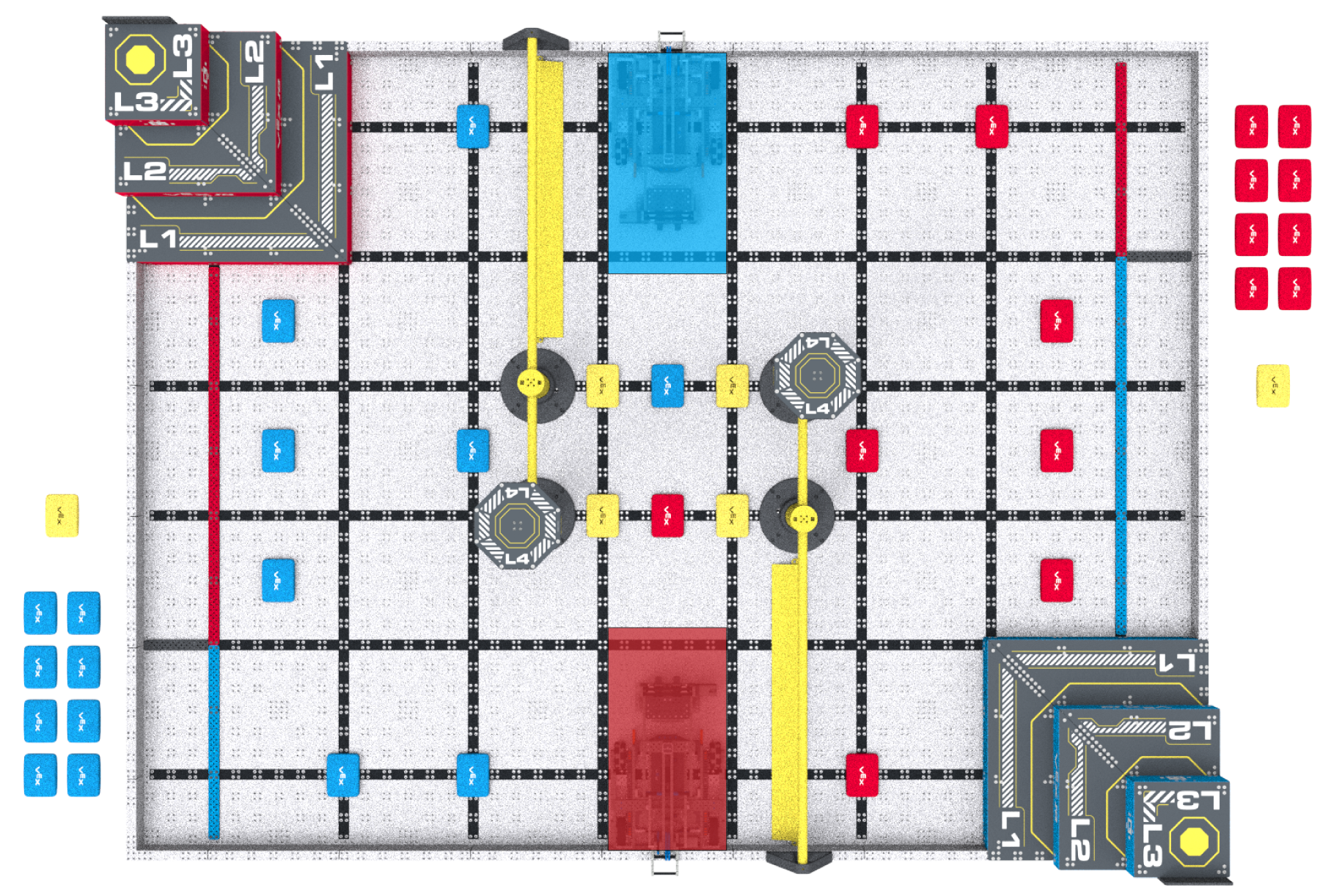
Figure RSC3-1: The field layout for a VEX IQ Robotics Competition Level Up Robot Skills Match.
<RSC4>Loader and Driver differences. All criteria listed in SG7 apply as written (e.g., a Loader cannot put a Scoring Object into a Load Zone if there’s already a Scoring Object there). Loading is modified as follows:
Upon handling the Robot, it must be immediately brought back to a legal starting position. The Robot does not get a new PreloadScoring Object during this reset.
Drive Team Members may reset or adjust the Robot as desired from this position, including pressing buttons on the Robot brain or activating sensors.
Any Scoring Objects that are Possessed by the Robot while being handled must be removed from the Field, will not be returned to the Field, and cannot be reintroduced by the Loaders. No other Scoring Objects should be moved or adjusted.
Pre-Match sensor calibration is considered part of the standard pre-Match setup time (i.e., the time when the Team would typically be turning on the Robot, moving any mechanisms to their desired legal start position, etc.).
Pressing a button on the VEX IQ Controller to begin the routine is not permitted. To avoid any confusion, Teams are advised not to bring controllers to Autonomous Coding Skills Matches.
<RSC7>Autonomous means “no humans.” During an Autonomous Coding Skills Match, Drive Team Members are not permitted to activate any controls on their VEX IQ Controller, and cannot manually trigger sensors (including the Vision Sensor) in any way, even without touching them.
The agreed-upon signal to stop the Match must be both verbal and visual, such as Drivers crossing their arms in an “X” while saying “Stop!” or placing their VEX IQ Controller on the ground while saying “Done!”
It is recommended that the Driver provides the Scorekeeper Referee with a verbal notice that the Team is approaching their intended Skills Stop Time, such as counting out “3-2-1-stop.”
The moment when the Match ends early is defined as the moment when the Robot and Scoring Objects have come to a rest and the Driver provides the agreed upon visual and audio signal to the Scorekeeper Referee.
If a Tournament Manager display is being used for field timing, then the Skills Stop Time is the time shown on the display when the Match is ended early (i.e., in 1-second increments).
If a manual timer is being used that counts down to 0 with greater accuracy than 1-second increments, then the time shown on the timer should be rounded up to the nearest second. For example, if the Robot is Disabled and the timer shows 25.2 seconds, then the Skills Stop Time should be recorded as 26.
Every Robot must pass a full inspection before being cleared to participate in the VEX IQ Robotics Competition. This inspection ensures that all Robot rules and regulations are met. Initial inspections will typically take place during Team check-in / practice time. Every Team should use the rules below as a guide to pre-inspect their Robot and ensure that it meets all requirements.
Most of these rules are “hard limits,” such as the maximum number of motors permitted. However, some are “at inspector discretion,” such as determining a mechanism’s potential safety risk. At many events, the lead inspector and the Head Referee are the same person; if they are not, then the volunteer inspector should work with the Head Referee to make any judgment calls. The Head Referee has final authority regarding all Robot rules, since it is ultimately their decision whether a Robot takes the Field for a Match after inspection has concluded (per R2D and R2E).
Comprehensive lists of legal and illegal VEX IQ Robotics Competition parts can be found in the VEX IQ Robotics Competition Legal Parts and VEX IQ Robotics Competition Illegal Parts Lists. These documents are updated as needed if/when new VEX IQ parts are released, and may not coincide with scheduled Game Manual updates.
<R1>One Robot per Team. Each Team can only bring one Robot to a given event. Though it is expected that Teams will make changes to their Robots at the event, a Team is limited to only one Robot, and a given Robot may only be used by one Team. The VEX IQ system is intended to be a mobile robotics design platform. As such, a VEX IQ Robotics Competition Robot, for the purposes of the VEX IQ Robotics Competition, has the following subsystems:
Subsystem 1: Mobile robotic base including wheels, tracks, or any other mechanism that allows the Robot to navigate the majority of the flat playing Field surface. For a stationary Robot, the robotic base without wheels would be considered Subsystem 1.
Subsystem 2: Power and control system that includes a VEX IQ legal battery, a VEX IQ control system, and associated Smart Motors for the mobile robotic base. Also includes the VEX IQ pneumatic air pump and solenoids if used on the Robot.
Subsystem 3: Additional mechanisms (and associated Smart Motors) that allow manipulation of Scoring Objects or navigation/manipulation of Field Elements.
Given the above definitions, a minimum Robot for use in any VEX IQ Robotics Competition event (including Robot Skills Matches) must consist of subsystems 1 and 2 above. Thus, if you swap out an entire subsystem 1 or 2, you have now created a second Robot and are no longer legal.
Teams may not compete with one Robot while a second is being modified or assembled at a competition.
Teams may not have an assembled second Robot on hand at a competition that is used to repair or swap parts with the first Robot.
Multiple Teams may not use the same Robot. Once a Robot has competed under a given Team number at an event, it is “their” Robot; no other Teams may EVER compete with it.
<R2>Robots must pass inspection. The Team’sRobot must pass inspection before being allowed to participate in any Matches. Noncompliance with any Robot design or construction rule will result in removal from Matches or Disqualification of the Robot at an event until the Robot is brought back into compliance, as described in the following subclauses.
Significant changes to a Robot, such as a partial or full swap of Subsystem 3, must be re-inspected before the Robot may compete again.
All possible functional Robot configurations must be inspected before being used in competition. This especially pertains to modular or swappable mechanisms (per R1) and Match starting configurations/sizes (per R3).
If a Robot is determined to not be legal before a Match begins and cannot be brought into compliance before the scheduled Match start time, the Robot will be removed from the Field. The Robot may remain at the Field so that the Team does not get assessed a “no-show” (per GG2).
Robots which have not passed inspection (i.e., that are in Violation of one or more Robot rules) will not be permitted to play in any Matches until they have done so. GG2 will apply to any Matches that occur until the Robot has passed inspection.
If a Robot has passed inspection, but is later found to be in Violation of a Robot rule during or immediately following a Match, then they will be Disqualified from that Match and R2D/GG3 will apply until the Violation is remedied and the Team is re-inspected. This is the only Match that will be affected; any prior Matches that have already been completed will not be revisited. R2D will apply until the Violation is remedied and the Team is re-inspected.
All Robot Rules are to be enforced at the discretion of the Head Referee within a given event. Robot legality at one event does not automatically imply legality at future events. Robots which rely on “edge-case” interpretations of subjective rules, such as whether a decoration is “non-functional” or not, should expect additional scrutiny during inspection.
Event staff and volunteers are allowed to contact and/or photograph Robots during inspection and/or at other times as needed.
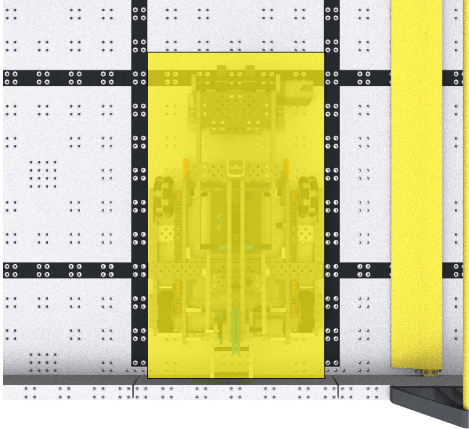
<R3>Robots must fit within an 11” x 20” x 15” (279.4mm x 508mm x 381.0mm) volume during inspection and at the start of each Match.
Teams using more than one possible Robot configuration must tell the inspector(s) and have the Robot inspected in all configurations. Rule R2C will apply if a Robot is placed in an uninspected configuration (i.e., will not be permitted to play until re-inspected, but will not be considered a “no-show”).
A Team may NOT have its Robot inspected in one configuration and then place it in an uninspected configuration at the start of a Match.
Figure R3-1: The approximate size limit for a Robot at the start of a Match (highlighted in yellow).
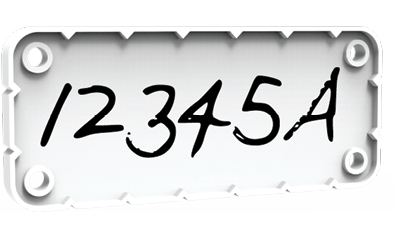
<R4>License Plates. Officially registered Team numbers must be legibly displayed on exactly two RobotLicense Plates that are mounted on opposing sides of the Robot. Teams may use the official VEX IQ Robotics Competition License Plate (VEX Part Number 228-7401) or a plain paper version of matching size (3.5” x 1.5” / 88.9mm x 38.1mm).
License Plates are considered functional components, and must meet the requirements of all other Robot rules.
License Plates must be clearly visible at all times. For example, License Plates must not be in a position that would be easily obstructed by a Robot mechanism during standard Match play.
A Team that circumvents a Robot rule for a competitive advantage should receive an immediate Disqualification for the current Match.
Figure R4-1: A VEX IQ Robotics Competition License Plate with a VEX IQ Robotics Competition Team number written upon it.
<R5>Let it go after the Match is over.Robots must be designed to permit easy removal of Scoring Objects from their Robot without requiring that the Robot have power or remote control after the Match is over.
<R6>Robots have one Brain.Robots are limited to one VEX IQ Robot Brain. Any other microcontrollers or processing devices are not allowed, even as non-functional decorations.
This includes microcontrollers that are part of other VEX product lines, such as VEX Cortex, VEX EXP, VEXpro, VEX CTE, VEX RCR, VEX V5, VEX GO, or VEX Robotics by HEXBUG*. This also includes devices that are unrelated to VEX, such as Raspberry Pi or Arduino devices.
If using a first generation VEX IQ Brain, Robots must use one VEX IQ 900 MHz radio, VEX IQ 2.4 GHz radio, or VEX IQ Smart Radio in conjunction with their VEX IQ Robot Brain. The VEX IQ Brain and VEX IQ Controller may not be physically connected during a Match, and may only communicate through the radio.
Additional Robot Brains cannot be used on the Robot (even Robot Brains that are not connected).
<R7>Design for easy troubleshooting.Teams are encouraged to design their Robots such that the Robot Brain’s screen and status light are visible, and that the power button and Robot Battery are accessible, without disassembling any part of the Robot.
Keeping these key components visible and accessible makes it easier to diagnose and troubleshoot issues quickly, minimizing downtime and ensuring a smooth competition experience.
This rule is intentionally a recommendation, not a requirement. There is no inspection criterion or Match penalty associated with this rule.
<R8>Firmware.Teams must use VEXos version 2.2.1 or newer on Gen1 Brains, or VEXos version 1.0.8 or newer on Gen2 Brains. The latest firmware can be found at https://link.vex.com/firmware. Custom firmware modifications are not permitted.
The minimum version requirement is subject to change over the course of the season.
When the minimum version is updated, Teams have a two week (14 calendar day) grace period from the time the minimum version is changed to update their firmware to the latest minimum version.
VEX Robotics reserves the right to deem any firmware update critical, and remove the allowable grace period.
<R9>Motors.Robots may use up to six VEX IQ Smart Motors.
Additional motors cannot be used on the Robot (even motors that aren’t connected).
<R10>Batteries. The only allowable sources of electrical power for a VEX IQ Robotics Competition Robot are one VEX IQ Robot Battery (first or second generation) or six AA batteries via the Robot AA Battery Holder (228-3493).
Additional batteries cannot be used on the Robot (even batteries that aren’t connected).
Teams are permitted to have an external power source (such as a rechargeable battery pack) plugged into their VEX IQ Controller during a Match, provided that this power source is connected safely and does not violate any other rules (such as GG1)
<R11>One Controller per Robot. No more than one VEX IQ Controller may control a single Robot.
No physical or electrical modification of the Controller is allowed under any circumstances.
Attachments which assist the Drivers in holding or manipulating buttons/joysticks on the IQ Controller (including 3D-printed controller attachments) are permitted, provided that they do not involve direct physical or electrical modification of the Controller itself.
No other methods of controlling the Robot (light, sound, etc.) are permissible.
Using sensor feedback to augment Driver control (such as motor encoders or the Vision Sensor) is permitted.
<R12>Robots are built from the VEX IQ product line.Robots may be built ONLY from official Robot components from the VEX IQ product line, unless otherwise specifically noted within these rules.
Official VEX IQ products are ONLY available from VEX Robotics. To determine whether or not a product is “official” and legal for competition use, consult the following sources:
If an inspector or Head Referee questions whether something is an official VEX IQ component, the Team will be required to provide documentation that proves the component’s source. Such documentation may include receipts, part numbers, or other printed documentation.
Only VEX IQ components specifically designed for use in Robot construction are allowed. Using additional components outside their typical purpose is against the intent of the rule (i.e., please don’t try using VEX IQ apparel, Team or event support materials, packaging, Field Elements, or other non-Robot products on a VEX IQ Robotics Competition Robot).
Official robotics components from the VEX IQ product line that have been discontinued are still legal for Robot use. However, Teams must be aware of R12B.
Additional VEX IQ products that are released during the season are legal for use, unless otherwise noted on their product pages.
VEX IQ Smart Cables may only be used for connecting legal electronic devices to the VEX IQ Robot Brain.
<R13>Prohibited items. The following types of mechanisms and components are NOT allowed:
Those that could potentially damage or entangle other Robots.
Tape and/or any other material that adheres to or changes a legal part, other than for labeling hardware as permitted by R14H or non-functional decorations as permitted by R15.
Products from the VEX 123, VEX V5, VEX CTE, VEX EXP, Cortex, or VEXpro product lines, unless specifically allowed by a clause of R14.
Electrical components from the VEX Robotics by HEXBUG* product line.
Electrical components from the VEX GO product line.
3D printed parts for any purpose, including License Plates, License Plate holders, and non-functional decorations.
Additional illegal parts are listed in the VEX IQ Robotics Competition Legal / Illegal Parts List, at https://link.vex.com/docs/viqrc/illegal-parts. This Appendix is updated as needed, and may not coincide with scheduled Game Manual updates.
<R14>Legal Non-VEX IQ components.Robots are allowed to use the following additional components from sources other than VEX Robotics:
Rubber bands no larger than 7.5” long and 0.25” wide.
⅛” metal shafts from the VEX V5 product line.
Other products from the VEX V5 product line that are also cross-listed as part of the VEX IQ product line are legal. A “cross-listed” product is one which can be found in both the VEX IQ and VEX V5 sections of the VEX Robotics website.
Mechanical/structural components from the VEX Robotics by HEXBUG* product line are legal for Robot construction.
Mechanical/structural components from the VEX GO product line are legal for Robot construction.
Aerosol-based cooling/freeze spray may be used to assist in cooling motors. Teams using freeze spray or similar products in ways that may reasonably be deemed unsafe could be subject to S1Violations.
Cleaners, disinfectants, and/or sanitizers may be used to assist in cleaning Robots, parts, components, etc. VEX Robotics recommends these procedures for cleaning/disinfecting/sanitizing Robot parts.
A limited amount of tape is allowed for the sole purpose of labeling motors, Robot Brains, and/or controllers.
Food-safe lubricants (grease, oils, or other lubricants) may be used on Robots, provided they are used in moderation and cannot contaminate the Field, other Robots, Field Elements, and/or Scoring Objects.
<R15>Decorations are allowed.Teams may add non-functional decorations, provided that they do not affect Robot performance in any significant way or affect the outcome of the Match. These decorations must be in the spirit of the competition. Inspectors and Head Referees will have final say in what is considered “non-functional.” Unless otherwise specified below, non-functional decorations are governed by all standard Robot rules.
Decorations must be in the spirit of an educational competition.
To be considered “non-functional,” any decorations must be backed by legal materials that provide the same functionality. For example, a giant decal cannot be used to prevent Scoring Objects from falling out of the Robot unless it is backed by VEX IQ material. A simple way to check this is to determine if removing the decoration would impact the performance of the Robot in any way.
The use of non-toxic paint is considered a legal non-functional decoration. However, any paint used as an adhesive or to impact how tightly parts fit together would be classified as functional.
Teams should be mindful of any non-functional decorations which could risk “distracting” an Alliance partner Robot’s Vision Sensor or other sensors.
<R16>Pneumatics.Robots using parts from the VEX IQ Pneumatics Kit (228-8795) must satisfy all of the following criteria:
No more than two Air Tanks, including any that aren’t connected.
No more than one Air Pump, including any that aren’t connected.
No additional parts that are not included in the VEX IQ Pneumatics Kit (e.g., unofficial tubing or fittings).
Teams may not use other elements for the purposes of storing or generating air pressure, and cannot use Pneumatic Cylinders or additional tubing solely for additional air storage. Robots are limited to the air pressure stored in two Air Tanks, as well as the normal working air pressure contained in any Pneumatic Cylinders and tubing on the Robot.
Teams can only use Pneumatic Cylinders and/or tubing as part of an actual pneumatic system (e.g., Air Tanks and/or an Air Pump).
There is no limit on the number of Pneumatic Cylinders or Pneumatic Solenoids that may be used, provided that no other rules are violated. There are no restrictions on running the Air Pump prior to (or during) Matches.
<R17>Modifications of parts. Parts may NOT be modified unless specifically listed as an exception in this rule. Examples of illegal modifications include, but are not limited to, bending, cutting, sanding, gluing, taping, and melting. The following exceptions are the only legal modifications of parts:
Cutting metal VEX IQ or VEX V5 shafts to custom lengths.
Bending parts which are intended to be flexible, such as string, rubber bands, or thin plastic sheets.
Cutting VEX IQ pneumatic tubing to custom lengths.
Tying knots to shorten or connect string or rubber bands.
<T1>Head Referees have ultimate and final authority on all gameplay and Robot ruling decisions during the competition.Head Referees are the only individuals permitted to explain a rule, Disqualification, or Violation to the Teams in a Teamwork Match.
Be a certified VEX IQ Robotics CompetitionHead Referee for the current season.
Cannot be the Event Partner or a Judge Advisor for the event.
<T3>The Drive Team Members are permitted to immediately appeal the Head Referee’s ruling. If Drive Team Members wish to dispute a score or ruling, they must stay in the Driver Station until the Head Referee talks with them. The Head Referee may then choose to meet with the Drive Team Members at another location and/or at a later time so that the Head Referee has time to reference materials or resources to help with the decision.
Once the Head Referee announces that their decision has been made final, the issue is over and no more appeals may be made (see rule T1); failure to accept this final decision may be considered a G1Violation. There is no system or opportunity for an appeal of the Head Referee’s final decision, either at or after the event.
Referees are not permitted to review any photo or video Match recordings when determining a score or ruling. Some events may also prohibit Drive Team Members from reviewing photo or video Match recordings while in the Driver Station; this should be announced to all Teams before Matches start.
Communication and conflict resolution skills are an important life skill for Students to practice and learn. In the VEX IQ Robotics Competition, we expect Students to practice proper conflict resolution using the proper chain of command. Violations of this rule may be considered a Violation of G1
<T4>The Event Partner has ultimate authority regarding all non-gameplay decisions during an event. The Game Manual is intended to provide a set of rules for successfully playing VEX IQ Robotics Competition Level Up; it is not intended to be an exhaustive compilation of guidelines for running a VEX IQ Robotics Competition event. Rules such as, but not limited to, the following examples are at the discretion of the Event Partner and should be treated with the same respect as this Game Manual:
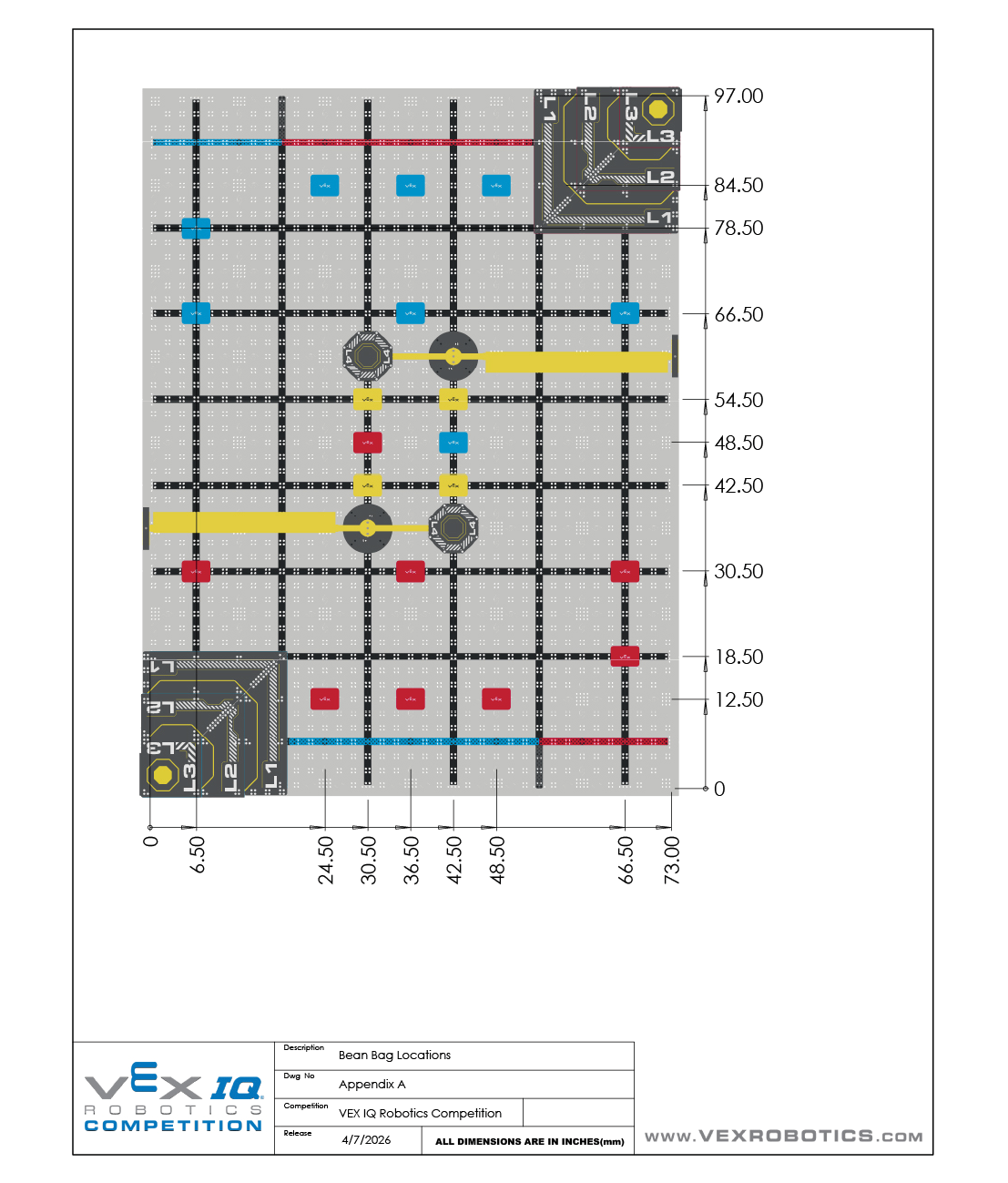
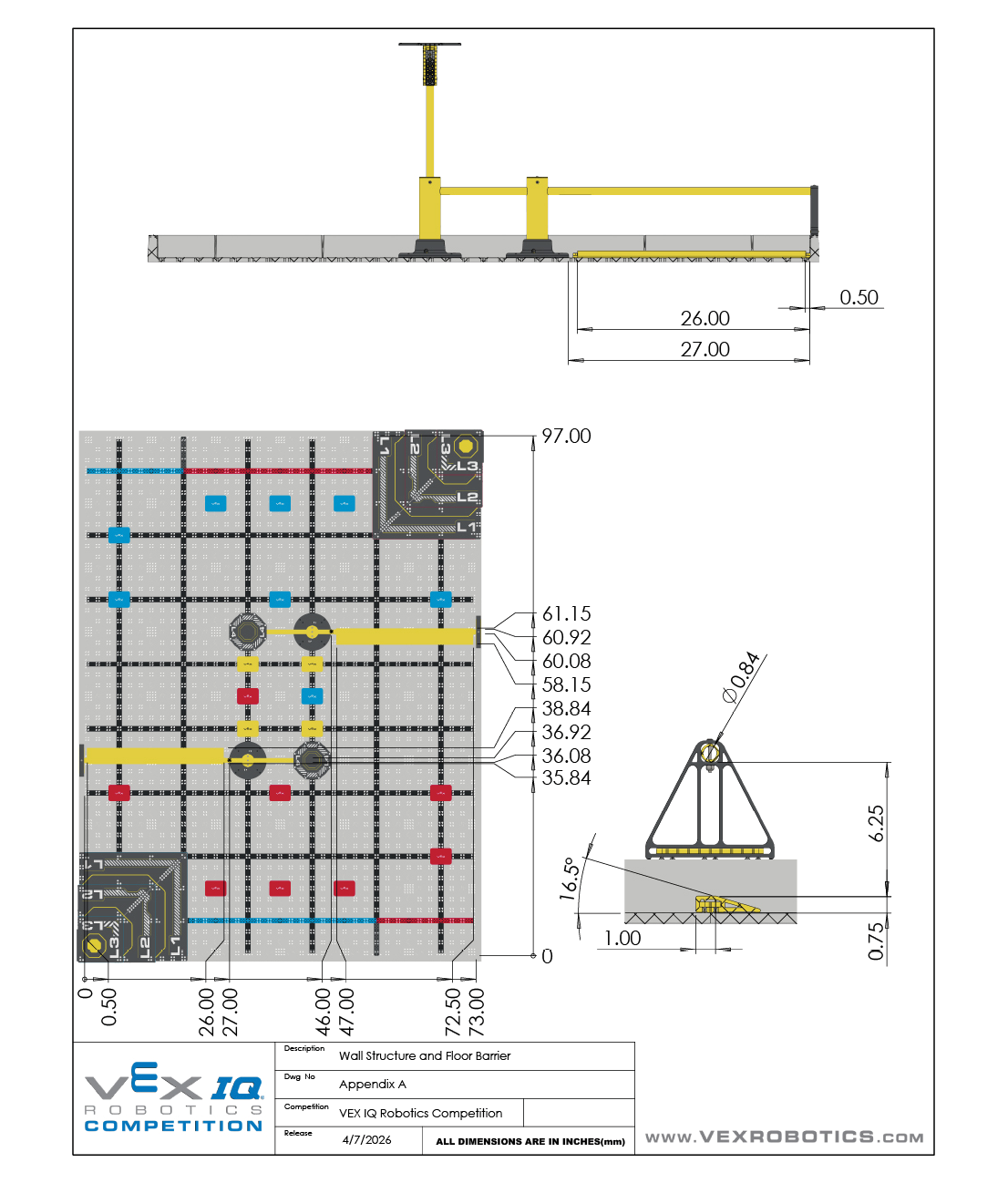
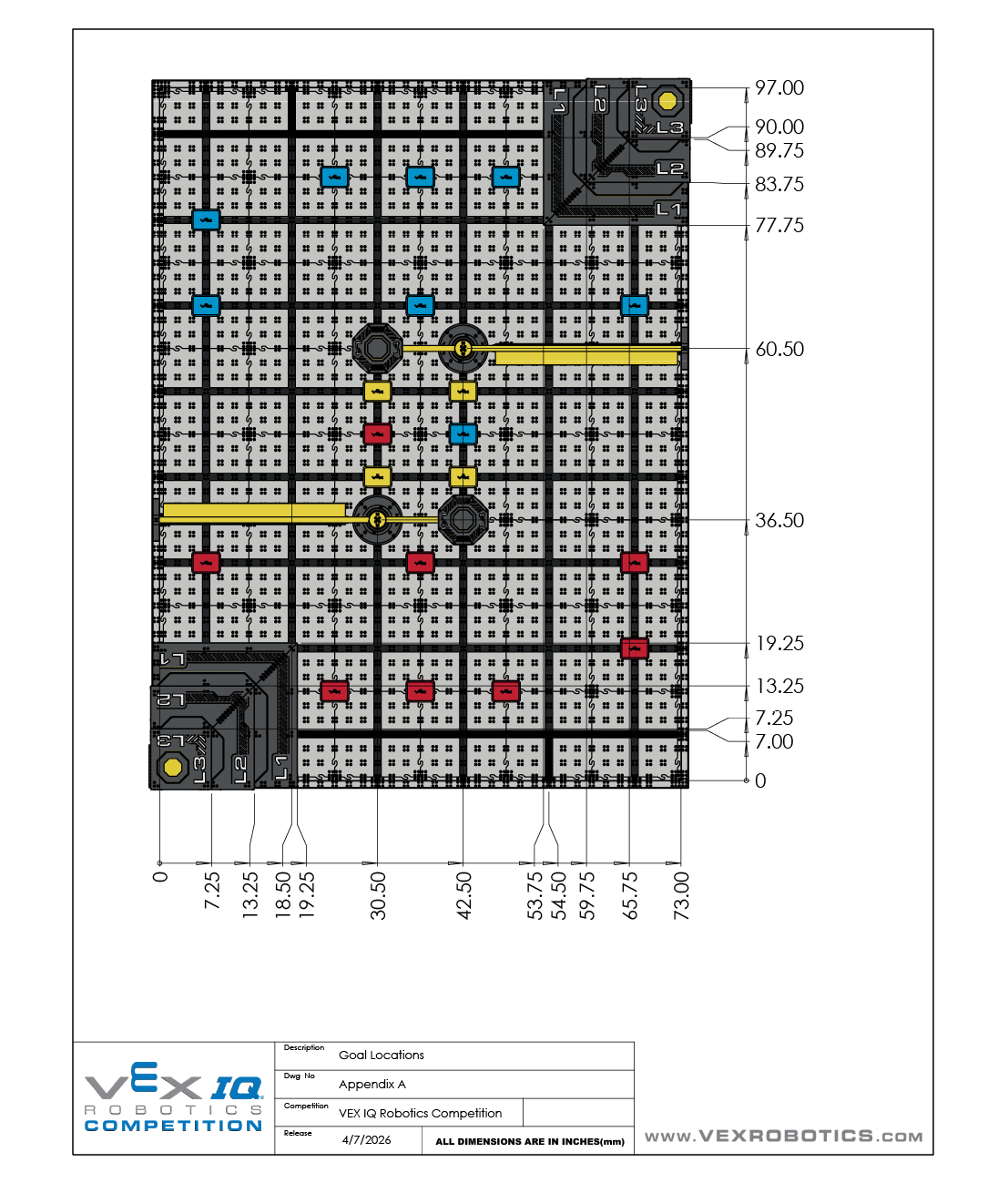
<T5>Be prepared for minor field variance.Field Element tolerances and Scoring Object positions may vary from nominal by up to ±0.5” [12.7mm], unless otherwise specified. Teams are encouraged to design their Robots accordingly. Please make sure to check Appendix A for more specific nominal dimensions and tolerances.
<T6>Fields and Field Elements may be repaired at the Event Partner’s discretion. All competition Fields and other Field Elements at an event must be set up in accordance with the specifications in Appendix A and/or other applicable support materials. Minor aesthetic customizations or repairs are permitted, provided that they do not impact gameplay (see T4).
Examples of permissible modifications include, but are not limited to:
Replacing a damaged or missing VEX IQ component with an identical part of any color
Elevating the playing Field off of the floor (common heights are 10” to 24” [254mm to 609.6mm])
Using off-the-shelf PVC to replace a damaged or missing pipe
Placing Field display monitors outside of the Field walls
Adding decorations to the outside of the Field walls or risers (e.g., LED lights, sponsor banners)
Using 0x2 or 0x3 Pins fully inserted into tiles to mark Bean Bag starting locations for field reset. Using colored pins that match the corresponding Bean Bags is recommended but not required
Repairing a Bean Bag that has been ripped open by sewing it back together
Modifications that may impact Robot functionality and/or how the game is played are generally not allowed. Examples of prohibited modifications include, but are not limited to:
Unofficial FieldFloor and/or walls, additional structural elements inside of the Field, or unofficial/replica Field Elements
Significant/large markings on Scoring Objects that could positively or negatively affect Robot sensors
Any specific repairs and/or modifications which pertain to the current season’s game will be documented in this rule and Appendix A, as needed.
<T7>Fields at an event must be consistent with each other. There are many types of permissible aesthetic and/or logistical modifications that may be made to competition Fields at the Event Partner’s discretion (see T6). If an event has multiple Teamwork MatchFields, they must all incorporate the same permissible modifications. If an event has multiple Robot Skills MatchFields, they must all incorporate the same permissible/applicable modifications. For example, if one Teamwork MatchField is elevated, then all Teamwork MatchFields must be elevated to the same height.
<T8>Qualification Matches will occur according to the official Match schedule. This schedule will indicate Alliance partners, Qualification Match times, and, if the event has multiple Fields, which Field each Qualification Match will be played on.
A Qualification Match can only start before its scheduled time if all Teams, Robots, and assigned volunteers are at the Field and ready to play.
Any multi-division event must be approved by VEX Robotics prior to the event, and divisions must be assigned in sequential order by Team number.
The official Match Schedule is subject to changes at the Event Partner’s discretion. Events should generally wait to generate the Match Schedule until all Teams have checked in and passed Robot inspection, or when it has been confirmed that Teams will not be participating.
If a Team must be removed from the Finals Match schedule after Finals Alliances have been formed (see T12B), the Event Partner can use the full-event Disqualification feature in TM to remove that Team from their scheduled Finals Match. Their spot in the Finals Alliance will be filled manually by the Event Partner by the next-highest-ranked Team that is not already in a Finals Alliance. If that Team is unavailable or unwilling to participate, the Event Partner can manually select the next-highest-ranked and available Team. If no replacement Team is available, the remaining half of that Alliance will play alone.
<T9>Each Team will be scheduled Qualification Matches as follows.
A league must include at least three league ranking sessions, with at least one week between sessions. Each session must include a minimum of two Qualification Matches per Team at that session. The suggested number of Qualification Matches per Team for a standard league ranking session is four. Event Partners may also choose to have Qualification Matches as part of their league finals session.
<T10>Teams are ranked by their average Qualification Match scores.
For Tournaments that have more than one division, Teams will be ranked among all Teams in their specific division.
When in a league, every Team will be ranked based on the number of Matches played. Teams that participate in less than 60% of the total Matches available will be ranked below Teams that participate in at least 60% of the total Matches available (e.g., if the league offers 3 ranking sessions with 4 Qualification Matches per Team, Teams that participate in 8 or more Matches will be ranked higher than Teams who participate in 7 or fewer Matches). Being a no-show to a Match that a Team is scheduled in still constitutes participation for these calculations.
A certain number of a Team’s lowest Qualification Match scores will be excluded from the rankings based on the quantity of Qualification Matches each Team plays. Excluded scores do not affect participation for leagues. “No show” Matches, as described in GG2, are not considered lowest scores for the purposes of calculating a Team’sQualification Match ranking and will never be excluded from the calculation.
In some cases, a Team will be asked to play an additional Qualification Match. The extra Match will be identified on the Match Schedule with an asterisk and will not impact the Team’s ranking (or participation for leagues). Teams are reminded that G1 is always in effect and Teams are expected to behave as if the additional Qualification Match counted.
If a Team must be removed from the Finals Match schedule after Finals Alliances have been formed (see T12B), the Event Partner can use the full-event Disqualification feature in TM to remove that Team from their scheduled Finals Match. Their spot in the Finals Alliance will be filled manually by the Event Partner by the next-highest-ranked Team that is not already in a Finals Alliance. If that Team is unavailable or unwilling to participate, the Event Partner can manually select the next-highest-ranked and available Team. If no replacement Team is available, the remaining half of that Alliance will play alone.
<T13>Teams playing in Finals Matches. The number of Finals Matches, and therefore the number of Teams who will participate in Finals Matches, is determined by the Event Partner. Events that qualify Teams directly to the VEX Robotics World Championship must have a minimum of five Finals Matches per division if there are ten or more Teams in attendance.
Alliances are ranked by their Finals Match score. The highest-scoring Alliance is in first place, the second-highest-scoring Alliance is in second place, etc.
If the Match Stop Time is also tied, a second series of tiebreaker Finals Matches will be played. If this second series of tiebreaker Finals Match is also tied, then the higher-seeded Alliance will be declared the winner.
If there is a tie for a place other than first, the higher-seeded Alliance will receive the higher rank.
For Tournaments that have more than one division, each division will have its own set of Finals Matches. The winners of each division will then have an overall event Finals.
Skills scores recorded by ineligible Teams will be deleted from Tournament Manager before the event is finalized on events.vex.com.
<T16>There is no requirement that Robot Skills Match fields have the same consistent modifications as the Teamwork fields. For example, there is no requirement that Robot Skills MatchFields are elevated to the same height as Teamwork MatchFields.
Teams must be given an opportunity to select which type of Field they want to use, i.e. they cannot be required to use a Teamwork Field for any Robot Skills Match.
<T17>Skills Rankings at events.Teams will be ranked at an event based on the following scores and tiebreakers:
If the tie still cannot be broken, the same process in the step above will be applied to the Teams’ highest Driving Skills Matches.
If the tie still isn’t broken, the Event Partner may choose to allow Teams to have one more deciding Match, or both Teams may be declared the winner.
<T18>Skills Rankings globally.Teams are ranked based on their Robot Skills scores from Tournaments and Leagues that upload results to events.vex.com, according to the following tiebreakers.
Earliest posting of the highest Autonomous Coding Skills Match score. The first Team to post a score ranks ahead of other Teams that post the same score at a later time, all else being equal.
Earliest posting of the highest Driving Skills Match score. The first Team to post a score ranks ahead of other Teams that post the same score at a later time, all else being equal.
<T19>Robot Skills at League Events. At league events in which Teams may submit Robot Skills Challenge scores across multiple sessions, the Robot Skills scores (combined highest Autonomous Coding Skills Match and Driving Skills Match scores) used for rankings will be calculated from Matches within the same session.
For example, consider the following scores for a hypothetical Team across two league event sessions:
This Team would have a Robot Skills score of 72 for this event’s rankings, and their scores from Session 2 would be used for the event and global tiebreakers listed in T17 and T18.
Welcome to the VEX IQ Robotics Competition. We’re excited to see you play Level Up! We know that learning new things can be hard, and that the game manual can feel like a lot. That’s why we’re here to help.
You and your teammates can start here and work together to learn about the Field, how to earn points, the basic rules, and different ways to play the game.
This section does not include all of the rules. You will still need to learn them all! After you understand everything here, and before your first event, go to the official game manual to make sure you know all the rules.
We hope you have fun, make new friends, and work together to build your best Robot. Have an awesome season!
This unofficial version of the VEX IQ Robotics Competition manual is a print-friendly resource for you and your Teams to help introduce Students to this season’s game, Level Up.
It’s very important to note that this is NOT a replacement for reading the official manual in its entirety. We encourage you to use this Appendix to support Team members who may be overwhelmed by the full game manual, and use it to aid in building a basic understanding of the game. Once Students are comfortable with this appendix and the rules outlined here, you should transition them to reading and using the full game manual, where they will gain a full-depth comprehension of the VEX IQ Robotics Competition.
We hope that you’ll find this guide helpful and that more Students feel welcomed, supported, and empowered to join your Teams.
It is important to follow all of the rules in Level Up. This applies to both Students and Adults. The choices that Students and Adults make work together, so everyone should follow the rules.
All event attendees must abide by the guidelines set forth in the Code of Conduct.G1
Be kind and do your best. This is one of the most important parts of VEX IQ.
Be respectful. It’s okay for Students and Adults to disagree, but it’s never okay to be disrespectful.
Be a good sport. Think about how your actions affect others.
Include everyone. Alliances should always work together to make a plan. You cannot tell another Team how they must play.
Participants must follow the Student Centered Policy.G2
The Student-Centered Policy is very important because VEX IQ is a competition for Students.
This means that the Students come up with the ideas, build the Robots, write the code, fix problems, and compete.
Adults can teach, but cannot do the work on the Robots, code, engineering notebook, or strategies. They can give tips, but not answers.
Students should speak up in a respectful way if an Adult is doing too much. Give a reminder that Student Centered is a rule all the time and everywhere with VEX IQ Robotics Competitions.
Before the Match starts, Robots cannot be bigger than 11” by 20” and cannot be taller than 15”. After the Match starts, Robots may grow bigger and taller by following rules SG2 and SG3.
Your Robot has to be designed, built, and coded by the Students on your Team, not by AdultsR2, using only VEX IQ parts R12.
Autonomous Period - A time period during which Robots operate and react only to sensor inputs and/or commands pre-programmed by the Students into the Robot control system.
Builder - Any StudentTeam member who helps build the Robot. Adults are permitted to teach Builders associated concepts, but should never work on the Robot.
Coder - Any StudentTeam member who contributes to the code that is downloaded onto the Robot. Adults are permitted to teach Coders associated concepts, but should never work on the code that goes on the Robot.
Designer - Any StudentTeam member who helps design the Robot to be built for competition. Adults are permitted to teach Designers associated concepts, but should never work on the design of the Robot.
Driver - A StudentTeam member who stands in the Driver Station and is responsible for operating and controlling that Team’sRobot during defined segments of a Match. Up to two Team members may fulfill this role in a given Match (see GG1), and there is no requirement that the same Students serve as Drivers in multiple Matches.
Driver Controlled Period - A time period during which Drivers operate their Robot using a VEX IQ controller.
Driver Station - A region beside the Field where the Drivers must remain during their Match unless legally interacting with their Robot. The Driver Stations are represented by the red and blue lines in Figure FO-3.
Drive Team Members - The Students who serve as Drivers and/or Loaders for their Team in a given Match.
Event Partner - The volunteer VEX IQ Robotics Competition Tournament coordinator who serves as an overall manager for the volunteers, venue, event materials, and all other event considerations.
Field - The entire playing Field, being six (6) Field tiles wide by eight (8) Field tiles long (totaling forty-eight (48) Field tiles), including the Field Perimeter.
Field Element - The Field Perimeter, Floor, PVC pipes, and VEX IQ pieces which comprise and/or are attached to the Field.
Field Perimeter - The outer part of the Field, made up of four (4) outside corners and twenty-four (24) straight sections.
Floor - The interior flat part of the playing Field, made up of the forty-eight (48) Field tiles that are within the Field Perimeter.
Game Design Committee (GDC) - The creators of VEX IQ Robotics Competition Level Up, and authors of this Game Manual. The Game Design Committee is the only official source for rules clarifications and Q&A responses; see Section 1.
Goal - A location inside the Field where Scoring Objects can be placed to earn points. There are multiple types of Goal in VEX IQ Robotics Competition Level Up:
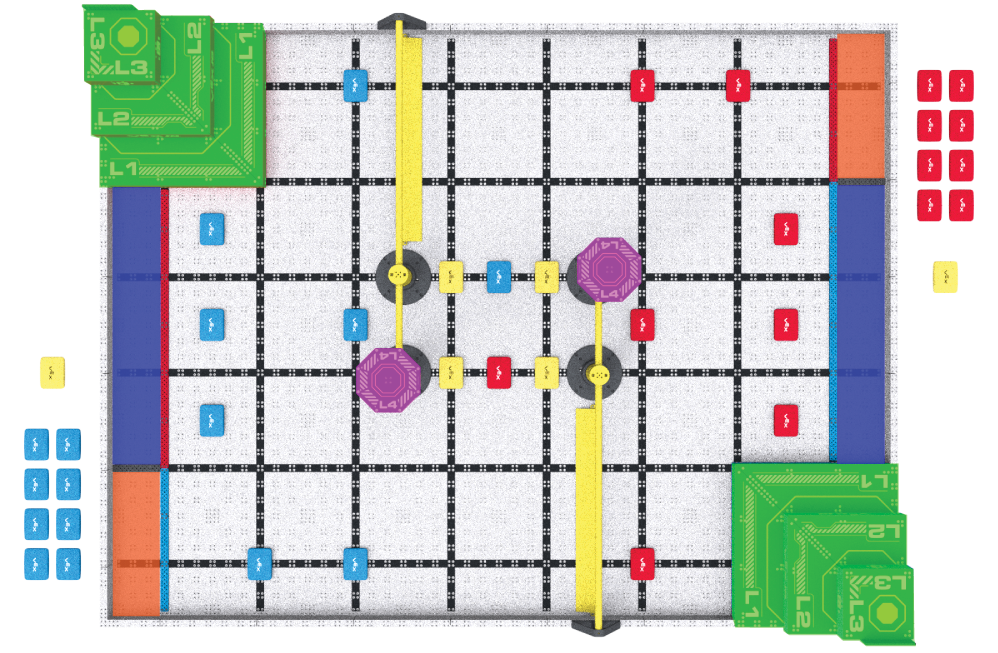
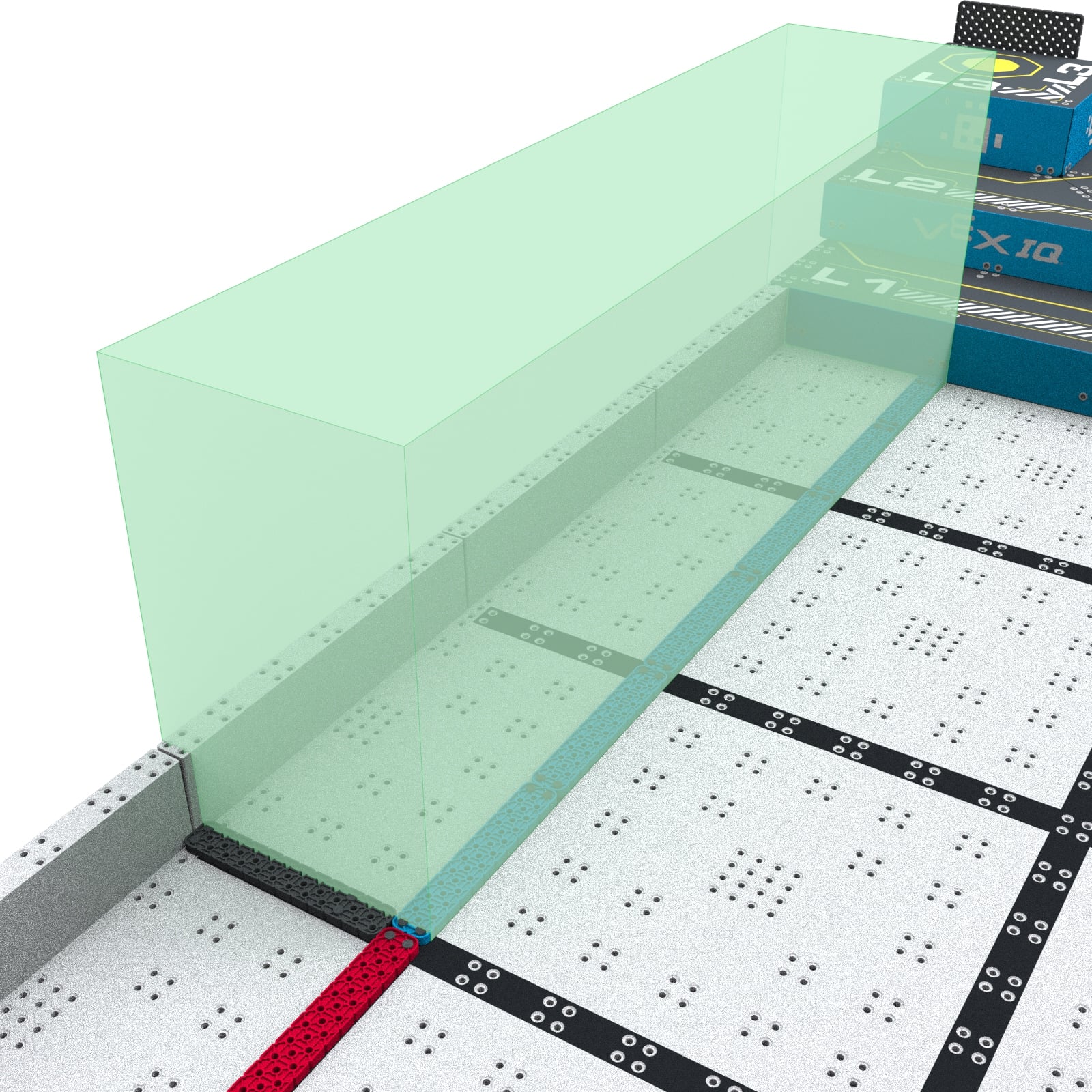
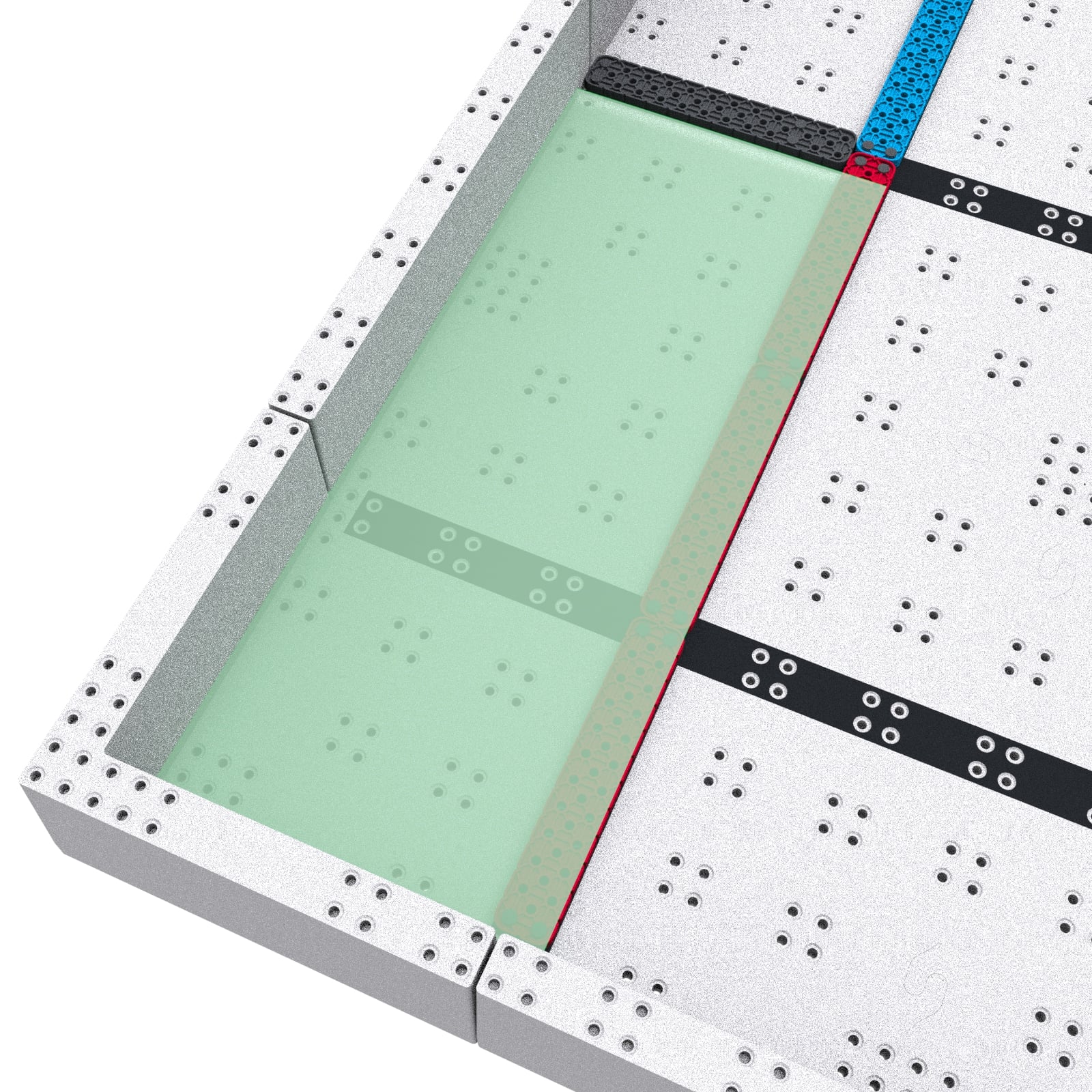
Floor Goal - An infinitely tall three-dimensional volume that is bounded by the outside edge of the red/blue IQ beams connected to the Floor, the outside edge of the Field Perimeter, the inside edge of the gray IQ beam connected to the Floor, and the vertical face of the adjacent L1 Goal. (See Figure G-1.) Each Floor Goal has a color, red or blue, determined by the color of the VEX IQ parts within its boundaries.
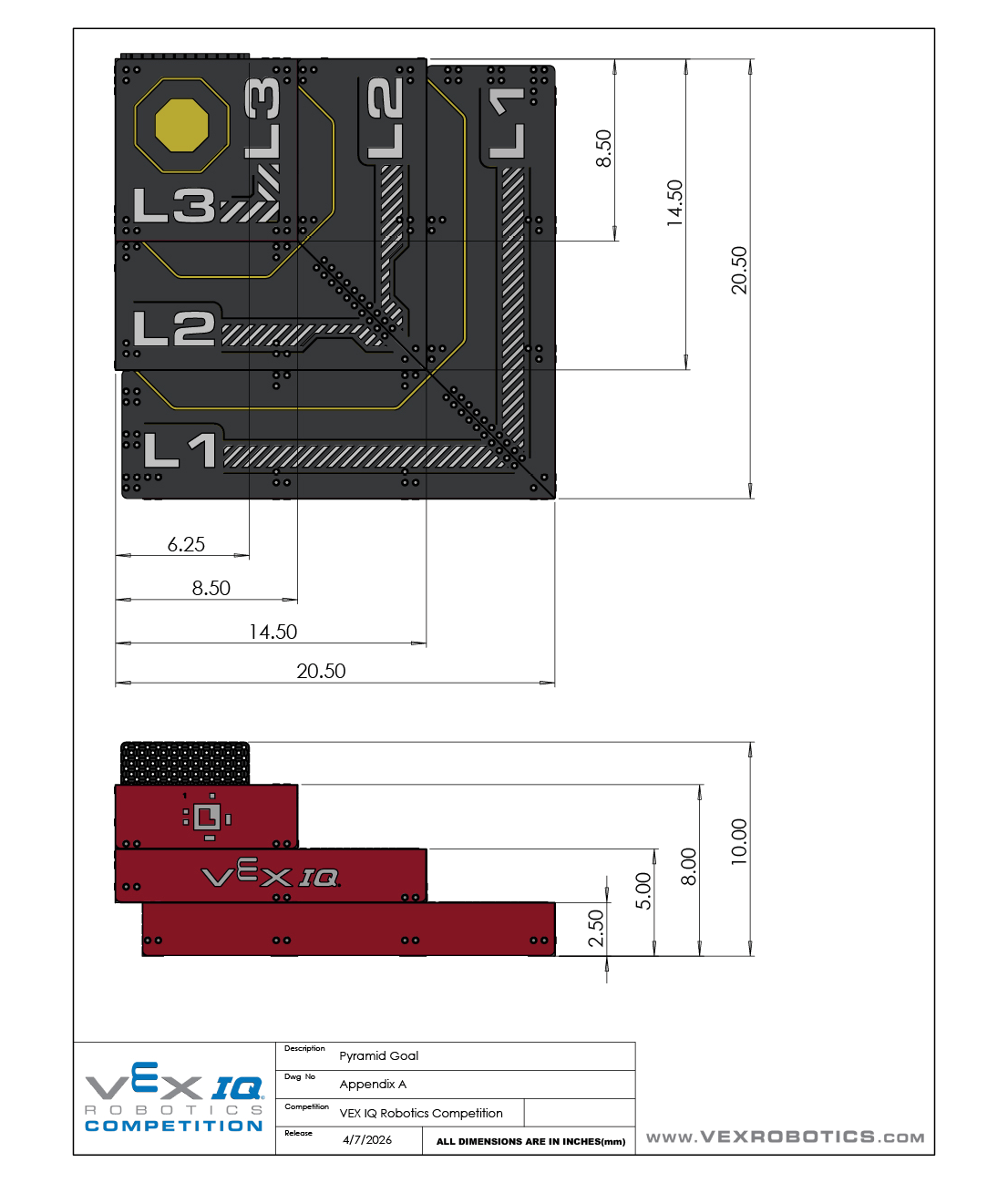
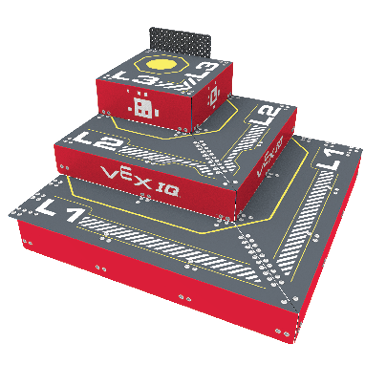
Pyramid Goal - A three-level structure in a corner of the Field. Each Pyramid Goal consists of three Goals of graduating size, designated by horizontal gray surfaces marked as L1, L2, or L3. Each Pyramid Goal has a color, red or blue, determined by the color of its vertical surfaces.
L1 Goal - The lowest Goal in a Pyramid Goal; labeled as L1 on its surface.
L2 Goal - The middle Goal in a Pyramid Goal, labeled as L2 on its surface.
L3 Goal - The highest Goal in a Pyramid Goal, labeled as L3 on its surface; includes a backstop aligned with the long side of the Field.
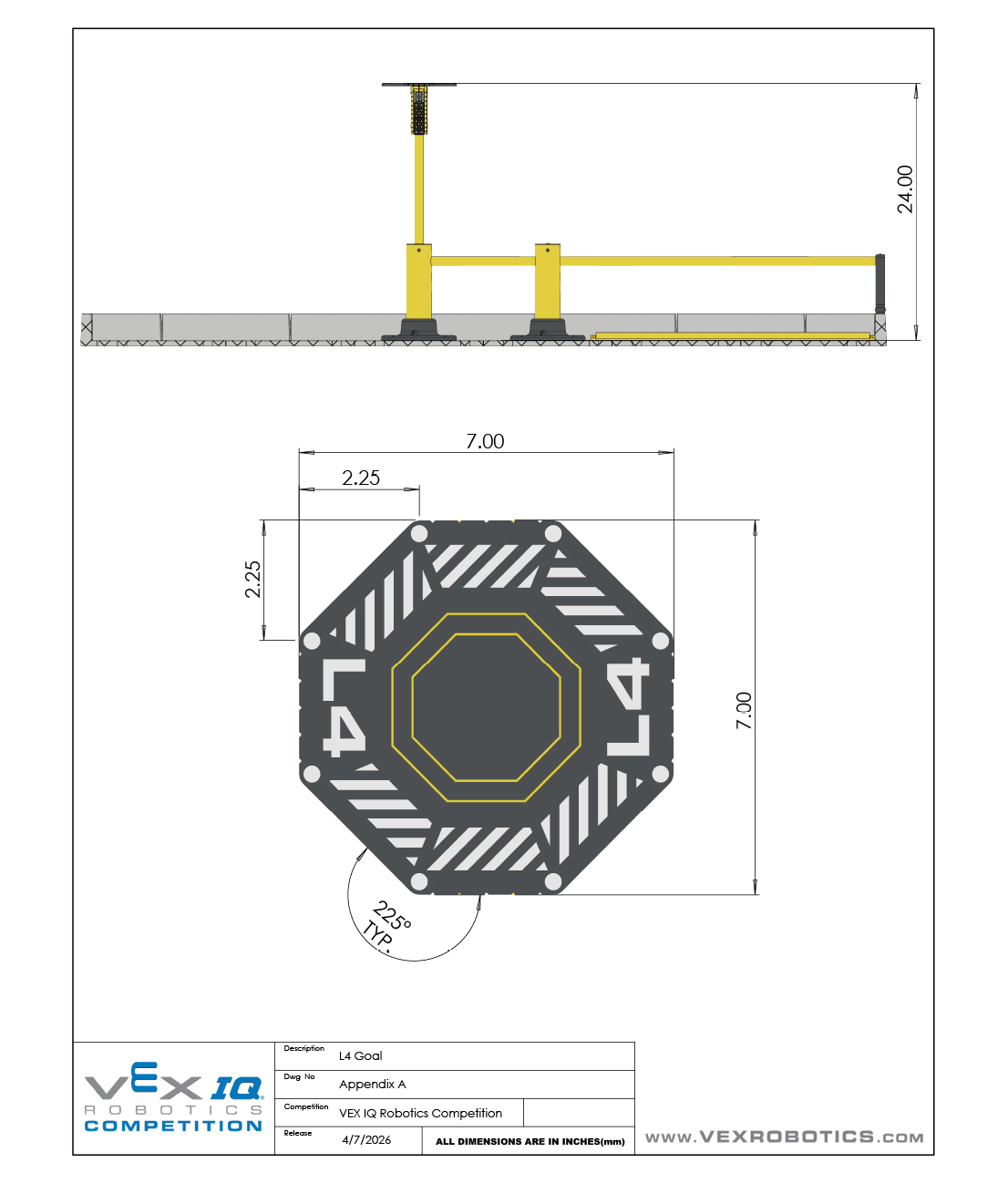
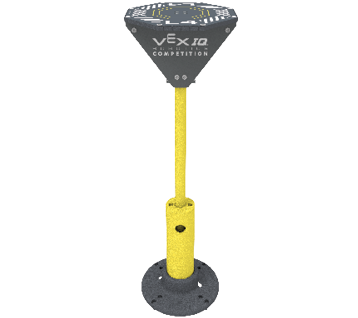
L4 Goal - The horizontal gray surface labeled as L4, located at the top of a vertical structure built from PVC pipe and VEX IQ pieces. L4 Goals do not have a defined color.
Figure G-1: The blue Floor Goal (highlighted in green).
Head Referee - A certified impartial volunteer responsible for enforcing the rules in this manual as written. Head Referees are the only people who may discuss ruling interpretations or scoring questions with Teams at an event. Large events (e.g., Signature Events, World Championships, etc.) might include multiple Head Referees at the Event Partner’s discretion.
License Plate - A physical component on the Robot that displays the Team’s VEX IQ Robotics Competition number. Each License Plate must have a length and height of 3.5” x 1.5” (88.9mm x 38.1mm) and must not exceed a width of 0.25” (6.35mm) per R4.
Load Zone - An area bounded by the outside edge of the red/blue IQ beams connected to the Floor, the inside edge of the gray IQ beam connected to the Floor, and the inside edges of the Field Perimeter. Each Load Zone has a color, red or blue, determined by the color of the VEX IQ parts within its boundaries. The Load Zone is intended to receive Scoring Objects from a human Loader.
Practice Match - A non-scored Match used to provide time for Teams to get acquainted with the official playing Field and procedures. Head Referees should not record or track standard gameplay Violations that occur during Practice Matches. Egregious Violations may be recorded and tracked at the discretion of the Head Referee.
Match Stop Time - The time remaining (i.e., displayed on the timer or audience display) in a tiebreaker Finals Match (which only occurs for 1st place) when an Alliance ends the Match early by placing their controllers on the ground. The Match Stop Time is rounded down to the nearest even number. For example, if controllers are set down when the displayed time is 13 seconds, the Match Stop Time is recorded as 12 seconds. If an Alliance does not finish the Match early, they receive a default Match Stop Time of 0 seconds.
Notebooker - Any StudentTeam member who contributes to the Team’s engineering notebook or associated documentation. Adults are permitted to teach Notebookers associated concepts, but should never work on the engineering notebook or other documentation.
Robot - A machine that has passed inspection, designed by StudentTeam members to execute one or more tasks autonomously and/or by remote control from Drivers.
Scorekeeper Referee - An impartial volunteer responsible for tallying scores at the end of a Match. Scorekeeper Referees do not make ruling interpretations, and should redirect any Team questions regarding rules or scores to the Head Referee.
Scoring Object - An object that can be placed in a Goal during a Match. There is one type of Scoring Object in VEX IQ Robotics Competition Level Up:
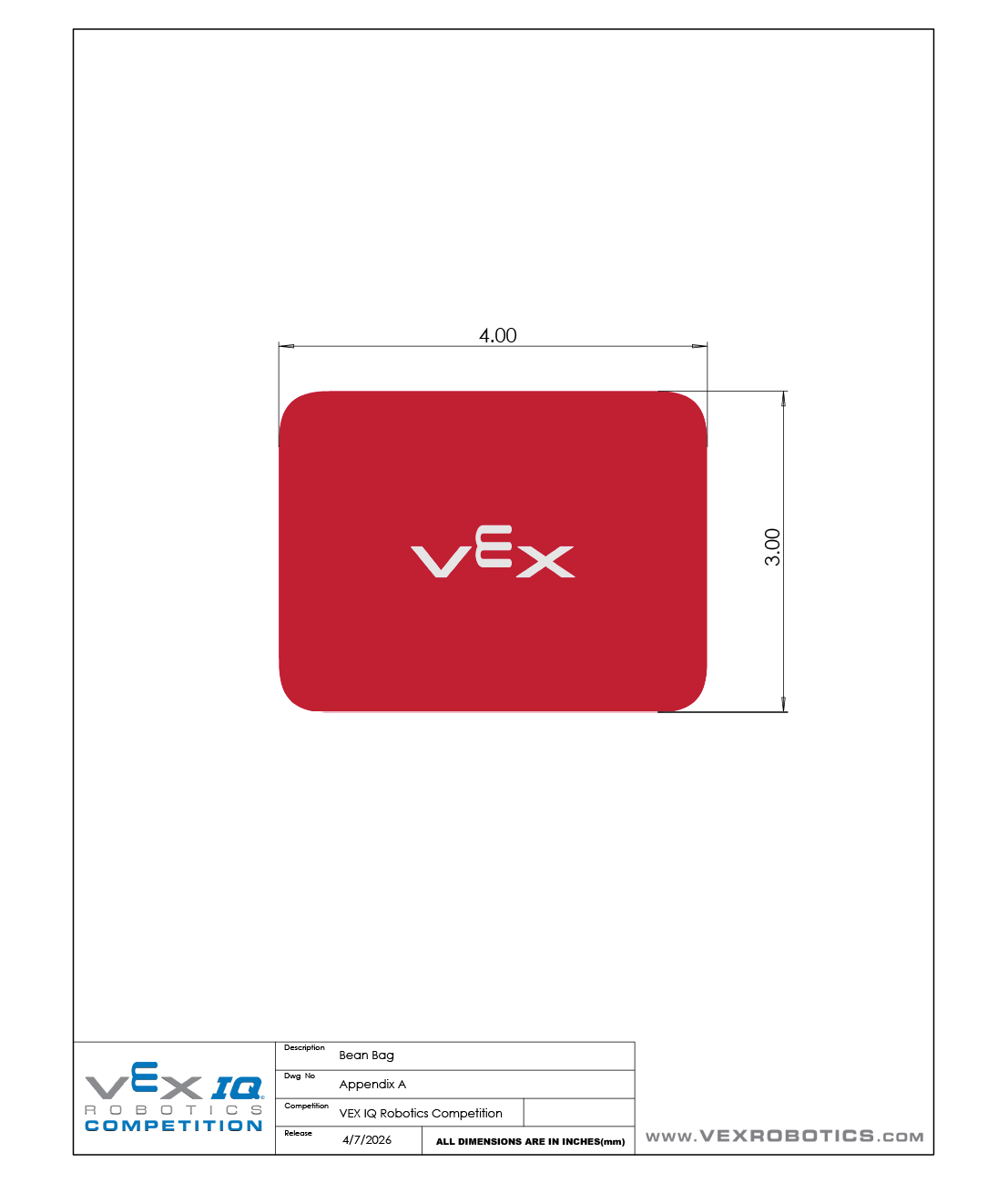
Bean Bag - A blue, red, or yellow rectangular, pellet filled fabric pouch, measuring approximately 3 inches by 4 inches, and weighing approximately 40 grams.
Strategist - Any StudentTeam member who contributes to the Match strategies used to score points during a Teamwork Match or Robot Skills Match, including assessing the impact of other Teams’ performance and strategies on the Team’s strategy (e.g., scouting). Adults are permitted to teach Strategists associated concepts, but should never create or dictate a Team’sMatch strategy.
Student - A person that meets the Student Eligibility Policy requirements for their respective competition program and level.
Team - Three or more Students make up a Team. In the context of this game manual, StudentTeam members fill multiple roles related to Robot design, build, coding, strategy, and documentation. See G2, G4, G5 for more information. Adults may not fulfill any of these roles. See Appendix E for more information about Team classifications and Student roles.
This appendix is intended to provide additional guidance regarding rule Violations within the VEX IQ Robotics Competition, and offer further explanation on how Violations may be interpreted and enforced during Matches. It is designed to promote consistency in officiating and to help Teams better understand how actions on the Field may impact scoring, Match outcomes, and referee decisions.
All Violation notes to denote special circumstances or provide additional clarifications have been consolidated into this section such that they may be easily referenced. If no Violation notes are found in a given rule, then it should be assumed that the below “default” definitions apply.
This appendix does not supersede any existing rule, but instead serves as a secondary resource to aid in their application.
Violation - The act of breaking a rule in the Game Manual.
Violations of <GG>, <SG>, and <RSC> rules that occur during a Robot Skills Match should only affect the outcome of that Match and should not be considered when determining whether a Violation has been repeated during the event.
Appendix E - Team Classifications and Student Roles
To participate in an official VEX IQ Robotics Competition event, a Team must first register on events.vex.com and receive a VEX IQ Robotics Competition Team number. A Team’s unique number identifies their organization and their Team within that organization. Each Team must design and build their own Robot, create their own code, develop their own strategies to play the game, and maintain their own engineering notebook if they choose to use one.
In the context of this Game Manual, StudentTeam members fill multiple roles related to Robot design, build, coding, strategy, and documentation. Adults may not fulfill any of these roles. See G2 and G4 for more information.
Designer - Any StudentTeam member who helps design the Robot to be built for competition. Adults are permitted to teach Designers associated concepts, but should never work on the design of the Robot.
Builder - Any StudentTeam member who helps build the Robot. Adults are permitted to teach Builders associated concepts, but should never work on the Robot.
Coder - Any StudentTeam member who contributes to the computer code that is downloaded onto the Robot. Adults are permitted to teach Coders associated concepts, but should never work on the code that goes on the Robot.
Strategist - Any StudentTeam member who contributes to the Match strategies used to score points during a Teamwork Match or Robot Skills Match, including assessing the impact of other Teams’ performance and strategies on the Team’s strategy (e.g., scouting). Adults are permitted to teach Strategists associated concepts, but should never create or dictate a Team’sMatch strategy.
Notebooker - Any StudentTeam member who contributes to the Team’s engineering notebook or associated documentation. Adults are permitted to teach Notebookers associated concepts, but should never work on the engineering notebook or other documentation.
Level Up Manual Versions
Every edition of the Level Up manual published this season. The Version menu at the top of each page opens the same page in another edition, and Compare with shows what changed on that page since an earlier one, side by side with its wording. On a phone, both are in the menu.