Every Qualification Match and Elimination Match must be watched by a certified Head Referee. A Head Referee may only watch one Match at a time; if multiple Matches are happening simultaneously on separate Fields, each Field must have its own Head Referee. Head Referees must follow the rules in this game manual and the Q&A, and must make rulings consistent with the intent of the game manual and Q&A.
<T3>Drive Team Members are permitted to immediately appeal a Head Referee’s ruling. If Drive Team Members wish to dispute a score or ruling, they must stay in the Alliance Station until the Head Referee from the Match talks with them. The Head Referee may then choose to meet with the Drive Team Members at another location and/or at a later time so that the Head Referee has time to reference materials or resources to help with the decision. Once the Head Referee announces that their decision has been made final, the issue is over and no more appeals may be made (See rule T1 ); failure to accept this final decision may be considered a G1Violation. There is no system or opportunity for an appeal of the Head Referee’s final decision, either at or after the event.
Referees are not permitted to review any photo or video Match recordings when determining a score or ruling. Some events may also prohibit Drive Team Members from reviewing photo or video Match recordings while in the Alliance Station ; this should be announced to all Teams before Matches start.
Communication and conflict resolution skills are an important life skill for Students to practice and learn. In the VEX V5 Robotics Competition, we expect Students to practice proper conflict resolution using the proper chain of command. Violations of this rule may be considered a Violation of G1.
<T4>The Event Partner has ultimate authority regarding all non-gameplay decisions during an event. The Game Manual is intended to provide a set of rules for successfully playing VEX V5 Override; it is not intended to be an exhaustive compilation of guidelines for running a VEX V5 Robotics Competition event. Rules such as, but not limited to, the following examples are at the discretion of the Event Partner and should be treated with the same respect as the Game Manual.
<T5>Be prepared for minor Field variance.Field Element tolerances and Scoring Objects may vary from specified locations/dimensions; Teams are encouraged to design their Robots accordingly. Please make sure to check Appendix A for more specific nominal dimensions and tolerances.
Field Element tolerances may vary from nominal by up to ±1.0”.
Scoring Object placement at the beginning of the Match may vary from nominal by up to ±1” (25.4mm). If a Scoring Object is within tolerance, it should not be adjusted before the Match.
The rotation of Scoring Objects is not specified. If a Scoring Object is within tolerance, either on the Field or within a Loader, it should not be adjusted before the Match.
The Field Perimeter and Field Elements are designed to be assembled and disassembled multiple times each year. Event Partners store and transport Fields between events, and the individuals setting up the Field at one event may differ from those at the next. While every effort will be made to ensure minimal variance, Teams should expect that any Field may be slightly different than another, and prepare accordingly. Just because something works on one Field does not fully guarantee it will work on the next, and is not enough evidence alone to determine if a Field is out of tolerance.
<T6>Fields may be repaired at the Event Partner’s discretion. All competition Fields at an event must be set up in accordance with the specifications in Appendix A and/or other applicable Sections. Minor aesthetic customizations or repairs are permitted, provided that they do not impact gameplay (see T4 ).
Examples of permissible modifications include, but are not limited to:
Applying threadlocker to Field Element mounting hardware
Using non-VEX electrical tape to add required lines to the Field
Anchoring Field Elements directly to Field risers instead of the metal plates
Anchoring the metal plates to the underlying surface with hardware or tape
Utilizing a non-VEX Strap under the Field to tie walls together
Parts added to the exterior of the Portable Field Perimeter to assist in assembly, transportation, and rigidity during Matches
Modifications that may impact Robot functionality and/or how the game is played are generally not allowed. Examples of prohibited modifications include, but are not limited to:
Additional VEX structural parts attached to a Field Element
Replacing the opaque Field walls on the VEX Portable Competition Field Perimeter with transparent panels
Assembling a VEX Portable Competition Field Perimeter without including the securing straps
Affixing stickers to the foam Field Tiles or otherwise marking object placements for Field reset
Any specific repairs and/or modifications which pertain to the current season’s game will be documented in this rule and Appendix A, as needed.
<T7>Fields at an event must be consistent with each other. There are many types of permissible aesthetic and/or logistical modifications that may be made to competition Fields at the Event Partner’s discretion (see T6 ). If an event has multiple Head-to-Head competition Fields, they must all incorporate the same permissible/applicable modifications. If an event has multiple Robot Skills Challenge Fields, they must all incorporate the same permissible modifications. For example, if one Head-to-Head competition Field is elevated, then all Head-to-Head competition Fields must be elevated to the same height.
Examples of these modifications may include, but are not limited to:
Elevating the playing Field off of the floor (common heights are 12” to 24” [30.5cm to 61cm])
Utilizing non-VEX Straps to hold the Field walls together
Note: If an event has dedicated Fields for Robot Skills Matches, there is no requirement for them to have the same consistent modifications as the Head-to-Head Fields. See T21 for more details.
<T8>There are three types of Field control that may be used.
A VEXnet Field Controller controlled by Tournament Manager, which connects to a Controller’s competition port via ethernet cable.
A V5 Event Brain controlled by Tournament Manager, which connects to a Controller via Smart Cable.
A VEXnet Competition Switch, which connects to a Controller’s competition port via Cat-5 cable, may only be used in Practice Matches, Robot Skills Matches, and Leagues, and only under extreme circumstances.
If an event has multiple Fields, then all Fields of the same game type must use the same control system, in accordance with T7 and T21. For example, it would be permissible for Head-to-Head competition Fields to use V5 Event Brains, and for Skills Challenge Fields to use VEXnet Field Controllers. However, it would not be permissible for one Head-to-Head Field to use a V5 Event Brain while another Head-to-Head Field uses a VEXnet Field Controller.
Note: Official Qualifying Events may only use the official, unmodified version of Tournament Manager for field control, along with approved hardware and networking solutions. Add-ons that abide by the TM Public API guidelines are permitted. Once add-ons are enabled, the software is no longer supported by VEX Robotics, or DWAB Technologies; any necessary troubleshooting will be done at the user’s own risk.
<T9>There are two types of Field Perimeter that may be used.
If an event has multiple Fields, then all Fields of the same game type must use the same Field Perimeter type, in accordance with T7 and T21. For example, it would be permissible for Head-to-Head competition Fields to use metal Field Perimeters, and for Skills Challenge Fields to use Portable Field Perimeters.
<T10>Qualification Matches follow the Match Schedule. A Qualification Match Schedule will be available on the day of competition. The Match Schedule will indicate Alliance partners, Match pairings, and Alliance colors for each Match. For Tournaments with multiple Fields, the schedule will indicate which Field each Match will take place on.
A Qualification Match can only start before its scheduled time if all Teams, Robots, and assigned volunteers are at the Field and ready to play.
Any multi-division event must be approved by VEX Robotics prior to the event, and divisions must be assigned in sequential order by Team number.
The Match Schedule is subject to change at the Event Partner’s discretion. Events should generally wait to generate the Match Schedule until all Teams have checked in and passed Robot Inspection, or when it has been confirmed that Teams will not be participating.
If it is determined by both the Event Partner and VEX Robotics that a Team should be removed from further Matches at the event based on the outcome of a serious Violation, the Event Partner can use the full-event Disqualification feature in TM to remove that Team from all further Matches at the event. Their spots in later Qualification Matches will be replaced automatically by Teams from the end of the Match Schedule, and Matches will be removed from the end of the schedule as appropriate. The Event Partner cannot do this without permission from VEX Robotics.
<T11>Each Team will have at least six Qualification Matches.
A league must include at least three league ranking sessions, with at least one week between sessions. Each session must include a minimum of two Qualification Matches per Team at that session. The suggested number of Qualification Matches per Team for a standard league ranking session is four. Leagues will have a championship session where elimination rounds will be played. Event Partners may also choose to have Qualification Matches as part of their championship session.
<T12>Qualification Matches contribute to a Team’s ranking for Alliance Selection.
For Tournaments that have more than one division, Teams will be ranked among all Teams in their specific division.
When in a league, every Team will be ranked based on the number of Matches played. Teams that participate in at least 60% of the total Matches available will be ranked above Teams that participate in less than 60% of the total Matches available; e.g., if the league offers 3 ranking sessions with 4 Qualification Matches per Team, Teams that participate in 8 or more Matches will be ranked higher than Teams who participate in 7 or fewer Matches. Being a no-show to a Match that a Team is scheduled in still constitutes participation for these calculations.
<T14>Small Tournaments have fewer Alliances. The number of Alliances for a given event is determined as follows, except in extraordinary circumstances with the permission of VEX Robotics:
This rule is applied differently for VEX U. See rule <VUT6>.
<T15>Send a Student representative to Alliance Selection. Each Team must send one Student representative to the playing Field (or other designated area) to participate in Alliance Selection. If the Team representative fails to report in for Alliance Selection, their Team will be ineligible for participation in the Alliance Selection process.
Once the Alliance Selection begins, Student representatives cannot use electronic devices unless they have been demonstrated to be in airplane mode. No electronic communication by or with Student representatives is allowed during the Alliance Selection process.
Teams are advised to complete their scouting prior to the beginning of Alliance Selection, and to come to Alliance Selection prepared with a written list of potential Alliance Partners. Non-electronic methods of communication are allowed. Rule G2 and the Student-centered Policy still apply during Alliance Selection. Any communication about Alliance Selection and specific Teams should be limited to StudentTeam Members.
Note: Alliances must have two Teams, and there are no “do-overs” during Alliance Selection. If enough Teams decline their invitations such that the full number of Alliances cannot be filled, the event will proceed with a reduced number of Alliances.
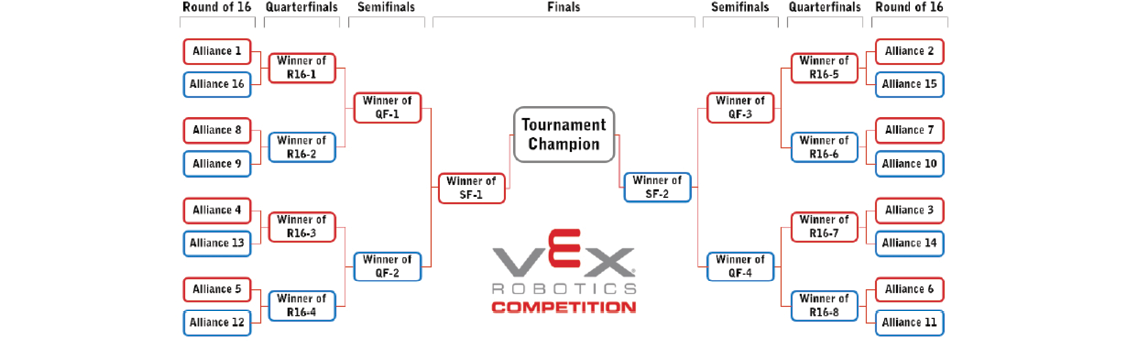
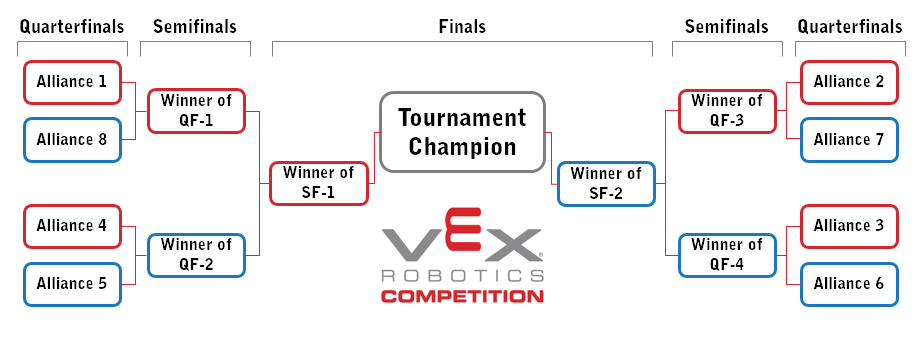
<T17>Elimination Matches follow the Elimination Bracket. A sixteen (16) Alliance bracket plays as shown in Figure T17-1, with Matches proceeding in numbered order through each round.
If an event is run with fewer than 16 Alliances, then they will use the bracket shown in Figure T17-1, with Byes awarded when there is no applicable Alliance. For example, in a Tournament with 12 Alliances, Alliances 1, 2, 3, & 4 would automatically advance to the Quarterfinals.
At events with multiple divisions, each division champion Alliance will advance to the overall event finals. Alliance color assignment for these Matches will be determined by the original Alliance seeding within their respective divisions. The higher seeded Alliance (e.g., 1 is higher than 2) will be designated as the red Alliance, and the lower-seeded Alliance will be designated as the blue Alliance.
If both Alliances hold the same seed number within their divisions, the Event Partner will conduct a coin flip to determine which Alliance is assigned to the red Alliance, with the remaining Alliance assigned to blue.
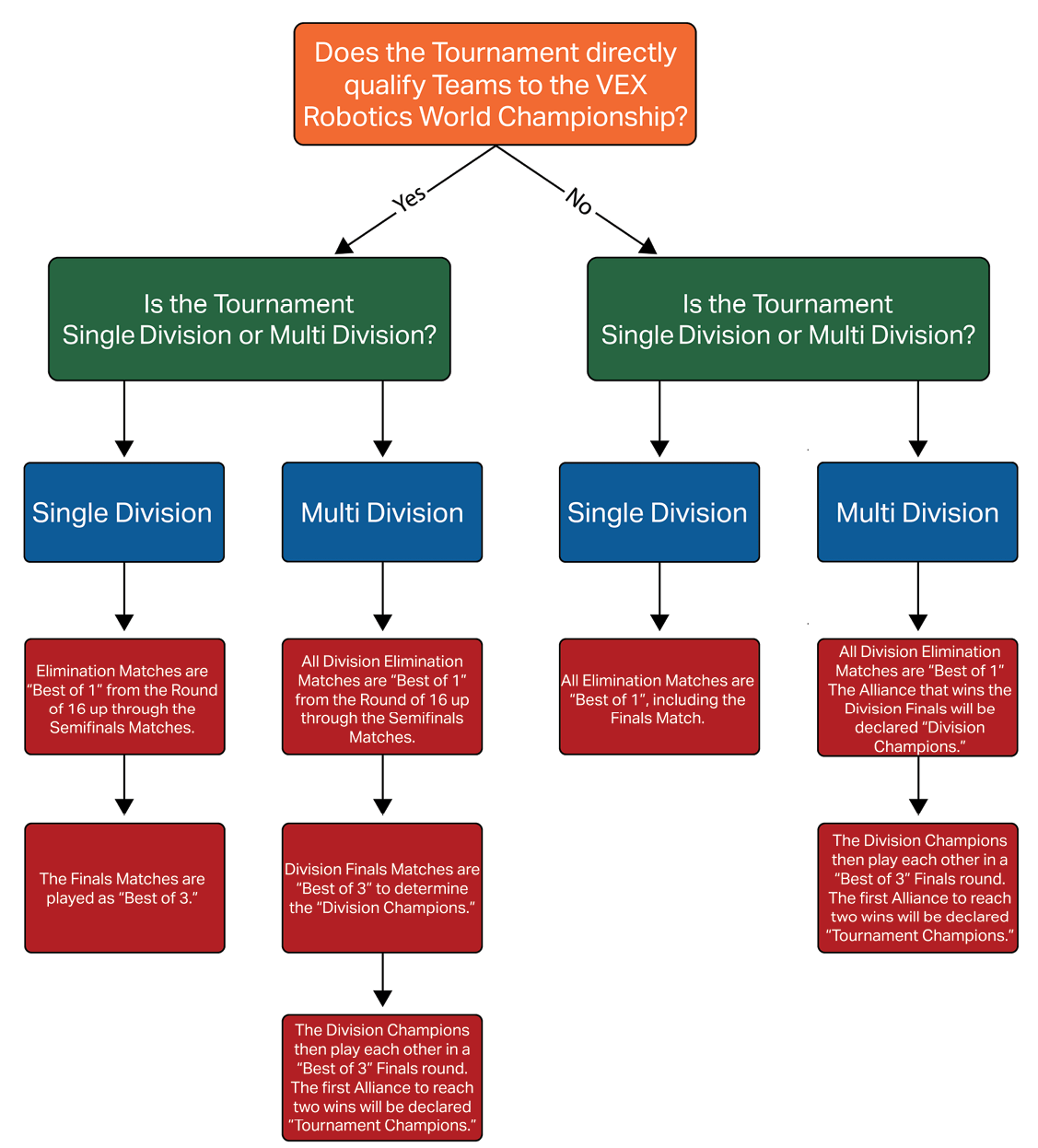
<T18>Elimination Matches are a blend of “Best of 1” and “Best of 3.” “Best of 1” means that the winning Alliance in each Match advances to the next round of the Elimination Bracket. “Best of 3” means that the first Alliance to reach two wins will advance.
See the flowchart below for more information.
Figure T18-1: The process for determining how Elimination Matches should be played.
<T19>Ties in Elimination Matches lead to limited rematches. In the case of tied Matches during Elimination Matches, Tournament Manager will apply the following logic to determine which Alliance will progress to the next round.
In a “Best of 1” Elimination Round, the higher-seeded Alliance will advance and be declared the winner under the following guidelines.
For single-division events or within a division: in a ”Best of 3” Elimination Round, the higher-seeded Alliance will advance and be declared the winner under the following guidelines.
After three (3) ties in a round in which neither Alliance has yet won a Match (0-0).
After two (2) ties in a round in which each Alliance has won a single Match (1-1).
For single-division events or within a division: after two (2) ties in a “Best of 3” Elimination Round in which one Alliance has won a single Match (1-0), the Alliance with one (1) win will be declared the winner.
For a “Best of 3” overall Finals round at a multi-division event, Teams should continue to play tiebreaker Matches until one Alliance has won two (2) Matches.
Teams should review the event agenda and their Match Schedule to determine when the best possible time is to complete their Robot Skills Matches. If the Robot Skills Challenge area closes before a Team has completed all six (6) Robot Skills Matches, but it is determined that there was adequate time given, then the Team will automatically forfeit those unused Matches.
<T21>There is no requirement that Skills Challenge Fields have the same consistent modifications as the Head-to-Head Fields. For example, there is no requirement that all Skills Challenge Fields are elevated to the same height as Head-to-Head Fields. However, all Skills Challenge Fields at a single event must use the same type of Field control and Field Perimeter, as described in rules T8 and T9.
It is strongly recommended/preferred that all Skills Challenge Fields are consistent with each other, but this may not be the case in extreme circumstances. In order to use non-conforming Head-to-Head Fields for Skills Challenge runs (e.g. during lunch), the following steps should be taken:
Teams must be informed that the Head-to-Head Fields may have some differences from the Skills Challenge Fields (e.g., they might not have GPS strips).
Teams must be given an opportunity to select which type of Field they want to use, i.e. they cannot be required to use a Head-to-Head Field for any Skills Challenge run.
<T22>Skills Rankings at events.Teams will be ranked at an event based on the following scores and tiebreakers:
If a tie cannot be broken after all above criteria, then the following ordered criteria will be used to determine which Team had the “best” Autonomous Coding Skills Match :
Number of Toggles set to a color other than yellow
If the tie still isn’t broken, the same process in Step 9 will be applied to each Team’s best Driving Skills Match.
If the tie still isn’t broken, events may choose to allow Teams to have one more deciding Driving Skills Match, to be ranked according to the standard criteria above, or declare both Teams the Robot Skills Challenge Winner.
<T23>Skills Rankings Globally.Teams will be ranked globally based on their Robot Skills scores from Tournaments and Leagues that upload results to events.vex.com, according to the following tiebreakers:
Earliest posting of the highest Autonomous Coding Skills Match score. The first Team to post a score ranks ahead of other Teams that post the same score at a later time, all else being equal.
Earliest posting of the highest Driving Skills Match score. The first Team to post a score ranks ahead of other Teams that post the same score at a later time, all else being equal.
<T24>Robot Skills at League Events. At league events in which Teams may submit Robot Skills Challenge scores across multiple sessions, the Robot Skills scores (combined highest Autonomous Coding Skills Match and Driving Skills Match scores) used for rankings will be calculated from Matches within the same session.
For example, consider the following scores for a hypothetical Team across two league event sessions:
This Team would have a Robot Skills score of 140 for this event, and their scores from Session 2 would be used for the Event and Global tiebreakers listed in T22 and T23.