


Compare "Section 2 - The Game": v1.0 → v2.1
VEX V5 Robotics Competition Override: A Primer
Section titled “VEX V5 Robotics Competition Override: A Primer”VEX V5 Robotics Competition Override is played on a 12’ x 12’ square Field, set up as illustrated in the figures throughout this manual.
In Head-to-Head Matches, two (2) Alliances — one (1) “red” and one (1) “blue” — composed of two (2) Teams each, compete in Matches consisting of a fifteen (0:15) second Autonomous Period followed by a one minute and forty-five second (1:45) Driver Controlled Period.
The object of the game is to attain a higher score than the opposing Alliance by stacking Pins and Cups on Goals, setting Toggles to your Alliance color, and ending the Match with your Robot in the contested Midfield.
An Autonomous Win Point is awarded to any Alliance that completes a set of assigned tasks by the end of the Autonomous Period.
An Autonomous Bonus is awarded to the Alliance that has the most points at the end of the Autonomous Period.
Teams may also compete in Robot Skills Matches, where one (1) Robot tries to score as many points as possible. See Section 3 for more information.
At the VEX U Collegiate level, Teams play in a modified Tournament with a 30-second Autonomous Period and additional Robot build challenges. See Section 6.
Added: Version 2.1 (New)
In the VEX AI Robotics Competition, Teams play with two fully autonomous Robots and no Driver Controlled Period. See Section 7.
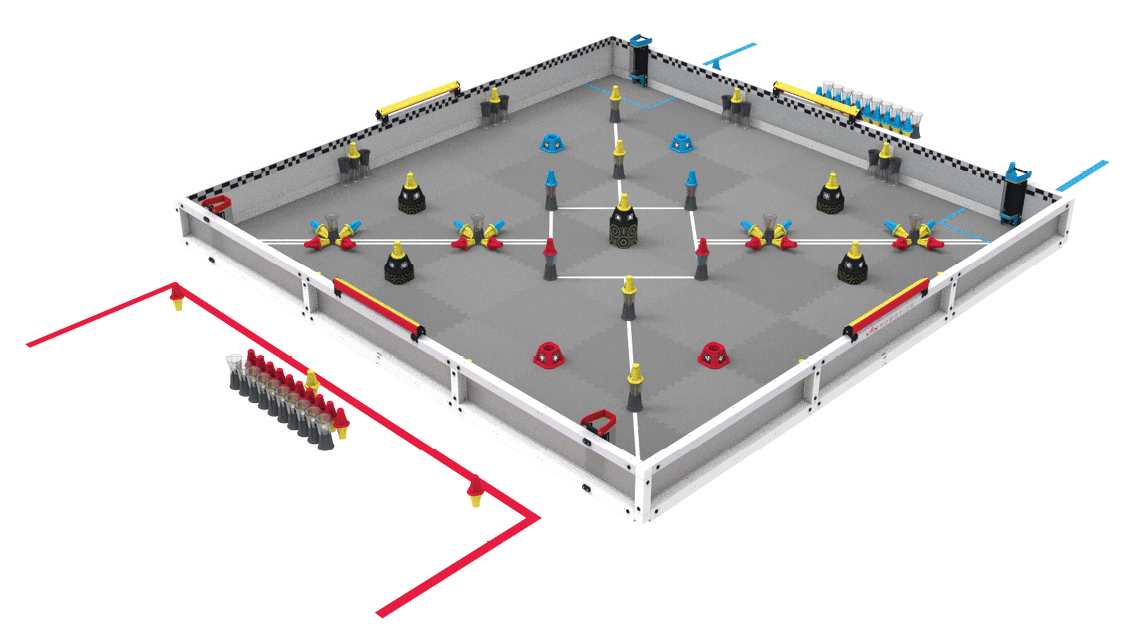
Field Overview
Section titled “Field Overview”The VEX V5 Override Field consists of the following:
- 56 Cups
- 63 Pins
- 4 red/blue that start the Match in predetermined locations
- 20 red/yellow
- 2 Preloads
- 10 Match Loads
- 8 that start the Match in predetermined locations
- 20 blue/yellow
- 2 Preloads
- 10 Match Loads
- 8 that start the Match in predetermined locations
- 19 yellow/yellow
- 2 Match Loads
- 17 that start the Match in predetermined locations
- 9 Goals
- 4 Alliance colored
- 2 red
- 2 blue
- 5 neutral colored
- 4 short
- 1 tall
- 4 Alliance colored
- 4 Toggles
- 4 Loaders, two adjacent to each Alliance Station
Note: The illustrations in this section of the Game Manual are intended to provide a general visual understanding of the game. Some figures may highlight or change the appearance of certain Field Elements and Scoring Objects to emphasize or clarify intent.
Teams should refer to official Field specifications, found in Appendix A, for exact Field dimensions, a full Field bill of materials, and exact details of Field construction.
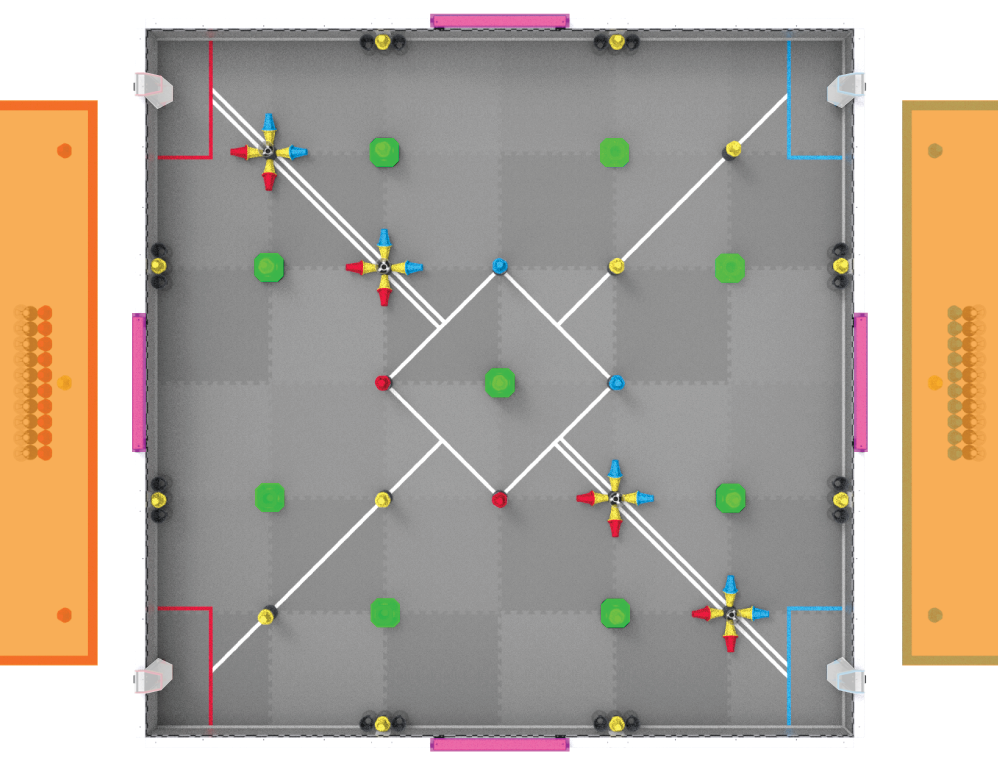
Figure FO-1: An overhead view of the VEX V5 Override Field, with Alliance Stations (orange), Loaders (white), Toggles (pink), and Goals (green) highlighted.
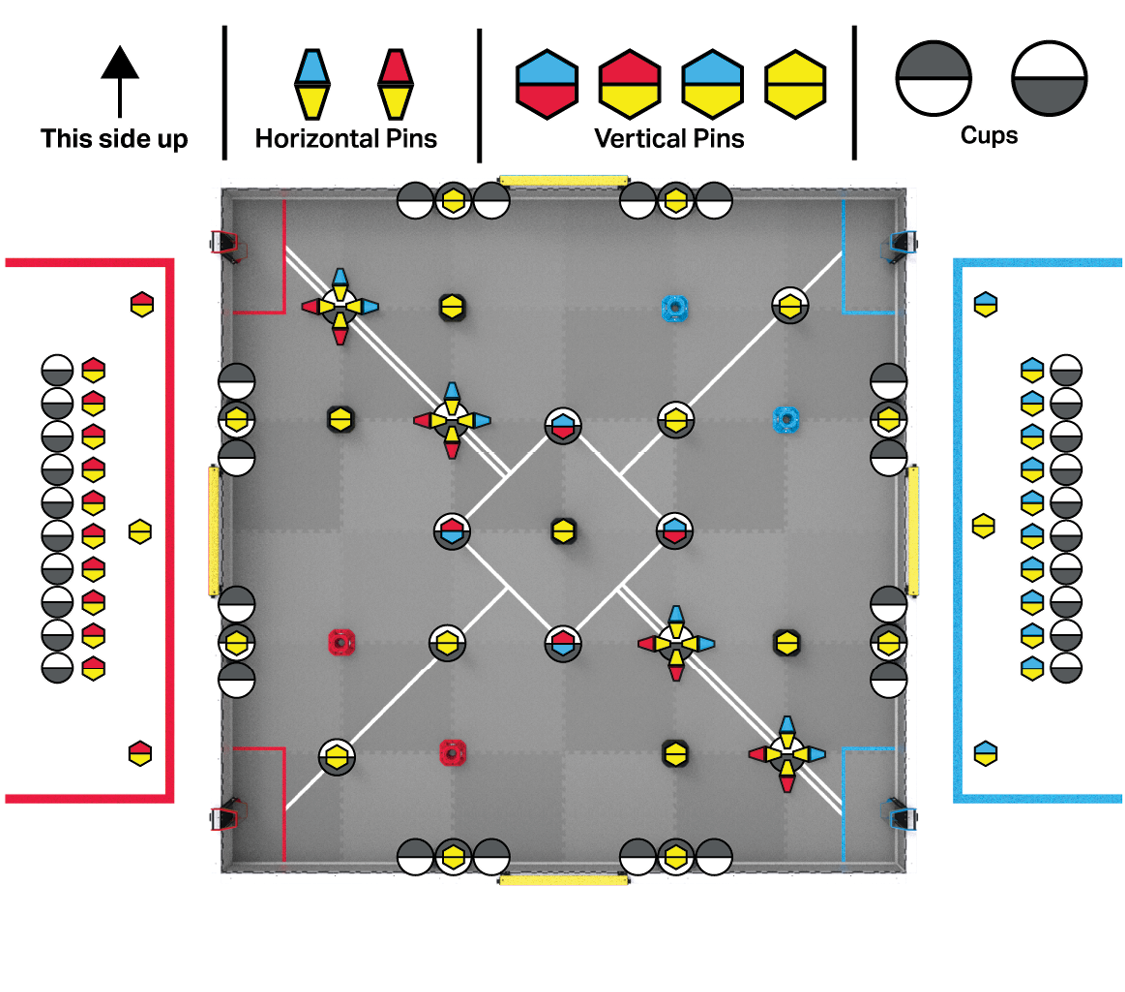
Figure FO-2: An overhead view of the VEX V5 Override Field in its starting configuration, with icons representing orientation of Scoring Objects.
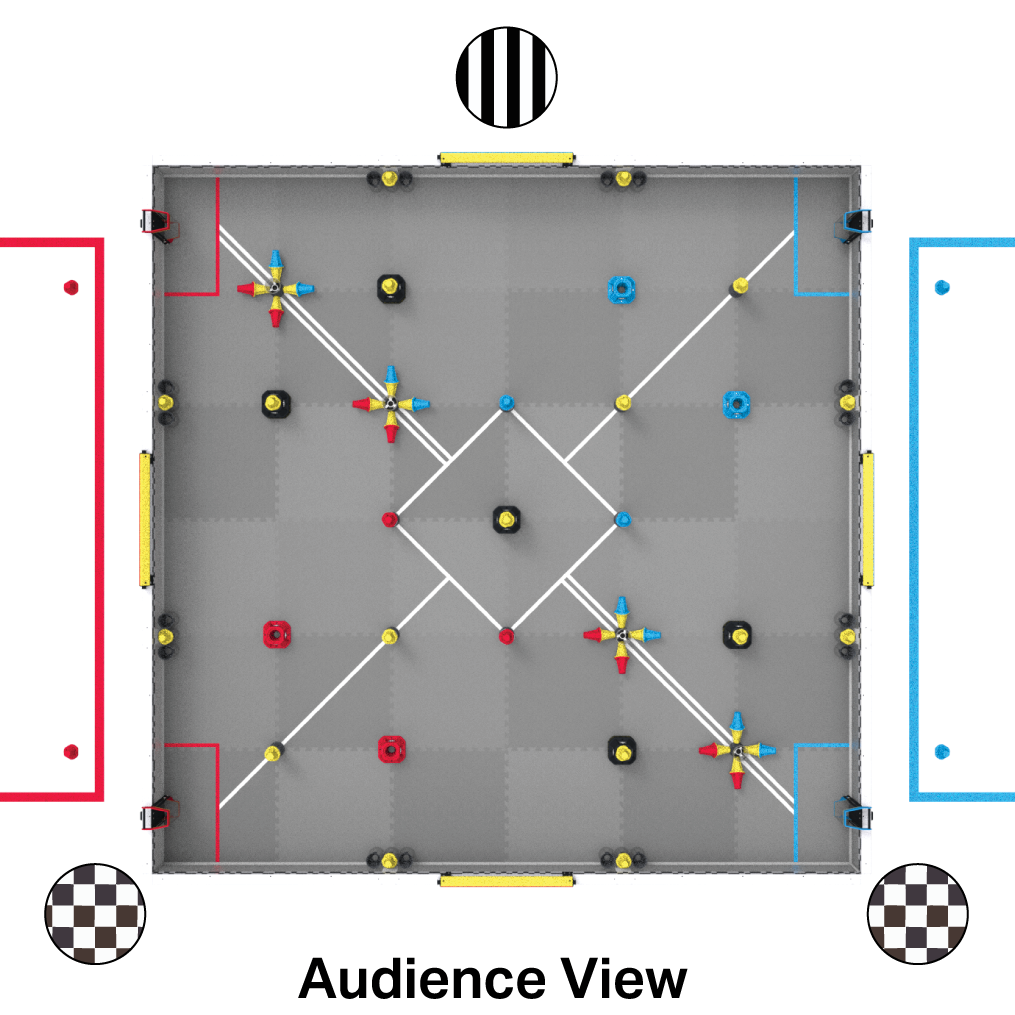
Figure FO-3: The recommended locations of the Head Referee (black & white stripes), and Scorekeeper Referees (black & white checkerboard).
Game Design Philosophy - A Letter from the GDC
Section titled “Game Design Philosophy - A Letter from the GDC”We want to take the opportunity to explain how this game was designed and what kind of gameplay we expect to see during the season. This section also points out parts of the game that we will watch closely in case updates are needed.
This is not a rules section. It does not add any new rules. Instead, it helps you understand the purpose of the game and what we as designers had in mind.
Override is a game that focuses on stacking and teamwork. We intend for Teams to work together with their Alliance partners to assemble stacks, gain points using Scoring Objects, and control Toggles to outscore their opponents.
Because of this, success in the game is not just about building a good Robot. It also depends on how well you:
- Communicate with your partner
- Plan your strategy
- Time your actions during a Match
Teams that coordinate well and make smart decisions will have an advantage.
The game is designed so that most points come from constructive actions, such as:
Interaction with the opposing Alliance is still an important part of the game. However, Matches cannot be dominated by tearing down what the other Alliance has built. Some defense and disruption is expected, but the main focus should stay on building and scoring.
If strategies that focus mostly on preventing stacks become too common, the Game Design Committee may consider making changes to ensure the game remains interesting with many strategy choices. We will look at how often these strategies are used and how they affect gameplay compared to our intentions.
The scoring values in Override are designed to encourage dynamic strategy and decision making. Because of this, it is possible for actions like controlling Toggles or scoring yellow Pins to create large point swings during a Match.
These moments can be exciting, but they should not become the only way to win. Teams should still have multiple viable strategies, including building stacks and competing in the Endgame.
We will monitor how these point swings impact Matches throughout the season. If they begin to outweigh other scoring opportunities or reduce strategic variety, the Game Design Committee may adjust point values to maintain a balanced and engaging game.
The last 10 seconds of the Match are designed to feel more intense and competitive. During this time, the game shifts to a “king of the hill” style challenge in the Midfield. This section of the Match will likely include increased Robot interaction. As such:
- Positioning and timing become critical
- Robot durability matters more
Removed: Version 1.0 (Old)
At the same time, there are still rules in place (like limits on how Robots can expand) to help prevent issues such as tipping over or getting tangled with other Robots. If the Endgame consistently leads to problems like Robots getting stuck, tipping too often, or not being able to recover, the Game Design Committee may adjust rules to keep Matches fair and playable.
Added: Version 2.1 (New)
If the Endgame consistently leads to problems like Robots getting stuck, tipping too often, or not being able to recover, the Game Design Committee may adjust rules to keep Matches fair and playable.
Override is a game where sensors can be very helpful. Tools like AI Vision Sensors and Optical Sensors can help your Robot :
The Game Design Committee will work to support sensor use through Field and game design. However, real-world conditions are not always perfect. Lighting and object placement may vary. Because of this, Teams should design and code their Robots so their sensors can handle small changes and still work reliably during a Match.
In addition, Robot rules will continue to be reviewed to make sure the game stays fair throughout the season. One important focus is preventing Teams from building Robots that could interfere with sensors in unfair ways like intentionally trying to confuse sensors or adding parts that look like Field Elements.
Making sure all Teams can rely on their sensors to work as expected is an important part of fair competition.
Have a great season!
- The VEX V5 Robotics Competition Game Design Committee
Scoring
Section titled “Scoring”| Autonomous Bonus | 12 Points |
|---|
Removed: Version 1.0 (Old)
| Autonomous Bonus | 12 Points |
|---|---|
| Each Scored Alliance-colored Pin | 5 Points |
| Each Scored yellow Pin | 10 Points |
| Each Robot in the Midfield | 8 Points |
Added: Version 2.1 (New)
| Autonomous Bonus | 12 Points |
|---|---|
| Each Scored Alliance-colored Pin Half | 5 Points |
| Each Scored yellow Pin Half | 10 Points |
| Each Robot ending in the Midfield | 8 Points |
<SC1> All scoring statuses are evaluated after the Match ends. Scores are calculated five seconds after the Match ends, or once all Scoring Objects, Field Elements, and Robots on the Field come to rest, whichever comes first.
- This 5-second delay is intended to be the only permitted “benefit of the doubt” for last-second scoring actions. If an object or Robot is still in motion and “too close to call” between two states at the 5-second mark, then the less advantageous of the two states should be awarded to the Robot (s) in question. A Robot which is breaking the plane of the Midfield but slowly droops down and away from the Midfield at five (5) seconds would not be considered in the Midfield.
- At the end of the Match, the on-screen timer displayed by Tournament Manager will hold the current Match information and “0:00” for five (5) seconds before moving to queue the next Match. This should be the primary 5-second visual cue used by Teams and Head Referees.
- This 5-second delay is only intended to be a “benefit of the doubt” grace period, not an extra five seconds of Match time. Robots which are designed to strategically exploit this grace period will receive a Minor Violation, and any post-Match movement will not be included in score calculation (i.e., the Match will be scored as it was at 0:00).
- Referees should avoid contacting or moving Robots and/or Scoring Objects as much as possible while evaluating scoring statuses. If an object must be moved to evaluate the status of another object, its status must be agreed upon by all Teams and the Head Referee, and noted or recorded, before it is moved.
- Referees must record counts based on verified scoring statuses evaluated after the Match, using final positions of Scoring Objects, Field Elements, and Robots. Point considerations used to determine whether a Violation is Match Affecting (e.g., specified in Violation Notes) should NOT be added to or deducted from the actual score, and points scored during a Violation should not be deducted from a score.
<SC2> Placed Scoring Object criteria.
Removed: Version 1.0 (Old)
Added: Version 2.1 (New)
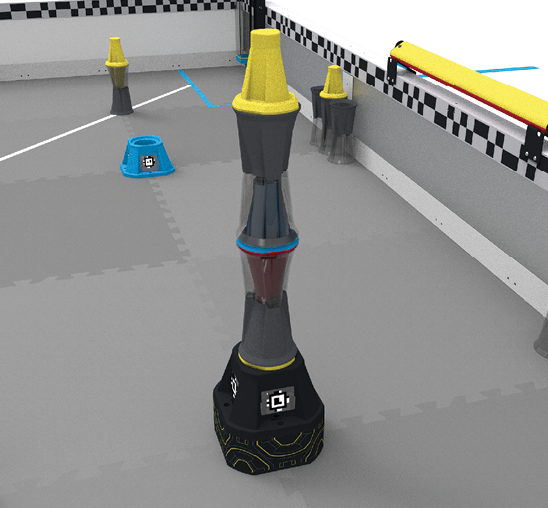
Figure SC2-1: The Scoring Objects stacked in the Goal all count as Placed, as they are all at least partially nested with the Goal and/or other Placed Scoring Objects.
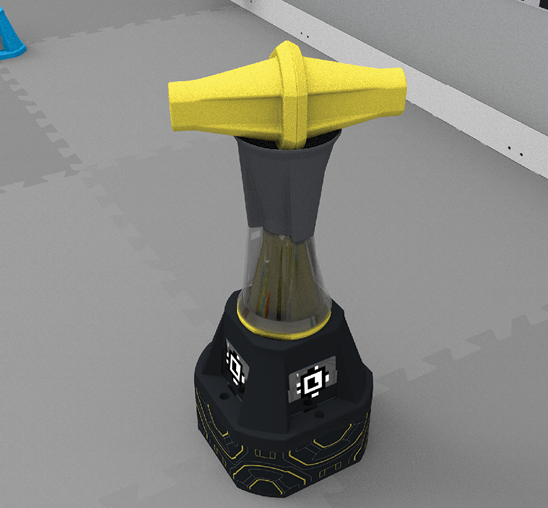
Figure SC2-2: The Pin resting on top is partially nested with the Cup, but the Pin is not considered Placed since that half of the Cup contains more than one Pin Half.
Removed: Version 1.0 (Old)
<SC3> Each Pin consists of two halves. Each Placed Pin can have zero, one or two Scored halves. To count as Scored for the corresponding Alliance, the half of the Placed Pin must remain fully visible (i.e., cannot be partially or fully nested inside the opaque half of a Cup).
- Each visible red half of a Placed Pin counts as a Scored red Pin, earning points for the red Alliance.
- Each visible blue half of a Placed Pin counts as a Scored blue Pin, earning points for the blue Alliance.
- Each visible yellow half of a Placed and Owned Pin counts as a Scored yellow Pin, earning points for the Alliance that Owns the Pin. (See <SC5>.)
Added: Version 2.1 (New)
<SC3> Each Pin consists of two Pin Halves. Each visible half of a Placed Pin is Scored and earns points according to its color:
- Scored red Pin Halves earn points for the red Alliance.
- Scored blue Pin Halves earn points for the blue Alliance.
- Scored yellow Pin Halves earn points for the Alliance that Owns them. (Yellow Pin Halves must be Owned to be considered Scored. See SC5.)
A Pin Half is considered visible unless it is partially or fully nested inside a Goal or the opaque half of a Cup.
<SC4> A Toggle is considered set to a color when it meets all of the following criteria:
- The Toggle must be fully seated, such that there is a face of the Toggle in contact and parallel with its mounts on the Field Perimeter at rest. (see Figure SC5-1)
- The Toggle is not in contact with a Robot from either Alliance.
Removed: Version 1.0 (Old)
If a Toggle is not considered set to a color, it is considered a neutral (yellow) Toggle by default, and neither Alliance receives Ownership of the yellow Pins Placed in that Quadrant. While the Toggle has infinite potential orientations, only three discrete orientations are considered “set” states.
<SC5> Yellow Pin Ownership. Each Placed Pin with one or more yellow halves can be Owned by an Alliance.
- A yellow Pin Placed in a Quadrant is Owned by an Alliance if the Toggle in that Quadrant is set to the Alliance’s color. If the Toggle is set to yellow, Placed yellow Pins in that Quadrant are not Owned and do not score points. (See SC3.)
- A yellow Pin Placed in the Midfield is Owned by the Alliance that ends the Match with a greater number of Robots in the Midfield. (See SC6.)
Added: Version 2.1 (New)
If a Toggle is not considered set to a color, it is considered a neutral (yellow) Toggle by default, and neither Alliance receives Ownership of the yellow Pin Halves in that Quadrant. While the Toggle has infinite potential orientations, only three discrete orientations are considered “set” states.
<SC5> Ownership of Yellow Pin Halves. Each yellow half of a Placed Pin can be Owned by an Alliance under the following conditions:
- For Pins Placed in a Quadrant Goal, the yellow Pin Halves are Owned by an Alliance if the Toggle in that Quadrant is set to the Alliance’s color. If the Toggle in that Quadrant is set to yellow, the yellow Pin Halves are not Owned and do not score points. (See SC3.)
- For Pins Placed in the Midfield Goal, the yellow Pin Halves are Owned by the Alliance that ends the Match with a greater number of Robots in the Midfield. (See SC6).
Removed: Version 1.0 (Old)
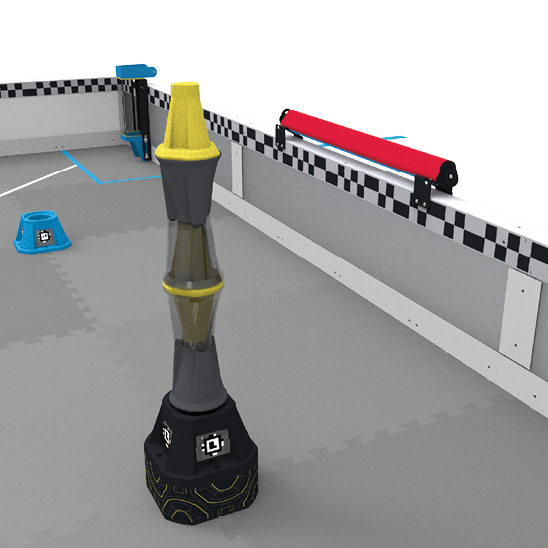
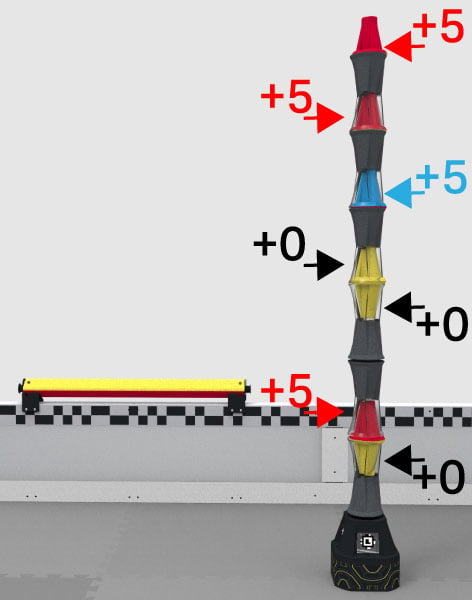
Figure SC5-1: This Quadrant’s Toggle is set to red, so yellow Pins Placed in this Quadrant’s Goals are Owned by the red Alliance.
Added: Version 2.1 (New)
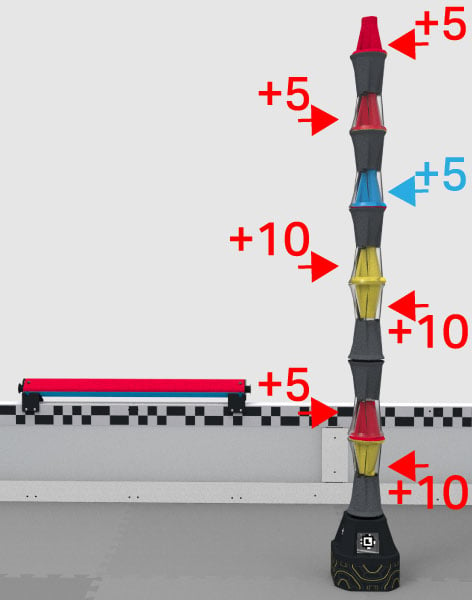
Figure SC5-1: This Quadrant’s Toggle is set to red, so these yellow Pin Halves are Owned by the red Alliance.
Removed: Version 1.0 (Old)
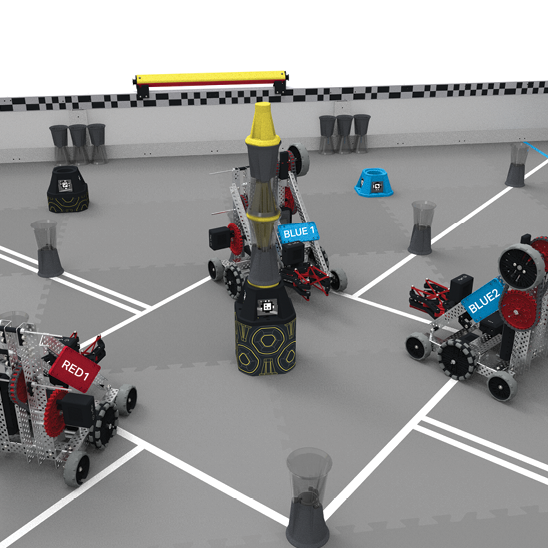
Figure SC5-2: The blue Alliance has more Robots in the Midfield at the end of the Match, so yellow Pins Placed in the Midfield Goal are Owned by the blue Alliance.
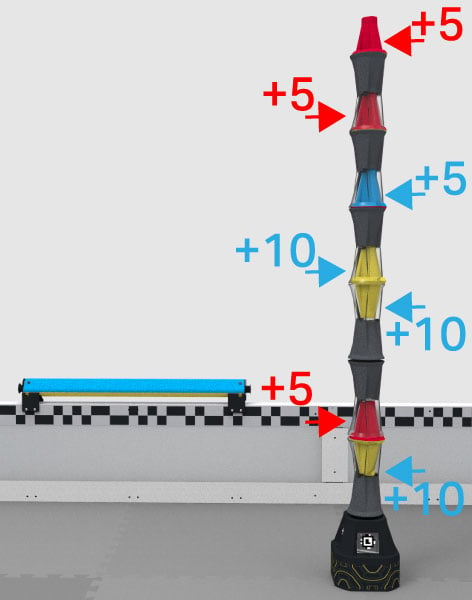
| A stack of pins and cups on the field. Behind the stack is a toggle set to yellow. Each pin has a point value listed on the image that is color coded to the alliance. From top to bottom those points are, red plus 5, red plus 5, blue plus 5, plus 0, plus 0, red plus 5, plus 0. | A stack of pins and cups on the field. Behind the stack is a toggle set to blue. Each pin has a point value listed on the image that is color coded to the alliance. From top to bottom those points are, red plus 5, red plus 5, blue plus 5, blue plus 10, blue plus 10, red plus 5, blue plus 10. | A stack of pins and cups on the field. Behind the stack is a toggle set to red. Each pin has a point value listed on the image that is color coded to the alliance. From top to bottom those points are, red plus 5, red plus 5, blue plus 5, red plus 10, red plus 10, red plus 5, red plus 10. |
|---|
Added: Version 2.1 (New)
Figure SC5-2: The blue Alliance has more Robots in the Midfield at the end of the Match, so these yellow Pin Halves are Owned by the blue Alliance.
 |
 |
 |
|---|
Removed: Version 1.0 (Old)
| A stack of pins and cups on the field. Behind the stack is a toggle set to yellow. Each pin has a point value listed on the image that is color coded to the alliance. From top to bottom those points are, red plus 5, red plus 5, blue plus 5, plus 0, plus 0, red plus 5, plus 0. | A stack of pins and cups on the field. Behind the stack is a toggle set to blue. Each pin has a point value listed on the image that is color coded to the alliance. From top to bottom those points are, red plus 5, red plus 5, blue plus 5, blue plus 10, blue plus 10, red plus 5, blue plus 10. | A stack of pins and cups on the field. Behind the stack is a toggle set to red. Each pin has a point value listed on the image that is color coded to the alliance. From top to bottom those points are, red plus 5, red plus 5, blue plus 5, red plus 10, red plus 10, red plus 5, red plus 10. |
|---|---|---|
| Red Pins: 15 points | Red Pins: 15 Points | Red Pins: 15 Points |
| Blue Pins: 5 Points | Blue Pins: 5 Points | Blue Pins: 5 Points |
| Yellow Pins: 0 Points | Yellow Pins: 30 Points (Scored for Blue) | Yellow Pins: 30 Points (Scored for Red) |
Added: Version 2.1 (New)
|
|
|
|---|---|---|
| Red Pin Halves: 15 points | Red Pin Halves: 15 Points | Red Pin Halves: 15 Points |
| Blue Pin Halves: 5 Points | Blue Pin Halves: 5 Points | Blue Pin Halves: 5 Points |
| Yellow Pin Halves: 0 Points | Yellow Pin Halves: 30 Points (Scored for Blue) | Yellow Pin Halves: 30 Points (Scored for Red) |
| Total Red : 15 Points / Blue : 5 Points | Total Red : 15 Points / Blue : 35 Points | Total Red : 45 Points / Blue : 5 Points |
Removed: Version 1.0 (Old)
<SC6> A Robot counts as being in the Midfield if any part of the Robot is within the infinite 3D vertical projection of the Midfield at the end of the Match.
Added: Version 2.1 (New)
<SC6> A Robot counts as ending in the Midfield if the Robot is at least partially within the Midfield at the end of the Match (i.e., any part of the Robot extends into the defined volume of the Midfield).
<SC7> Scoring of the Autonomous Bonus is evaluated immediately after the Autonomous Period ends.
Removed: Version 1.0 (Old)
- Points for ending the Autonomous Period in the Midfield are not included in the calculation of an Alliance’s score for the purposes of determining the Autonomous Bonus.
Added: Version 2.1 (New)
- If the Autonomous Period ends in a tie, including a zero-to-zero tie, each Alliance will receive an Autonomous Bonus of six (6) points.
- Any Violations, Major or Minor, committed during the Autonomous Period will result in the Autonomous Bonus being automatically awarded to the opposing Alliance. See GG13.
- Per rule GG13, if both Alliances commit Violations during the Autonomous Period, then no Autonomous Bonus will be awarded.
This rule is applied differently for VEX U. See Rule VUG5.
Added: Version 2.1 (New)
This rule is applied differently for the VEX AI Robotics Competition. See Rule VAISC1.
<SC8> An Autonomous Win Point is awarded to any Alliance that ends the Autonomous Period with all of the following tasks completed, and that has committed no Violations during the Autonomous Period :
Removed: Version 1.0 (Old)
- At least seven (7) Pins Scored for your Alliance. (Does not include Pins Scored in Quadrants on the opposing side of the Autonomous Line )
- At least three (3) Goals each contain at least two (2) Pins Scored for your Alliance. (Does not include Goals in Quadrants on the opposing side of the Autonomous Line )
- Neither Robot is contacting the Field Perimeter
Added: Version 2.1 (New)
- At least six (6) Pin Halves Scored for your Alliance. (Does not include Pin Halves Scored in Quadrants on the opposing side of the Autonomous Line )
- At least two (2) Goals each contain at least two (2) Pin Halves Scored for your Alliance. (Does not include Goals in Quadrants on the opposing side of the Autonomous Line.)
- Neither Robot is contacting the Field Perimeter.
For events which qualify directly to the VEX Robotics World Championship (such as Event Region Championships and Signature Events), the following tasks must be completed for an Alliance to receive an Autonomous Win Point. The standard criteria above still apply to all other events.
- At least seven (7) Pin Halves Scored for your Alliance. (Does not include Pin Halves Scored in Quadrants on the opposing side of the Autonomous Line )
- At least three (3) Goals each contain at least two (2) Pin Halves Scored for your Alliance. (Does not include Goals in Quadrants on the opposing side of the Autonomous Line )
- Neither Robot is contacting the Field Perimeter.
This rule is applied differently for VEX U. See Rule VUG6.
This rule is applied differently for the VEX AI Robotics Competition. See Rule VAISC2.
Specific Game Rules
Section titled “Specific Game Rules”<SG1> Starting a Match. Prior to the start of each Match, each Robot must be placed such that it meets all of the following criteria:
- No larger than 18” (457.2 mm) long by 18” (457.2 mm) wide by 18” (457.2 mm) tall.
- Not contacting any Scoring Objects other than a maximum of one (1) Preload. See rule SG5.
- Not contacting Goals, Loaders, Load Zones, or Toggles.
- Not contacting any other Robots, and not sharing a Quadrant with another Robot.
- Completely stationary (i.e., no motors or other mechanisms in motion).
- Contacting the Field tiles and Field Perimeter on their Alliance’s side of the Autonomous Line.
Note: Using external influences, such as Preloads or the Field Perimeter, to maintain a Robot’s starting size is only acceptable if the Robot would still satisfy the constraints of R3 and pass inspection without these influences.
Removed: Version 1.0 (Old)
Added: Version 2.1 (New)
Violation Notes:
- The Match will not begin with any conditions in this rule unmet. If a Robot cannot meet these conditions in a timely manner, the Robot will be removed from the Field and rules <R2d> and GG2 will apply until the situation is corrected. They will not receive a Disqualification, but should receive a Minor Violation and will not be permitted to play in the Match.
Added: Version 2.1 (New)
This rule is applied differently for the VEX AI Robotics Competition. See Rule VAIG4.
<SG2> Horizontal expansion is limited. Once the Match begins, Robots may expand horizontally beyond the starting size limit within the following criteria:
Removed: Version 1.0 (Old)
Added: Version 2.1 (New)
Violation Notes:
- Incidental/insignificant infractions that occur during a Match are only considered Minor Violations. Repeated Minor Violations should only escalate to a Major Violation in extreme circumstances. Examples of Minor Violations include, but are not limited to:
- Loose wires
- Broken zip ties / rubber bands
- Bent or broken mechanical components that are not used for strategic gain
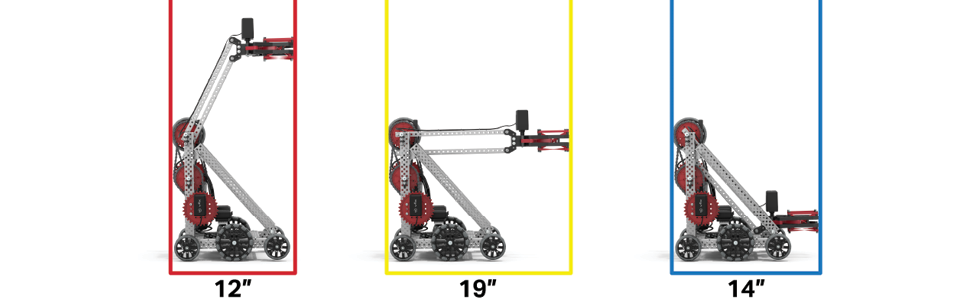
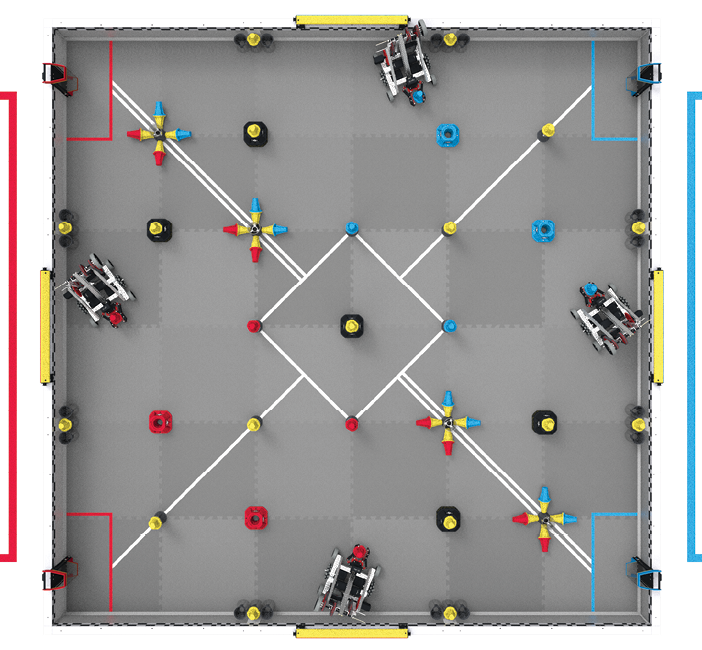
Figure SG-2: A demonstration of how the size of the Robot may change horizontally through the course of a vertical expansion.
Removed: Version 1.0 (Old)
<SG3> Vertical expansion is limited. Once the Match begins, Robots may expand vertically beyond the starting size limit, but no part of the Robot may exceed an overall height of 50” at any point during the Match (must always be able to fit within a hypothetical 50” vertical sizing box). For exceptions to this rule involving Robots in the Midfield during the Endgame period, see SG12.
Added: Version 2.1 (New)
<SG3> Vertical expansion is limited. Once the Match begins, Robots may expand vertically beyond the starting size limit, but no part of the Robot may exceed an overall height of 50” at any point during the Match (must always be able to fit within a hypothetical 50” vertical sizing box).
<SG4> Keep Scoring Objects in the Field. Teams may not intentionally remove Scoring Objects from the Field. A Scoring Object that leaves the Field during Match play will be returned to the Field in a location near where it left, in contact with the Field tiles and the Field Perimeter but no other Field Elements or Scoring Objects and no Robots. Volunteers should return Scoring Objects to the Field as quickly as possible, and any delay in returning a Scoring Object should not be considered Match Affecting or cause for a replay.
- A Scoring Object that comes to rest on top of the Field Perimeter is considered to have left the Field.
Removed: Version 1.0 (Old)
Added: Version 2.1 (New)
Violation Notes:
- Due to the difficulty of determining Match Affecting implications of this rule, most Violations should be considered Minor. However, blatantly intentional and/or Match Affecting Violations may still immediately escalate to a Major Violation at the Head Referee’s discretion.
<SG5> Each Robot gets one Pin as a Preload. Red Alliance Preloads are red/yellow Pins ; blue Alliance Preloads are blue/yellow Pins. Prior to the start of each Match, each Preload must be placed such that it meets all of the following criteria:
- Contacting one Robot of the same Alliance color as the Preload.
- Not contacting the same Preload as another Robot.
- Not contacting other Scoring Objects.
- Not contacting any other Goals, Loaders, Load Zones, or Toggles.
Note: If a Robot is not present for their Match, then that Robot’s Preload may be used as a Match Load in accordance with SG11.
Removed: Version 1.0 (Old)
<SG6> Possession is limited to a maximum of one Pin and one Cup. Robots may not have Possession of more than one (1) Pin at once. Robots may not have Possession of more than (1) Cup at once. Robots in Violation of this rule must immediately stop all actions except for attempting to remove the excess Scoring Objects.
If they are unable to remove the excess Scoring Objects, then they must return to a legal starting position (as described by SG1 ). They will not be eligible to receive points for ending the Match in the Midfield, and cannot interact with Toggles, Goals, or other Scoring Objects while in Possession of excess Scoring Objects.
Removed: Version 1.0 (Old)
- Plowing multiple Scoring Objects is permitted. Teams which employ Plowing strategies are encouraged to clearly demonstrate that none of the Scoring Objects are being Possessed, e.g., by using a flat face of the Robot with no active mechanisms.
<SG7> Don’t cross the Autonomous Line, and don’t interfere with your opponents’ actions. During the Autonomous Period, Robots may not contact foam tiles, Scoring Objects, or Field Elements which are on the opposing Alliance’s side of the Autonomous Line.
-
The Autonomous Period should be primarily Offensive, with Teams focusing on scoring and executing strategic maneuvers rather than Defensive disruption. Teams should avoid actions that are primarily Defensive in nature, including but not limited to:
- Intentionally disrupting Scoring Objects or Field Elements on the opponent’s side of the Autonomous Line.
- Deliberately contacting an opponent’s Robot to interfere with their autonomous path.
Removed: Version 1.0 (Old)
- Scoring Objects that begin the Match in contact with the Autonomous Line are not considered to be on either side, and may be utilized by either Alliance during the Autonomous Period. For the purpose of this rule, all 20 Scoring Objects that begin the Match on or at the Autonomous Line are considered to be in contact with the Autonomous Line. See Figure SG-7.
Added: Version 2.1 (New)
-
Scoring Objects that begin the Match on the Autonomous Line are not considered to be on either side, and may be utilized by either Alliance during the Autonomous Period.
Note: All 28 Scoring Objects that begin the Match above or in contact with the Autonomous Line are considered to be on the Autonomous Line. See Figure SG-7.
-
While incidental contact or unintentional interactions may occur with Robots on the other side of the Autonomous Line, Teams that employ deliberate Defensive autonomous strategies that impact their opponents’ autonomous routines may be subject to Minor or Major Violations at the discretion of the Head Referee.
Removed: Version 1.0 (Old)
- Teams cannot intentionally place Scoring Objects on the opponent’s side of the Autonomous Line.
Added: Version 2.1 (New)
-
Teams cannot intentionally move Scoring Objects to the opposing Alliance’s side of the Autonomous Line.
-
Contact with either of the following during the Autonomous Period will result in the Autonomous Bonus and an Autonomous Win Point being awarded to the opposing Alliance, unless the opposing Alliance also breaks rules in the Autonomous Period :
Removed: Version 1.0 (Old)
- An opponent Robot that isn’t interacting with the Autonomous Line, objects that begin the Match positioned above or in contact with the Autonomous Line, or the Midfield (see SG8 ).
Added: Version 2.1 (New)
- An opposing Robot that isn’t interacting with (1) the Autonomous Line, (2) objects that begin the Match on the Autonomous Line, or (3) the Midfield. (See SG8.)
- Scoring Objects on the other side of the Autonomous Line.
Removed: Version 1.0 (Old)
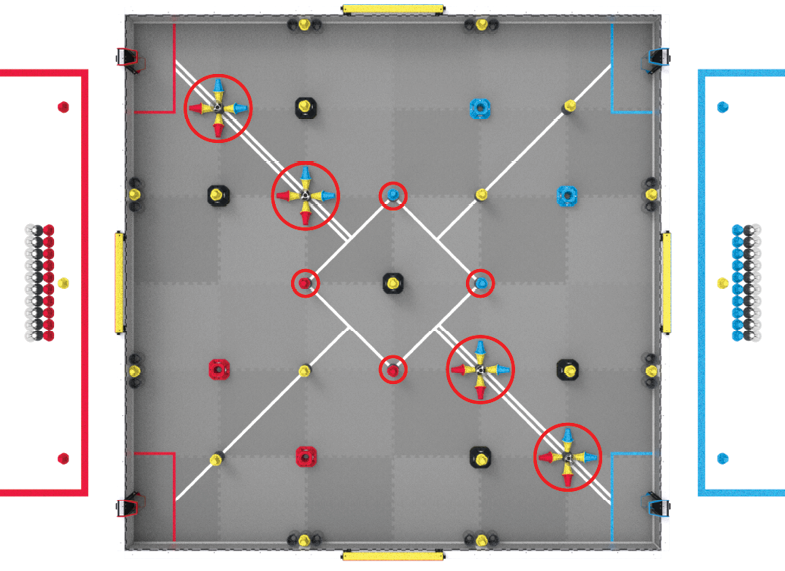
Figure SG-7: These Scoring Objects (circled in red) would be considered to be on the Autonomous Line.
Added: Version 2.1 (New)
Violation Notes:
- All Violations of this rule (Major or Minor) will result in the Autonomous Bonus being awarded to the opposing Alliance. See <SG8b> for a potential exception caused by Autonomous Line interactions.
- Intentional, strategic, or egregious Violations, such as intentional contact with an opposing Robot while contacting the foam tiles on the opposing side of the Autonomous Line, or the interactions described in <SG7e> will be considered Major Violations and should result in a Disqualification for the Match.
- Deliberate Defensive Autonomous strategies, as described in <SG7a>, may also be recorded as G1 Violations at the Head Referee’s discretion.
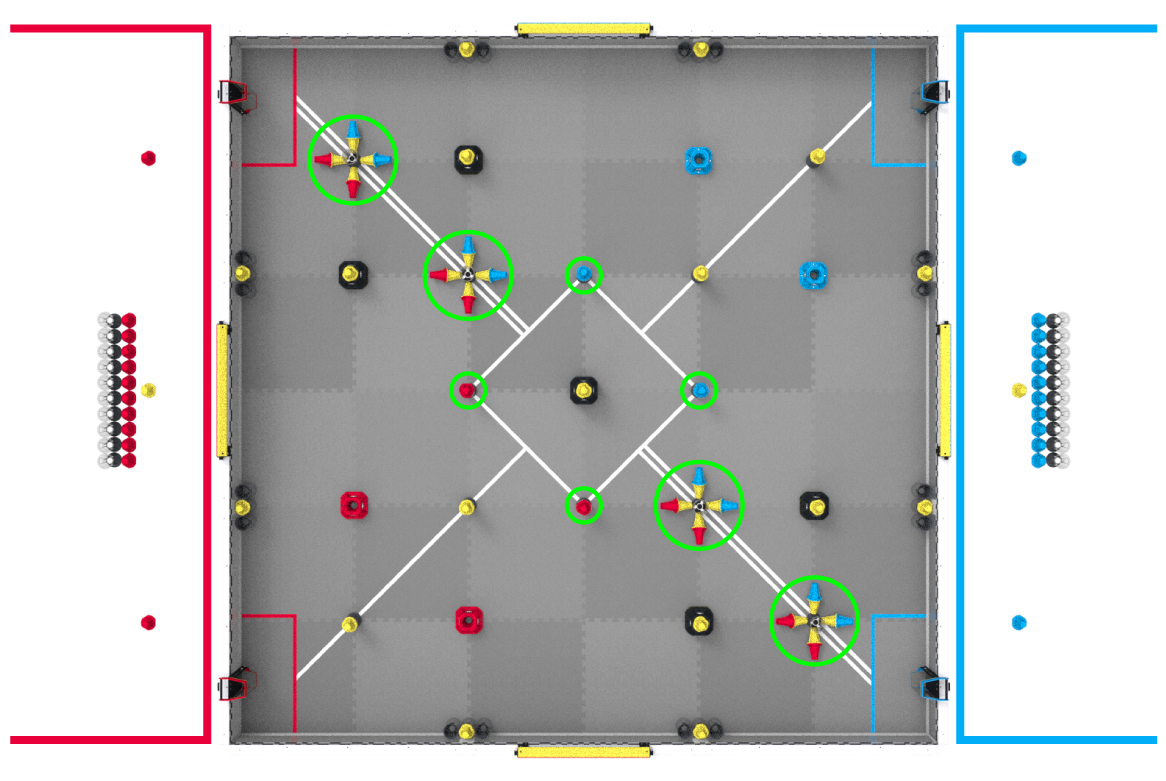
Figure SG-7: These Scoring Objects (circled in green) would be considered to be on the Autonomous Line.
<SG8> Engage with the Midfield and/or Autonomous Line during the Autonomous Period at your own risk. Any Robot that engages with the Midfield and/or Scoring Objects that begin the Match on the Autonomous Line should be aware that opponent Robots may also choose to do the same. Per GG12 and GG13, Teams are responsible for the actions of their Robots at all times.
- For the purposes of this rule, “engages with” means any combination of:
- Contacting foam tiles within the Midfield
- Contacting the Goal in the Midfield
- Contacting Scoring Objects that begin the Match on the Autonomous Line
Removed: Version 1.0 (Old)
- If opposing Robots contact one another while both engaging with the Midfield or the Autonomous Line, and a possible GG14 Violation occurs (e.g., damage, Entanglement, or tipping over), a judgment call will be made by the Head Referee within the context of GG14 and GG15 (just as it would if the interaction had occurred during the Driver Controlled Period ).
- If opposing Robots contact one another while both engaging with the Midfield or Autonomous Line, and an incidental Violation of SG4 occurs, no penalty will be assessed on either Alliance.
- Intentional, strategic, repeated, or egregious offenses, such as negatively impacting Robots that are not engaging with the Midfield or the Autonomous Line, may still be deemed a Violation of GG13, GG14, GG15, SG7, G1, and/or S1 at the Head Referee’s discretion.
<SG9> Alliance Goals are protected. Robots may not directly or indirectly interact with opposing Alliance-colored Goals. Examples of interactions include, but are not limited to:
Removed: Version 1.0 (Old)
- Making contact with the Goal
- Making contact with Scoring Objects stacked on the Goal
- Adding or removing Scoring Objects (Placed or otherwise)
- Strategically covering the Goal in a manner that prevents additional Scoring Objects from being Placed
<SG10> Placed Scoring Objects cannot be removed from neutral Goals.
<SG11> Match Loads may be introduced during the Match under certain conditions. For the purpose of this rule, “introduce” refers to the moment when a Drive Team Member has released a Scoring Object into a Loader.
During this action, a Drive Team Member’s hands may temporarily break the plane of the Field Perimeter. This momentary interaction is an exception to rule GG4. Excessive, unnecessary, or unsafe actions while introducing a Match Load may be considered a Violation of S1 and/or G1 at the Head Referee’s discretion.
Drive Team Members may introduce Match Load Scoring Objects by placing a single Pin, a single Cup, or a nested Cup and Pin into either of their Alliance-colored Loaders. Scoring Objects can be introduced through the top of the Loader when the Loader is not lifted, or through the back of the Loader when the Loader is raised by a Drive Team Member.
- Scoring Objects may only be introduced into Loaders during the Driver Controlled Period of the Match.
- A Match Load Scoring Object may not be contacted by a Robot prior to being introduced into a Loader.
- Match Load Scoring Objects may only be removed through the bottom opening of the Loader, by a Robot whose Alliance color matches the Loader.
Added: Version 2.1 (New)
- Making contact with the Goal or with Scoring Objects stacked on the Goal. (Direct)
- Adding or removing Placed Scoring Objects. (Direct)
- Strategically covering the Goal in a manner that prevents additional Scoring Objects from being Placed. (Indirect)
- Pushing an opposing Robot into Scoring Objects stacked in their own Alliance-colored Goal, knocking some or all of them out of the Goal. (Indirect)
Violation Notes:
- Incidental interactions, such as unintentional/inconsequential contact with the Goal and/or Scoring Objects stacked on the Goal, should typically be considered Minor Violations.
- Intentional, strategic, or egregious interactions, as well as any interactions involving the addition or removal of Placed Scoring Objects on the Goal, will be considered Major Violations.
- Repeated Minor Violations can escalate to a Major Violation at the Head Referee’s discretion, especially in cases where Violations occur after multiple prior warnings.
Significant Q&As:
- Q&A 3249 - Robots are allowed to remove Placed Scoring Objects from their own Alliance-colored Goals
<SG10> Placed Scoring Objects may not be removed from neutral Goals via direct or indirect interactions. Examples of interactions include, but are not limited to:
- Grabbing and lifting a Scoring Object out of the Goal. (Direct)
- Contacting Scoring Objects stacked in the Goal, knocking some or all of them out of the Goal. (Direct)
- Pushing an opposing Robot into Scoring Objects stacked in the Goal, knocking some or all of them out of the Goal. (Indirect)
Violation Notes:
-
For the purposes of Match Affecting calculations, the removal of Placed Scoring Objects from neutral Goals should be evaluated as follows:
- For an interaction resulting in the removal of 1, 2, or 3 Pins, each Pin removed as part of this interaction should be considered worth a value of 10 points.
- For an interaction resulting in the removal of 4+ Pins, the Pins removed as part of this interaction should be considered worth a combined value of 50 points. The value of removed Pins is determined for each independent interaction/Violation. When multiple Violations occur, the point values attributed to each Violation may stack and can cumulatively become Match Affecting.
If subtracting these point values from the offending Alliance’s final score would change the outcome of the Match, then the Violation(s) should be considered Match Affecting. (These point values are not actually subtracted from the final scores of either Alliance; this is merely a check made by the Head Referee.) These calculations should be taken into account simultaneously for both Alliances, prior to determining whether any Violation affected the outcome of the Match in favor of one Alliance or the other.
Note: Head Referees cannot be expected to track the number of Pins Placed in each Goal throughout a Match, and when Pins get removed from Goals, they cannot be expected to have a 100% accurate count of the Pins that were previously Placed in that Goal. For each interaction involving removed Pins, Head Referees can only be asked to make their best educated guess as to how many Pins were removed, and Teams must accept Head Referee counts, even if not perfectly accurate. (Accurately counting 1, 2, or 3 Pins is difficult. Counting beyond 3 becomes even less reliable, which is why a fixed point value applies to interactions resulting in the removal of 4+ Pins.)
-
Intentional, strategic, or egregious Violations will be considered Major Violations.
-
Repeated Minor Violations can escalate to a Major Violation at the Head Referee’s discretion, especially in cases where Violations occur after multiple prior warnings.
Significant Q&As:
- Q&A 3232 - Removal of Placed Pins Scored for your Alliance is still an SG10 Violation
- Q&A 3233 - Match Affecting calculations when both Alliances commit Violations
- Q&A 3244 - Violation stacking for Qualification and Elimination Matches
- Q&A 3250 - Failed attempt to Place Scoring Objects on Goal (removal of momentarily Placed Scoring Objects) is not an SG10 Violation
<SG11> Drive Team Members may only introduce Match Loads to the Field through Loaders, under the following conditions:
- Drive Team Members may introduce Match Loads through their Alliance-colored Loaders, and may operate (raise/lower) those Loaders, only during the Driver Controlled Period of the Match.
- Match Loads may only be introduced by placing or dropping them through the top or back of a Loader, either separately or nested together.
- Match Loads may have momentary, simultaneous contact with both a Drive Team Member and a Robot as the Match Load is introduced, prior to being released by the Drive Team Member. Once a Match Load has been released, it may no longer be contacted by a Drive Team Member.
- Match Loads may only be removed through the bottom opening of the Loader, and only by Robots.
When introducing Match Loads to the Field through Loaders, Drive Team Members should never extend any part of their body beyond the bottom edge of the Loader plastic. Drive Team Members must also be careful not to lift and pull on the Field Perimeter while lifting the Loader. Excessive, unnecessary, or unsafe actions while introducing a Match Load may be considered a Violation of S1 and/or G1 at the Head Referee’s discretion.
This rule is applied differently for VEX U. See Rule VUG4.
Removed: Version 1.0 (Old)
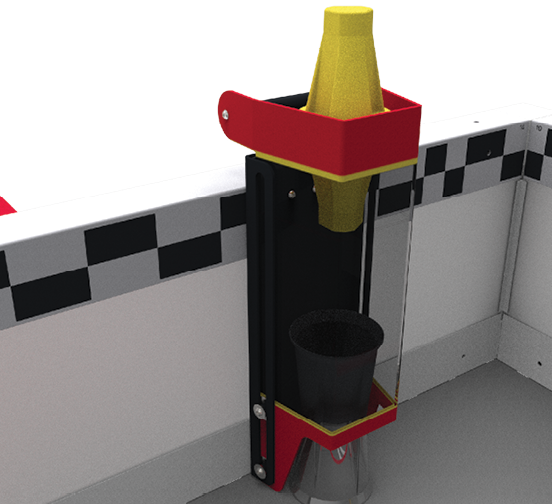
Figure SG11-1: Scoring Objects can be introduced through the top opening of the Loader.
Removed: Version 1.0 (Old)
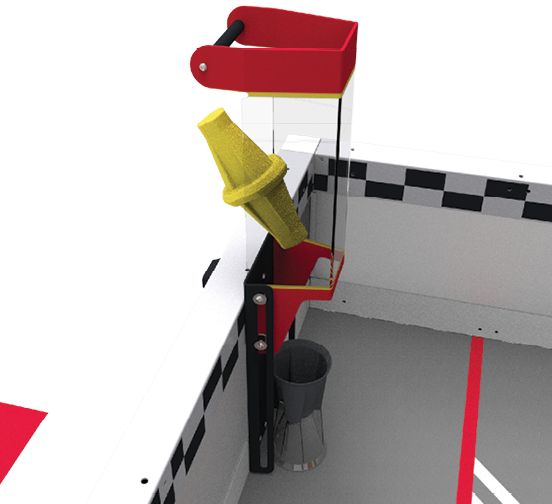
Added: Version 2.1 (New)
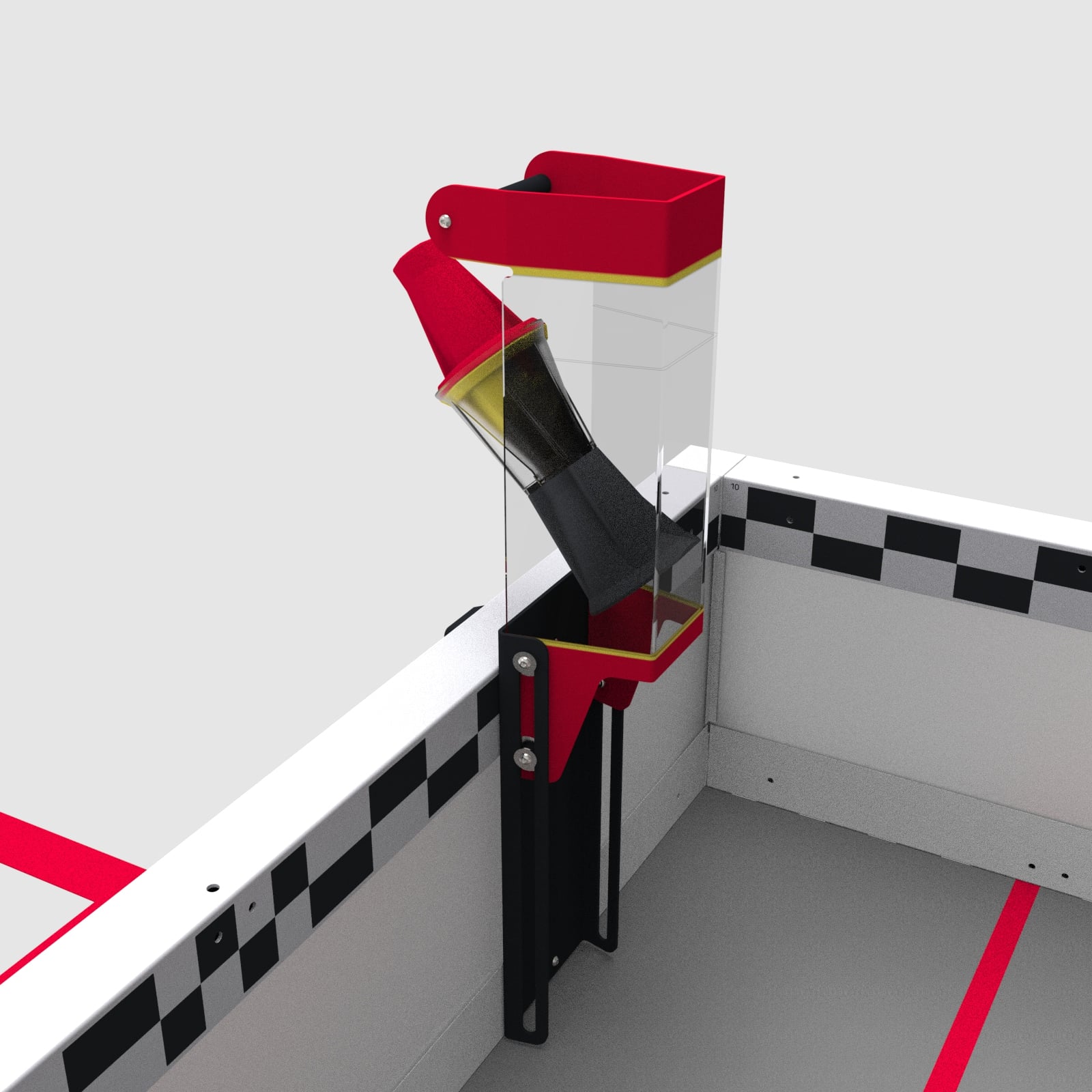
Figure SG11-2: Scoring Objects may also be introduced through the back of the Loader while it is raised.
<SG12> Some rules change during the Endgame period.
Removed: Version 1.0 (Old)
- Robots that are partially or entirely within the infinite 3D vertical projection of the Midfield must make an effort to limit vertical expansion to the approximate starting height of the Robot. If a Head Referee sees a Robot within the Midfield that is clearly expanded past its approximate starting height, that Robot should receive a verbal warning and must either return to approximate starting height or exit the Midfield.
- A Robot should receive a Violation if it takes no action to either return to approximate starting height or exit the Midfield after a brief period of time. The length of this period of time is subject to Head Referee judgement within the context of the Match and the warned Robot’s actions (or lack thereof).
- Robots that attempt to end the Match in the Midfield should expect vigorous interactions from opposing Robots. When a Robot is contacting or engaging with the Midfield, or is in proximity to the Midfield, incidental damage that is caused by opposing Robots pushing, tipping, or becoming Entangled with them would not be considered a Violation of GG14. Intentional damage or dangerous mechanisms may still be considered a Violation of S1 or G1 at the Head Referee’s discretion.
The intent behind the Endgame vertical expansion limit is to reduce the likelihood of tipped Robots due to expected Endgame interactions. Vigorous interactions involving taller Robots are much more likely to result in tipping compared to those involving shorter Robots.
Enforcement of this rule should focus on vertically expanded Robot lifts, rather than small pop-up mechanisms that are typically set to expand at the start of the Match.
Added: Version 2.1 (New)
- Robots may not Place Scoring Objects on the Midfield Goal during the Endgame period.
- Robots that attempt to end the Match in the Midfield should expect vigorous interactions from opposing Robots, and must accept increased risk of becoming Entangled or being tipped, especially when vertically expanded. When a Robot is contacting or engaging with the Midfield, or is in proximity to the Midfield, incidental damage that is caused by opposing Robots pushing, tipping, or becoming Entangled with them would not be considered a Violation of GG14. Intentional damage or dangerous mechanisms may still be considered a Violation of S1 or G1 at the Head Referee’s discretion.
Violation Notes:
- Most Violations of this rule should be considered Minor Violations. However, repeated Minor Violations can escalate to a Major Violation at the Head Referee’s discretion, especially in cases where Violations occur after multiple prior warnings.
- Violations involving Scoring Objects Placed on the Midfield Goal that change the outcome of the Match in favor of the offending Robot’s Alliance will be considered Match Affecting Violations.
<SG13> Load Zones are protected during the Driver Controlled Period of the Match.
- A Robot is protected while it is at least partially within one of its Alliance Load Zones. Robots may not directly or indirectly contact a protected opposing Alliance Robot.
- Robots may only enter an opposing Alliance Load Zone momentarily (e.g., while passing through or to retrieve a Scoring Object); Robots may not remain within an opposing Alliance Load Zone.
- Robots may not cause Scoring Objects to accumulate within an opposing Alliance Load Zone.
Added: Version 2.1 (New)
- Robots may not add Scoring Objects to, or remove them from, opposing Alliance-colored Loaders.
The intent of this rule is to protect Load Zones from intentional interference by the opposing Alliance (i.e., obstructing the Load Zone in an effort to inhibit Loader access).
This rule does not apply during the Autonomous Period.
Removed: Version 1.0 (Old)
This rule is applied differently for VEXU. See Rule VUG7.
Added: Version 2.1 (New)
Violation Notes:
- Egregious Violations will be considered Major Violations.
- Repeated Minor Violations can escalate to a Major Violation at the Head Referee’s discretion, especially in cases where Violations occur after multiple prior warnings.
Safety Rules
Section titled “Safety Rules”<S1> Be safe out there. If at any time the Robot operation or Team actions are deemed unsafe or have damaged a Field Element, Scoring Object, or the Field, the offending Team may receive a Disablement and/or Disqualification at the discretion of the Head Referee. The Robot will require re-inspection as described in rule R2 before it may take the Field again.
<S2> Students must be accompanied by an Adult. Every Student at a VEX Robotics Competition event must be supervised by a responsible Adult. The Adult must obey all rules and be careful to not violate Student-centered policies, but must be present for the full duration of the event in the case of an emergency. Violations of this rule may result in removal from the event and additional penalties.
<S3> Each Student Team member must have a completed participant release form on file for the event and season. A Student Team member cannot participate in an event without a completed release form on file.
<S4> Stay inside the Field. If a Robot is completely outside of the Field during a Match, it will receive a Disablement for the remainder of the Match.
Note: The intent of this rule is not to penalize Robots for having mechanisms that inadvertently cross the Field Perimeter during normal game play.
<S5> Wear safety glasses. Drive Team Members must wear eye protection. All Drive Team Members must wear some form of eye protection while at the Field for Matches. Safety glasses or other eye wear with side shields and non-shattering lenses are recommended. While in the pit and queuing areas, it is highly recommended that all Team members wear eye protection.
General Rules
Section titled “General Rules”Removed: Version 1.0 (Old)
<G1> Treat everyone with respect. All Teams and other attendees are expected to conduct themselves in a respectful and professional manner while participating in or attending VEX V5 Robotics Competition events. If a Team or any of its members (Students or anyone else associated with the Team or its members) are disrespectful or uncivil to event staff, volunteers, or fellow competitors, they may be Disqualified from a current or upcoming Match. Team conduct pertaining to G1 may also impact a Team’s eligibility for judged awards. Repeated or extreme Violations of G1 could result in a Team being Disqualified from an entire event, depending on the severity of the situation.
- Event attendees are not allowed to record audio or video of Teams’ discussions with Head Referees or other event staff/volunteers.
<G2> VEX V5 is a Student-centered program. Adults should not make decisions about the Team’s /Robot’s build, design, coding, documentation, or gameplay, and should not provide an unfair advantage by providing ‘help’ that is beyond the Students’ independent abilities. Students must be prepared to demonstrate an active understanding of their design, Robot construction, programming, notebook, and strategies to judges or event staff. Students should build, design, and code the Robot with minimal Adult involvement. If a Team has an engineering notebook, the format, layout, and contents should be created and maintained by Students with minimal Adult involvement; Adults should not transcribe or type notebook entries or code for Students.
Some amount of Adult mentorship, teaching, and/or guidance is an expected and encouraged facet of VEX competitions. No one is born an expert in robotics! However, obstacles should always be viewed as teaching opportunities, not problems for an Adult to solve for the Team.
Added: Version 2.1 (New)
<G1> Participants must follow the Code of Conduct. All event attendees must abide by the guidelines set forth in the Code of Conduct.
Violation Notes:
- Any Violation of G1 may be considered a Major Violation and should be addressed on a case-by-case basis. Teams at risk of a G1 Major Violation due to multiple disrespectful or uncivil behaviors will usually receive a “final warning”, although the Head Referee is not required to provide one.
<G2> Participants must follow the Student Centered Policy. All event attendees must abide by the guidelines set forth in the Student Centered Policy.
Violation Notes:
- Potential Violations of this rule will be reviewed on a case-by-case basis. By definition, all Violations of this rule become Match Affecting as soon as a Robot which was built or programmed by an Adult scores points in a Match.
<G3> Use common sense. When reading and applying the various rules in this document, please remember that common sense always applies in the VEX V5 Robotics Competition.
Removed: Version 1.0 (Old)
<G4> All work must represent the skill level of the Students on the Team. All work must represent the skill level of the Students currently on the Team. Teachers, coaches, mentors, and peers can teach concepts, skills, and processes; demonstrate techniques; ask guiding questions; review/critique the Team’s work; and otherwise advise Team members. All final solutions used in competition (including the Team’s design, Robot, code, strategies, documentation, and ongoing work) must be the work of the Student Team members. Organizations should develop a plan that encourages and empowers Students to make their own decisions (see G2 ).
- Designs and code provided by VEX Robotics:
- Teams may use Robot plans and code (e.g., Hero Bots, VEXcode configurations, etc.) provided by VEX Robotics, but are encouraged to use these Robots, mechanisms, and code only as a starting point that Students modify, improve, or replace as their skills increase.
- Plans provided by VEX Robotics are the only legal plans available for use in competition.
- Robot design and construction:
- Teams must avoid academic dishonesty and should not directly copy a Robot or mechanism other than those included in clause A. This includes, but is not limited to, the use of instructions, pictures, videos, notebooks, CAD designs, and/or any other documentation useful to the design process.
- Teams may be inspired by designs created by other Teams, and can use an idea from someone else to spark innovation, but are expected to clearly document and give credit to all ideas that are used for inspiration. The Team must describe how they made meaningful changes to the original idea to arrive at a design that is uniquely their own. It should be clear that this final implementation is not an exact copy of ANY other original design.
- Teams should demonstrate their design process in their engineering notebook, and provide it if asked to do so by event staff. Failure to demonstrate evidence of iteration, innovation, and/or modification will result in a Violation.
- Teams may only use custom parts (e.g., cut/shaped non-shattering plastic, or heavily modified legal VEX components) that were designed and created by the Students on that Team.
- Robot code:
- Teams may use publicly available example code and/or custom libraries from outside sources. However, Student Team members must understand the resulting code, be able to explain all facets of their competition code, and be capable of independently creating code on a level equivalent to the code used on their Robot if asked to do so.
- Teams may not use Large Language Models, or similar forms of artificial intelligence (AI), to create or improve the code used in competition, as the resulting code does not reflect the skill level of the Students on the Team.
- Engineering notebook:
- The Team’s engineering notebook must be the work of the Students on the Team, and cannot be edited, formatted, or revised by anyone other than the Students on the Team.
- Teams may not use Large Language Models, or similar forms of AI, to create or improve the content of their engineering notebook.
- Teams can be inspired by engineering notebooks and formats from other Teams and/or seasons, but must ensure that all content is original and created by the members of the Team.
- Collaboration with other Teams :
- Teams can collaborate on game analysis, brainstorming, strategy, and other steps of the engineering design process, but the final solutions used/presented at competitions must be the independent work of the Students on each Team.
- Robots, code, and/or engineering notebooks that are identical or substantially similar to one another across Teams, whether they’re within the same school/organization/club or from separate organizations, are in Violation of this rule, regardless of whether they compete in the same or different events. Every Team is expected to put in the time, effort, and resources needed to undergo an independent design process and develop their own Robots and code.
<G5> Each Student can only belong to one Team. Each Team must include Drive Team Members, Coder (s), Designer (s), and Builder (s). Many also include Strategists and Notebooker (s). No Student may fulfill any of these roles for more than one VEX V5 Robotics Competition Team in a given competition season. Students may have more than one role on the Team (e.g., the Designer may also be the Builder, the Coder, and a Drive Team Member ).
- Team members may only move from one Team to another for non-strategic reasons outside of the Team’s control.
- Examples of permissible moves may include, but are not limited to, changing schools, conflicts within a Team, or combining/splitting Teams.
- Examples of strategic moves in Violation of this rule may include, but are not limited to, one Coder “switching” Teams in order to program multiple Robots, one Student designing multiple Teams’ Robots, or one Student writing the engineering notebook for multiple Teams.
- If a Student leaves a Team to join another Team, G4 still applies to the Students remaining on the previous Team. For example, if a Coder leaves a Team, then that Team’s Robot must still represent the skill level of the Team without that Coder. One way to accomplish this would be to ensure that the Coder teaches or trains a “replacement” Coder in their absence.
- Points ii and iii are intended to represent real-world situations that are found in industry engineering. If a vital member of a professional engineering team were to suddenly leave, the remaining members of the team should still be capable of working on / maintaining their project.
- When a Team qualifies for a Championship event (e.g., States, Nationals, Worlds, etc.) the Students on the Team attending the Championship event are expected to be the same Students on the Team that was awarded the spot. Students can be added as support to the Team, but may not be added as Builders, Drive Team Members, Coders, or Notebookers for the Team.
- An exception is allowed if only one (1) member of the Team is able to attend the event. The Team can make a single substitution of a Drive Team Member or Coder for the Championship event with another Student, even if that Student has competed on a different Team. This Student will now be a member of this new Team and may not substitute back to the original Team during the season.
Note: Teams cannot “borrow” Students from other Teams to serve as Drive Team Members, Coders, Designers, Builders, or Notebookers. However, Teams can add permanent members throughout the season under the guidelines of this rule.
<G6> There is a difference between accidentally and willfully violating a Robot rule. Any Violation of Robot rules, accidental or intentional, will result in a Team being unable to play until they pass inspection (per <R2d>).
Added: Version 2.1 (New)
<G4> Students must meet the Student Eligibility Policy requirements. All Student participants must fall within the eligibility requirements set forth in the Student Eligibility Policy for their respective program.
Violation Notes:
- Teams believed to be in Violation of this rule should be reported to the Judge Advisor, Head Referee, or Event Partner for further investigation in coordination with VEX Robotics. Based on the investigation the Team may be removed from further Matches, have their Robot Skills Match scores removed, and/or be removed from consideration from judged awards.
- Violations of this rule will be evaluated on a case-by-case basis, in tandem with VEX Robotics as noted in G1 and G2.
<G5> There is a difference between accidentally and willfully violating a Robot rule. Any Violation of Robot rules, accidental or intentional, will result in a Team being unable to play until they pass inspection (per <R2d>).
However, Teams who intentionally and/or knowingly circumvent or violate rules to gain an advantage over their fellow competitors are in Violation of the spirit and ethos of the competition.
Removed: Version 1.0 (Old)
Added: Version 2.1 (New)
Violation Notes:
- A Team that circumvents a Robot rule for a competitive advantage should receive an immediate Disqualification for the current Match.
General Game Rules
Section titled “General Game Rules”<GG1> Only Drive Team Members, and only in the Alliance Station. During a Match, Robots may be operated only by that Team’s Drive Team Members and/or by software running on the Robot’s control system in accordance with R9 and GG11. A Team may send up to (3) Drive Team Members to their Alliance Station for each Robot, and those Drive Team Members must remain in their Alliance Station for the duration of the Match.
Drive Team Members are the only Team members that are allowed to be in the Alliance Station during a Match. Adults (other than event staff) are not permitted to be in the Alliance Station during a Match.
- Drive Team Members are prohibited from any of the following actions during a Match :
- Using any sort of communication device in the Alliance Station. Non-headphone devices with communication features turned off (e.g., a phone in airplane mode, a walkie talkie turned off, smart glasses with communication features disabled) are allowed. Communication features can be enabled for translation apps during post-Match discussions.
- Standing or sitting on any sort of object during a Match, regardless of whether the Field is on the floor or elevated, except as required by an officially approved accommodation request.
- Bringing/using additional materials to simplify the game challenge during a Match (e.g., device to align or add Scoring Objects to a Loader.
- To ensure that Drive Team Members are aware of verbal calls during a Match (as an application of rules T1, G1, S1, and G3 ), powered headphones, earbuds, passive earpieces connected to electronic devices, or other personal accessories/devices that transmit audio cannot be worn/used in the Alliance Station except as required by an officially approved accommodation request.
- Individuals who are not Drive Team Members for a Match cannot provide directions, commands, or advice to the Drive Team Members during that Match. They’re welcome to provide cheerful, positive encouragement, but should not affect Match play or strategy.
Removed: Version 1.0 (Old)
Added: Version 2.1 (New)
- Major Violations of this rule are not required to be Match Affecting, and could invoke Violations of other rules, such as G1, G2, or G4.
This rule is applied differently for the VEX AI Robotics Competition. See Rule VAIG2.
<GG2> A Team’s Robot should attend every Match. The Team’s Robot must be in the Alliance Station or on the Field for the Team’s assigned Match, even if the Robot is not functional. If the Robot is not at the Field for the entire duration of the Match, the Team will be considered a “no-show” and receive zero (0) Win Points, Autonomous Win Points, Autonomous Points, and Strength of Schedule Points.
- Teams are expected to participate in all scheduled Qualification Matches, Alliance Selection, and Elimination Matches (if they’re an Alliance Captain or were selected to join an Alliance for Elimination Matches ). Failure to attend scheduled Matches or Alliance Selection may be considered a Violation of G1. Teams that participate in zero Qualification Matches cannot be considered for judged awards.
<GG3> Robots on the Field must be ready to play. When a Team puts their Robot on the Field, it must be prepared to play (e.g., battery charged, sized within the starting size constraint, includes only the correct Alliance -color license plates, etc.).
- Robots must be placed on the Field promptly. Repeated failure to do so could result in a Violation of G1 and/or removal of the Robot from the current Match at the Head Referee’s discretion.
- If a Robot is delaying the scheduled start of a Match, it may be removed from the Field at the discretion of the Head Referee and Event Partner. The Robot may remain at the Field so that the Team does not get assessed a “no-show” (per GG2 ).
- If a Robot is not placed on the Field prior to the start of a Match, it cannot be placed on the Field during that Match.
- Teams who use VEX pneumatics must have their systems charged before they place the Robot on the Field.
- If an event is using Smart Field Control and a Robot is unable to successfully connect to Smart Field Control prior to the scheduled start of a Match, the Head Referee may ask the Team to remove their Robot from the Field in accordance with clause B.
Removed: Version 1.0 (Old)
<GG4> Hands out of the Field. During a Match, Drive Team Members are prohibited from making intentional contact with any Field Element, Robot, or Scoring Object that has been introduced to the Field, except for the contact specified in <GG4a> or while introducing Match Loads as described in rule SG11.
- Drive Team Members are not permitted to reach into the 3-dimensional volume of the Field Perimeter at any time during the Match, apart from the actions described above. Rule S1 applies.
Added: Version 2.1 (New)
<GG4> Hands out of the Field. During a Match, Drive Team Members are prohibited from reaching into the 3-dimensional volume of the Field Perimeter and from making intentional contact with any Field Element, Robot, or Scoring Object that has been introduced to the Field, unless otherwise noted below.
- Drive Team Members are allowed to reach into the Field during the Match while introducing Match Loads as described in rule SG11. Rule S1 applies.
- Any concerns regarding Field Element or Scoring Object starting positions should be raised with the Head Referee prior to the Match. Team members may never adjust Scoring Objects or Field Elements themselves.
- Transitive contact, such as contact with the Field Perimeter that causes the Field Perimeter to contact Field Elements or objects inside of the Field, could be considered a Violation of this rule.
Removed: Version 1.0 (Old)
- During the Driver Controlled Period, Drive Team Members may only touch their own Robot if the Robot has not moved at all during the Match. Movement caused by an external force, such as another Robot, should not prevent a Drive Team Member from interacting with their Robot under this rule. Touching the Robot in this case is permitted only for the following reasons:
Added: Version 2.1 (New)
- During the Driver Controlled Period, Drive Team Members may reach into the Field and touch their own Robot only if the Robot has not moved at all during the Match. Movement caused by an external force, such as another Robot, should not prevent a Drive Team Member from interacting with their Robot under this rule. Touching the Robot in this case is permitted only for the following reasons:
Added: Version 2.1 (New)
This rule is applied differently for the VEX AI Robotics Competition. See Rule VAIG2.
<GG5> Match replays are allowed, but rare. Match replays (i.e., playing a Match over again from its start) must be agreed upon by both the Event Partner and Head Referee, and will only be issued in the most extreme circumstances. Some example situations that may warrant a Match replay are as follows (note that this is not an exhaustive list):
- Match Affecting “Field fault” issues.
- One or more Field Elements and/or Scoring Objects starting in incorrect positions, and out of the allowed tolerances (see T5 ).
- Tape lines lifting.
- Field Elements detaching or moving beyond normal tolerances (not as a result of Robot interactions).
- The Autonomous Period or Driver Controlled Period ending early.
- Field control disconnecting or Disabling multiple Robots. Note, this is sometimes confused with a Robot whose motors have overheated, or bent pins on a controller’s competition port causing intermittent drop-outs. In general, any true Field fault will impact both Alliances simultaneously, not one Robot at a time.
- Match Affecting game rule issues.
- Head Referee Disables a Robot for a misinterpretation of a rule Violation.
- Head Referee starts the Driver Controlled Period of the Match without determining the outcome of the Autonomous Period winner.
- The Field is reset before a score is determined.
- A Match is run before its scheduled time without a Team.
<GG6> Disqualifications. When a Team receives a Disqualification in a Qualification Match, they receive a score of zero (0) for the Match, as well as zero (0) Win Points, Autonomous Win Points, Autonomous Points, and Strength of Schedule Points.
- If the Team receiving the Disqualification is on the winning Alliance, then Teams on the opposing Alliance who are not also Disqualified will receive the win for the Match and two (2) Win Points.
- The Team’s non-Disqualified Alliance Partner is unaffected, i.e., they will also receive the win for the Match and two (2) Win Points.
- If the Match was a tie, then each Team on the opposing Alliance (the Alliance that did not receive the Disqualification ) will receive the win for the Match and two (2) Win Points. If both Alliances have a Team receiving a Disqualification, then all non-Disqualified Teams will receive a tie for the Match and one (1) Win Point.
- Autonomous Win Points are not given to Teams that receive a Disqualification, and are not automatically awarded to the opposing Alliance.
When a Team is Disqualified in an Elimination Match, the entire Alliance is Disqualified ; they receive a loss for the Match, and the opposing Alliance is awarded the win. If both Alliances receive a Disqualification in an Elimination Match, both Alliances receive a loss and will play another Match to determine a winner.
Note: If a Team is Disqualified in a Robot Skills Match, a score of zero (0) will be recorded for that Match.
<GG7> Time-outs. Each Elimination Alliance gets one three-minute Time-out, which they may request during the Elimination Bracket. The Time-out will be served at the time of the Alliance’s next upcoming Match. Alliances must request their Time-out between Elimination Matches ; they may not use their Time-out during a Match, for another Alliance’s Match, or after they have been eliminated. There are no Time-outs during the Qualification Match schedule.
- A Time-out can be ended early, but only if agreed to by both Alliances and the Head Referee.
- An Alliance’s Time-out request should never be denied if the Alliance legitimately needs extra time.
<GG8> Keep your Robots together. Robots may not intentionally detach parts during the Match or leave mechanisms on the Field.
Note: Parts which become detached unintentionally are a Minor Violation, are no longer considered “part of a Robot,” and should be ignored for the purpose of any rules which involve Robot contact or location (e.g., scoring) or Robot size.
Removed: Version 1.0 (Old)
Added: Version 2.1 (New)
Violation Notes:
- Major Violations of this rule should be rare, as Robots should never be designed to intentionally violate it. Minor Violations are usually due to Robots being damaged during gameplay, such as a wheel falling off.
<GG9> Don’t hook your Robot to the Field, and don’t get Entangled. Robots may not intentionally grasp, grapple, hook, attach to or otherwise Entangled with any Field Elements. Strategies with mechanisms that react against multiple sides of a Field Element in an effort to latch or hook onto said Field Element are prohibited. The intent of this rule is to prevent Teams from unintentionally damaging the Field and/or from anchoring to or otherwise Entangling themselves with the Field.
Whenever possible, Head Referees should alert Teams to potential Violations before they happen to prevent actual Violations. If a Robot takes immediate action to avoid or resolve the issue, and if the Head Referee determines that the issue had no effect on the Match, no Violation should be recorded.
<GG10> The red Alliance may choose to place last. The red Alliance has the right to place its Robots on the Field last in Qualification Matches and Elimination Matches. Once a Team has placed its Robot on the Field, in order to avoid schedule delays its position should not be adjusted prior to the Match. GG3 applies. If a Team chooses to reposition their Robot after it has already been placed, the opposing Alliance will also be given the opportunity to reposition their Robots promptly.
Removed: Version 1.0 (Old)
This rule is applied differently for VEX U. See Rule VUG2
Added: Version 2.1 (New)
This rule is applied differently for VEX U. See Rule VUG2.
This rule is applied differently for the VEX AI Robotics Competition. See Rule VAIG1.
<GG11> Controllers must stay connected to the Field. Prior to the beginning of each Match, Drive Team Members must plug their V5 Controller into the Field’s control system. This cable must remain plugged in for the duration of the Match, and may not be removed until the “all-clear” has been given for Drive Team Members to retrieve their Robots. See T8 for more information regarding Field control system options.
Removed: Version 1.0 (Old)
Added: Version 2.1 (New)
Violation Notes:
- The intent of this rule is to ensure that Robots abide by commands sent by the tournament software. Temporarily removing the cable to assist with mid-Match troubleshooting, with an Event Partner or other event technical staff present and assisting, would not be considered a Violation.
<GG12> Autonomous means “no humans.” During the Autonomous Period, Drive Team Members are not permitted to interact with the Robots in any way, directly or indirectly. This could include, but is not limited to:
- Activating any controls on their V5 Controllers
- Unplugging or otherwise manually interfering with the Field connection in any way
- Manually triggering sensors (including the Vision Sensor) in any way, even without touching them
Note: In extreme cases, with permission from the Head Referee, Teams may Disable their Robot during the Autonomous Period by holding the power button on their V5 Controller. This exception is only intended for egregious safety- or damage-related circumstances; Disabling an autonomous routine for strategic purposes would still be considered a Violation of GG12.
Removed: Version 1.0 (Old)
Added: Version 2.1 (New)
Violation Notes:
- See GG13.
This rule is applied differently for the VEX AI Robotics Competition. See Rule VAIG2.
<GG13> All rules still apply in the Autonomous Period. Teams are responsible for the actions of their Robots at all times, including during the Autonomous Period. Any Violations, Major or Minor, committed during the Autonomous Period will result in the Autonomous Bonus being automatically awarded to the opposing Alliance and make the violating Team’s Alliance ineligible for the Autonomous Win Point.
If both Alliances commit Violations during the Autonomous Period, then no Autonomous Bonus will be awarded.
Removed: Version 1.0 (Old)
Added: Version 2.1 (New)
Violation Notes:
- In general, Minor Violations of SG rules that occur during the Autonomous Period should only affect the outcome of the Autonomous Period (i.e., the Alliance can’t win the Autonomous Bonus or earn an Autonomous Win Point ) and should not be considered when determining whether a Violation has been repeated during the event.
- If a Head Referee determines that a Violation of an SG or GG rule during the Autonomous Period was intentional/strategic rather than accidental/situational, it should be recorded as a Minor Violation or Major Violation and considered when determining whether a Violation has been repeated during the event.
<GG14> Don’t destroy other Robots. But, be prepared to encounter defense. Strategies aimed solely at the destruction, damage, tipping over, or Entanglement of opposing Robots are not part of the ethos of the VEX V5 Robotics Competition and are not allowed.
- VEX V5 Override is intended to be an Offensive game. Teams that partake in solely Defensive or destructive strategies will not have the protections implied by this rule (see GG15 ). However, Defensive play which does not involve destructive or illegal strategies is still within the spirit of this rule.
- VEX V5 Override is also intended to be an interactive game. Some incidental tipping, Entanglement, and damage may occur as a part of normal gameplay without Violation. It will be up to the Head Referee’s discretion whether the interaction was incidental or intentional.
- A Team is responsible for the actions of its Robot at all times, including the Autonomous Period. This applies both to Teams that are driving recklessly or potentially causing damage, and to Teams whose Robots have small and/or unstable wheel bases. A Team should design its Robot such that it is not easily tipped over or damaged by minor contact.
- GG14 may be applied differently in the Midfield during the Endgame. See SG12.
Removed: Version 1.0 (Old)
Added: Version 2.1 (New)
Violation Notes:
- Major Violations of this rule are not required to be Match Affecting. Intentional and/or egregious tipping, Entanglement, or damage may be considered a Major Violation at the Head Referee’s discretion.
- Repeated Violations within a Match or Tournament could be considered a Violation of G1 and/or S1 at the Head Referee’s discretion.
<GG15> Offensive Robots get the “benefit of the doubt” when judgment calls are required. In a case where a Head Referee is forced to make a judgment call regarding a destructive interaction between a Defensive and Offensive Robot, or an interaction which results in a questionable Violation, referees will decide in favor of the Offensive Robot. This also applies during the Autonomous Period (see <SG7a>).
Removed: Version 1.0 (Old)
<GG16> You can’t force an opponent into a penalty. Intentional strategies that cause an opponent to break a rule are not permitted, and will not result in a Violation for the opposing Alliance.
Added: Version 2.1 (New)
<GG16> You can’t force an opponent into a penalty. Actions that cause an opposing Robot to break a rule are not permitted, and will not result in a Violation for the opposing Robot.
Violation Notes:
- In most cases, if a Team causes their opponent to break a rule, the Head Referee will simply not enforce the penalty on that opponent, and it will be considered a Minor Violation for the Team that forced a Violation. However, if the forced situation becomes Match Affecting in favor of the Team that forced the Violation, it will be considered a Major Violation for the Team that forced the Violation.
<GG17> No Holding for more than a 3-count. A Robot may not Hold an opposing Robot for more than a 3-count during the Driver Controlled Period.
For the purposes of this rule, a “count” is defined as an interval of time that is approximately one second in duration, and “counted out” by Head Referees verbally. A Holding count should begin immediately once the Head Referee observes a suspected Holding interaction.
The Holding count should pause when at least one of the following conditions is met:
- The two Robots are separated by at least two (2) feet (approximately one foam tile).
- Either Robot has moved at least two (2) feet away (approximately one tile) from the location where the Trapping or Pinning count began.
- The Holding Robot becomes Trapped or Pinned by a different Robot.
- In this case, the original count would end, and a new count would begin for the newly Trapped or Pinned Robot.
- In the case of Trapping, if an avenue of escape becomes available due to changing circumstances in the Match.
After a Holding count ends, a Robot may not resume Holding the same Robot again for a 5-count. If a Team resumes Holding the same Robot within that 5-count, the original Holding count will resume from where it ended. A Head Referee should use fingers to display the 5-count that occurs after the end of a Holding count, and “wave it off” after the Holding interaction has been cleared.
If two Robots are working together to Trap an opponent simultaneously, the Holding count can be applied to both Robots ; it’s possible for them to legally take turns Trapping, but it’s risky.
Removed: Version 1.0 (Old)
Added: Version 2.1 (New)
Violation Notes:
- When determining whether a Holding Violation was Match Affecting, they should consider the full context of the Match and both Robots’ actions, including the following. Because the first three seconds of a Hold are legal game play and not a Violation, only the extended portion of a Hold should be considered. Holding is an inherently Defensive action, so rule GG15 may also be considered if a judgment call is required.
<GG18> Use Scoring Objects to play the game. Scoring Objects may not be used to accomplish actions that would be otherwise illegal if they were attempted by Robot mechanisms. If a rule is Violated through the use of a Scoring Objects instead of a Robot mechanism, it should be evaluated as though the rule in question had been Violated by a Robot mechanism. Examples include, but are not limited to:
- Interfering with an opponent’s Autonomous routine per SG7
- Using a Scoring Objects to intentionally tip or Entangle an opponent Robot
The intent of this rule is to prohibit Teams from using Scoring Objects as “gloves” to loophole any rule that states “a Robot may not [do some action].” This rule is not intended to be taken in its most extreme literal interpretation, where any interaction between a Scoring Object and a Robot needs to be scrutinized with the same intensity as if it were a Robot.