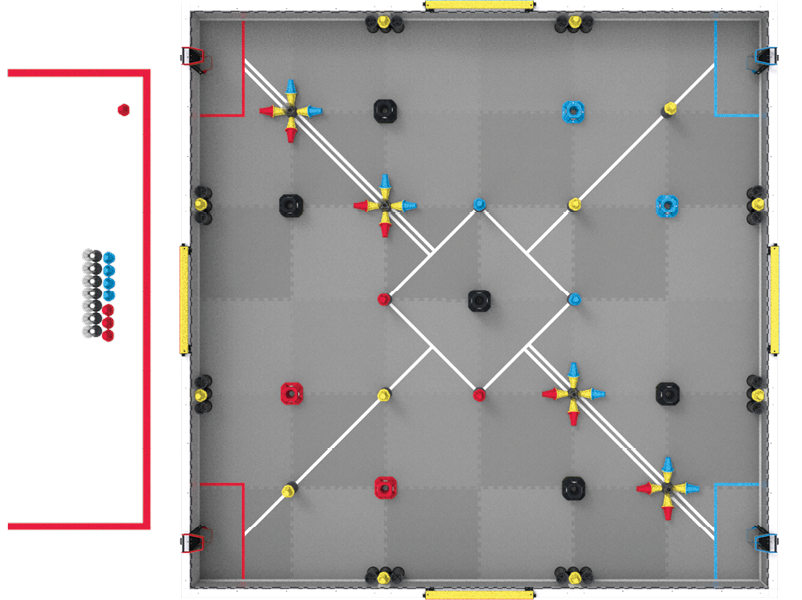
In Robot Skills Matches, Teams have one minute to score as many points as possible. There are two types of Robot Skills Matches : Driving Skills Matches, which are entirely Driver controlled, and Autonomous Coding Skills Matches, which are autonomous with limited human interaction. Teams are ranked based on their combined score in the two types of Robot Skills Matches.
Robot Skills Matches are optional for all Teams. Teams who do not compete in Robot Skills Matches will not be penalized in Teamwork Matches. However, participation in Robot Skills Matches may impact eligibility for judged awards at the event.
At events that include Teamwork Matches, Teams may only participate in Robot Skills Matches if they also participate in the Qualification Matches. See rule <T20>.
In the Robot Skills Challenge, the standard definition of Match Affecting does not apply, because there is no winner or loser. When evaluating whether a rule Violation should be classified as a Major Violation or Minor Violation in the context of this criteria, the term “score affecting” can be substituted for “Match Affecting.” A Violation is considered “score affecting” if it results in a net increase of that Team’s score at the end of the Match.
Violations of <GG>, <SG>, and <RSC> rules that occur during a Robot Skills Match should only affect the outcome of that Match and should not be considered when determining whether a Violation has been repeated during the event.
<RSC2>Match play is different in Robot Skills Matches.
This V5 Robot Brain must be running the official field control user program.
For more information regarding the use of a V5 Robot Brain for Robot Skills Challenge field control, and to download the official field control user program, visit this VEX Knowledge Base article.
For more information regarding the use of TM Mobile for field control, see the Tournament Manager documentation.
At events which do not have a V5 Robot Brain or the TM Mobile App available for Robot Skills Challenge field control, Drive Team Members and field staff must agree prior to the Match on the signal that will be used to end the Match early. A manual timer must be used in conjunction with a VEXnet Competition Switch.
The moment when the Match ends early is defined as the moment when the Robot is “Disabled ” by the field control system. The time shown on the timer should be rounded up to the nearest second. For example, if the Robot is Disabled and the timer shows 25.2 seconds, then the Skills Stop Time should be recorded as 26.
The agreed-upon signal must be both verbal and visual, such as Drive Team Members crossing their arms in an “X” or placing their V5 Controller(s) on the ground.
It is recommended that Drive Team Members also provide verbal notice that they are approaching their Skills Stop Time, such as by counting out “3-2-1-stop.”
It is at the Event Partner’s discretion which method will be used to record Skills Stop Times at a given event. The chosen method must be communicated prior to the start of Matches (such as during an event meeting), and made equally available to all Teams.
If an event intends to use a manual timekeeping method, a Team cannot bring their own V5 Robot Brain just for use during their own Robot Skills Match.
If an event is using multiple Fields for Robot Skills Matches, the same method must be used at all Fields, as described in rule T21. Multiple V5 Robot Brains may be used as needed (e.g., a “Field 1 Brain” and a “Field 2 Brain”).
The default timed “Drive” program accessed from a V5 Controller is intended for practice only, and cannot be used for an official Robot Skills Match.
If a Team chooses to utilize/record a Skills Stop Time, the 5-second grace period described in rule SC1 does not apply.