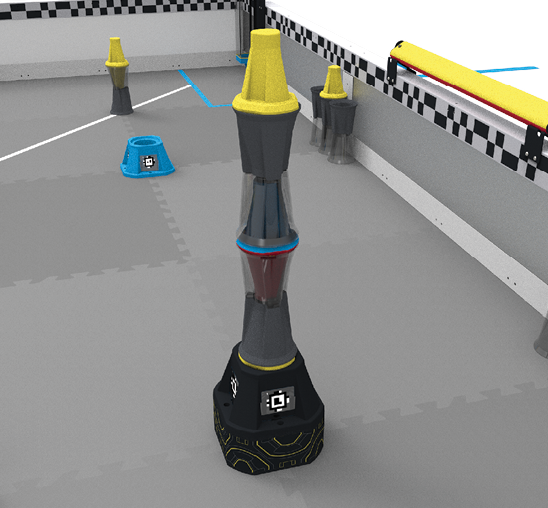
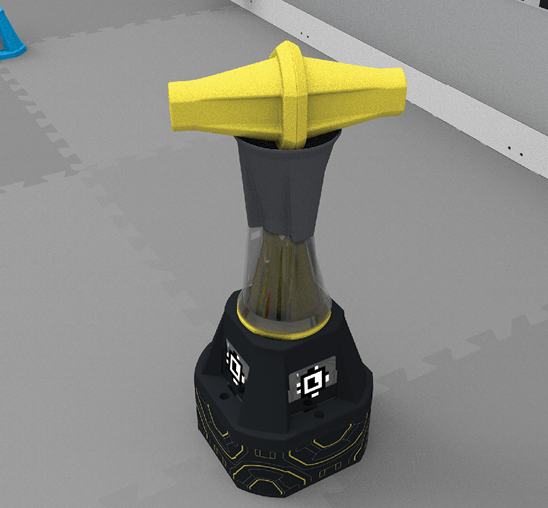
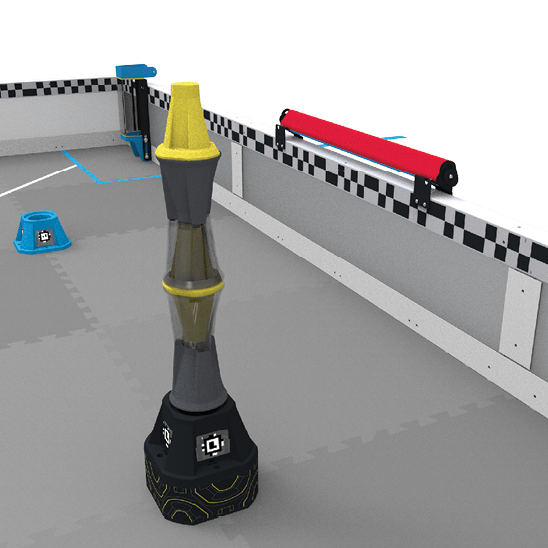
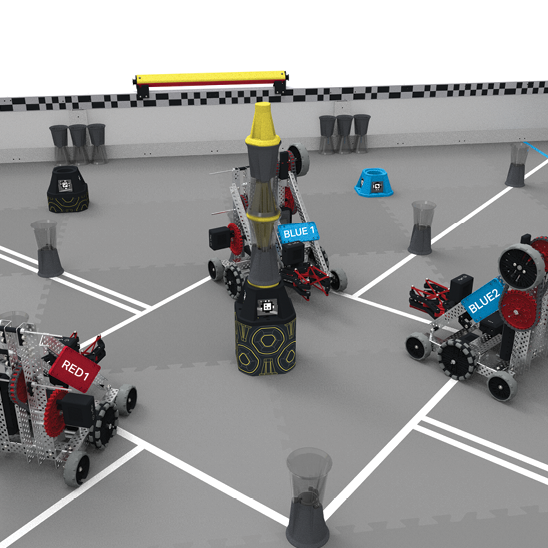
상대 진영과의 상호작용은 여전히 게임의 중요한 부분입니다. 하지만 상대 진영이 쌓아 올린 것을 무너뜨리는 방식으로 경기를 지배할 수는 없습니다. 수비와 공격 방해는 어느 정도 예상되지만, 주된 목표는 공격 전개와 득점에 집중하는 것이어야 합니다.
스택 방지에만 집중하는 전략이 너무 흔해지면, 게임 디자인 위원회는 다양한 전략적 선택지가 존재하여 게임의 재미를 유지할 수 있도록 변경을 고려할 수 있습니다. 우리는 이러한 전략들이 얼마나 자주 사용되는지, 그리고 우리의 의도와 비교했을 때 게임 플레이에 어떤 영향을 미치는지 살펴볼 것입니다.
토글 스위치와 노란색 핀이 있는 대형 포인트 스윙
Override의 점수 체계는 역동적인 전략 수립과 의사 결정을 장려하도록 설계되었습니다. 이 때문에 토글 조작이나 노란색 핀 득점과 같은 행동으로 인해 경기 중 점수 변동이 크게 발생할 수 있습니다.
이러한 순간들은 흥미진진할 수 있지만, 승리의 유일한 방법이 되어서는 안 됩니다. 팀은 스택 구축 및 엔드게임 경쟁을 포함하여 여전히 여러 가지 실행 가능한 전략을 보유해야 합니다.
우리는 이러한 점수 변동이 시즌 내내 경기 결과에 미치는 영향을 모니터링할 것입니다. 만약 특정 득점 방식이 다른 득점 기회를 압도하거나 전략적 다양성을 저해하기 시작하면, 게임 디자인 위원회는 균형 잡히고 흥미로운 게임을 유지하기 위해 점수 값을 조정할 수 있습니다.
최종결전: 마지막 10초
경기 마지막 10초는 더욱 긴장감 넘치고 경쟁적인 분위기를 조성하도록 설계되었습니다. 이 시간 동안 게임은 미드필드에서 “언덕 위의 왕” 스타일의 경쟁으로 전환됩니다. 경기 중 이 부분에서는 로봇과의 상호작용이 더욱 증가할 가능성이 높습니다. 따라서:
게임 디자인 위원회는 현장 조사 및 게임 디자인을 통해 센서 활용을 지원하기 위해 노력할 것입니다. 하지만 현실 세계는 항상 완벽한 것은 아닙니다. 조명 및 물체 배치는 다를 수 있습니다. 따라서 팀은 로봇의 센서가 경기 중 발생하는 작은 변화에도 안정적으로 작동할 수 있도록 설계하고 코딩해야 합니다.
또한, 로봇경기 규칙은 시즌 내내 공정한 경기 진행을 위해 지속적으로 검토될 예정입니다. 중요한 목표 중 하나는 팀들이 센서를 고의적으로 혼란시키거나 필드 요소처럼 보이는 부품을 추가하는 등 부당한 방식으로 센서를 방해할 수 있는 로봇을 제작하는 것을 막는 것입니다.
모든 팀이 센서가 예상대로 작동할 것이라고 믿을 수 있도록 보장하는 것은 공정한 경쟁을 위해 중요한 부분입니다.
<SC1> 모든 점수 산정은 경기 종료 후 이루어집니다. 점수는 경기 종료 후 5초가 지나거나, 경기장 내 모든 득점 요소, 필드 요소 및 로봇이 정지한 후( 중 먼저 발생하는 시점)에 계산됩니다.
이 5초 지연은 경기 종료 직전 득점 상황에서 허용되는 유일한 “의심의 여지 없는 유리한 판정”으로 의도된 것입니다. 만약 물체나 로봇이 5초 시점에서 여전히 움직이고 있고 두 상태 중 어느 쪽이 더 유리한지 판단하기 어려운 경우, 해당 로봇에게 덜 유리한 상태를 부여해야 합니다. 미드필드 평면을 돌파하고 있지만 5초 동안 천천히 미드필드에서 멀어지는 로봇은 미드필드에 있는 것으로 간주되지 않습니다.
경기 종료 시 토너먼트 관리자 화면에 표시되는 타이머는 현재 경기 정보와 “0:00”을 5초 동안 표시한 후 다음 경기를 대기열에 추가합니다. 이는 팀과 주심이 사용해야 할 주요 5초 시각적 신호입니다.
이 5초 지연은 단순히 “의심스러운 상황을 고려해 주는” 유예 기간일 뿐이며, 경기 시간을 5초 더 늘려주는 것이 아닙니다. 이 유예 기간을 전략적으로 악용하도록 설계된 로봇은 경미한 위반을 받게 되며 경기 후의 움직임은 점수 계산에 포함되지 않습니다(즉, 경기는 0:00 시점의 점수로 계산됩니다).
심판은 득점 상황을 평가하는 동안 로봇 및/또는 득점 장치를 접촉하거나 이동시키는 것을 최대한 피해야 합니다. 다른 물체의 상태를 평가하기 위해 물체를 이동해야 하는 경우, 이동하기 전에 모든 팀과 주심이 해당 물체의 상태에 대해 합의하고 이를 기록해야 합니다.
심판은 경기 종료 후 득점 대상, 경기장 요소 및 로봇의 최종 위치를 기준으로 검증된 득점 현황에 따라 카운트를 기록해야 합니다. 위반이 경기 영향인지 여부를 판단하는 데 사용되는 점수 고려 사항(예: 위반 참고 사항에 명시됨)은 실제 점수에 추가되거나 차감되어서는 안 되며 위반 중에 획득한 점수는 점수에서 차감되어서는 안 됩니다.
In the 2.0 manual, Appendix C - Rule Violations: "Match Affecting - A Violation which changes the winning and losing Alliance in the Match. Multiple Violations within a Match can cumulatively become Match Affecting."
This question presents scenarios where multiple match affecting violations occur in a single match and seeks clarity how to apply them.
Scenario 1
One robot, same goal: Blue1 descores two pins from a neutral goal, then later in the match Blue1 descores another pin from the same neutral goal.
Scenario 2
One robot, different goals: Blue1 descores two pins from a neutral goal, then later in the match Blue1 descores another pin from a different neutral goal.
Scenario 3
Two robots, same alliance: Blue1 descores two pins from a neutral goal, then later in the match Blue2 descores another pin from a different neutral goal.
In all of these scenarios, the match ends with the score of Blue 85, Red 60. How should these match affecting violations be cumulatively applied and does the guidance change if the match is in qualifications or eliminations?
Answered by committeeOct 7, 2026
Per <SG10> violation note #1, the value of removed Pins is determined for each independent interaction/violation. When multiple violations occur, the point values attributed to each violation may then stack.
For example, if Blue 1 removes one Pin from a neutral Goal, that interaction is valued at 10 pts. If Blue 1 later removes 3 additional Pins from a neutral Goal, that interaction is valued at 30 points. The cumulative value of these potentially match affecting violations would be 40 points. (Note: This is not evaluated as a single interaction resulting in the removal of 4+ Pins, which would be valued at 50 points. These were two separate interactions, and the points from each interaction stack. The Pin counts do not stack.)
In Elimination Matches, violations are tracked and shared for the Alliance, rather than each individual Robot. For example, if Blue 1 removed one Pin from a neutral Goal, that SG10 violation would be valued at 10 points. If Blue 2 removed 2 Pins from a neutral Goal, that SG10 violation would be valued at 20 points. These separate SG10 violations stack and are cumulatively valued at 30 points for the blue Alliance in this Elimination Match. If the blue Alliance were to win this Elimination Match by 30 points or less, the 30-point advantage gained via SG10 violations would be considered Match Affecting (Major Violation) in favor of the blue Alliance, and the blue Alliance would be disqualified for this Match.
In Qualification Matches, violations are tracked for each individual Robot, rather than shared across both Robots on an Alliance. Multiple violations committed by the same Robot will stack and be cumulatively applied for only that Robot. Any Violations committed by the other Robot on the Alliance, along with any Match Affecting calculations, are handled independently for each Robot. If Red 1 removed one Pin from a neutral Goal, that SG10 violation would be valued at 10 points. If Red 2 removed one Pin from a neutral Goal in one interaction (10 points) and removed 2 Pins from a neutral Goal in another interaction (20 points), Red 2's SG10 violations would be cumulatively valued at 30 points. Now, here are some different scenarios to consider how each Robot might be affected for this Qualification Match:
If the red Alliance were to win this Qualification Match by 10 points, both Red 1's SG10 violation (worth 10 points) and Red 2's SG10 violations (cumulatively worth 30 points) would independently be considered Match Affecting in favor of the red Alliance, and both red Alliance Robots would receive Major Violations and disqualifications for this Match.
If the red Alliance were to win this Qualification Match by 15 points, Red 1's SG10 violation (worth 10 points) would not be considered Match Affecting, and would result only in a Minor Violation. Red 2's SG10 violations (cumulatively worth 30 points) would be considered Match Affecting in favor of the red Alliance, and the Red 2 Robot would receive a Major Violation and disqualification for this Match.
If the red Alliance were to win this Qualification Match by 40 points, neither Red 1's SG10 violation (worth 10 points) nor Red 2's SG10 violations (cumulatively worth 30 points) would independently be considered Match Affecting, so both red Alliance Robots would only receive Minor Violations for this Match.
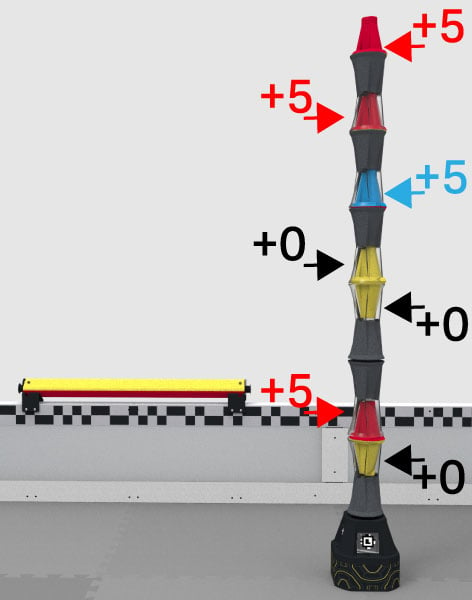
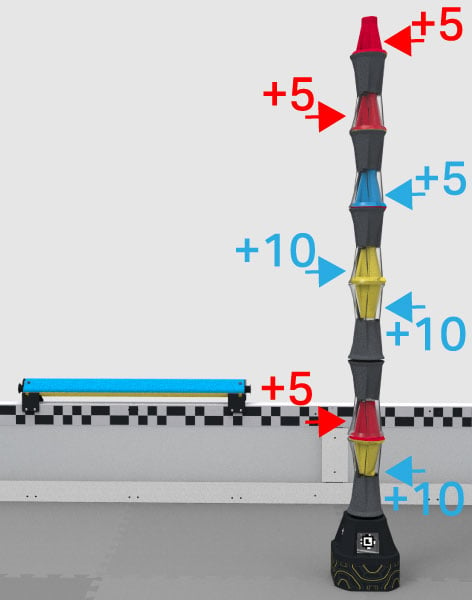
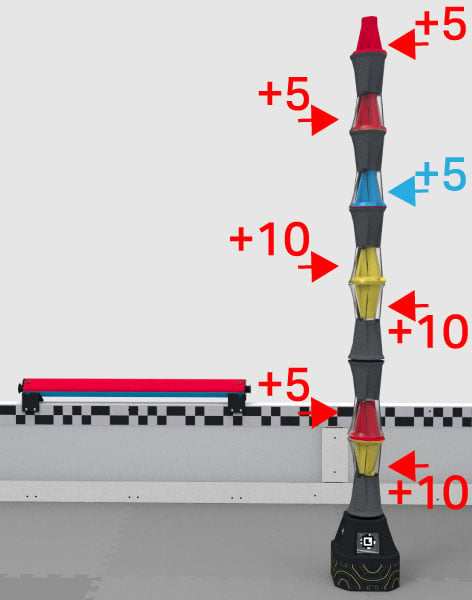
토글이 특정 색상으로 설정되지 않은 경우 기본적으로 중립(노란색) 토글로 간주되며, 해당 사분면의 노란색 핀 절반에 대한 소유권은 어느 연합에도 부여되지 않습니다. 토글 스위치는 무한한 방향으로 움직일 수 있지만, 실제로 “설정”된 상태로 간주되는 방향은 세 가지뿐입니다.
<SC5>노란색 핀 절반의 소유권. 배치된 핀의 각 노란색 절반은 다음 조건에 따라 동맹이 소유할 수 있습니다.
사분면 목표에 배치된 핀의 경우, 해당 사분면의 토글이 동맹의 색상으로 설정되어 있으면 노란색 핀 절반은 해당 동맹의 소유입니다. 해당 사분면의 토글이 노란색으로 설정되어 있으면 노란색 핀 절반은 소유되지 않은 상태이며 점수를 얻지 못합니다. (SC3 참조).
중앙 골대에 배치된 핀의 경우, 노란색 핀 절반은 경기 종료 시 중앙 골대에 더 많은 로봇을 보유한 연합의 소유가 됩니다. (SC6 참조).
만약 양 진영이 경기 종료 시 미드필드에 있는 로봇 수가 같을 경우, 노란색 핀 절반은 어느 진영도 소유하지 않은 것으로 간주되어 점수를 얻지 못합니다.
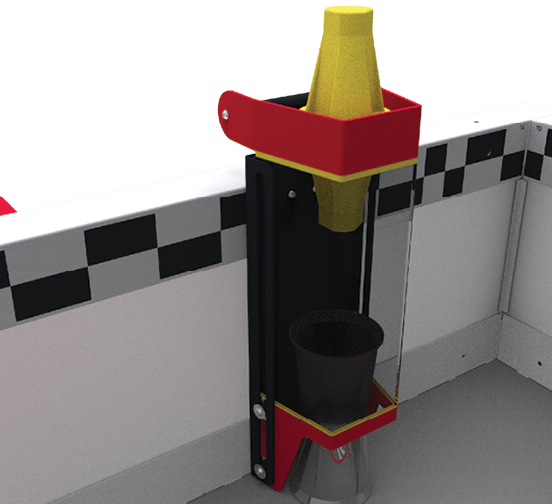
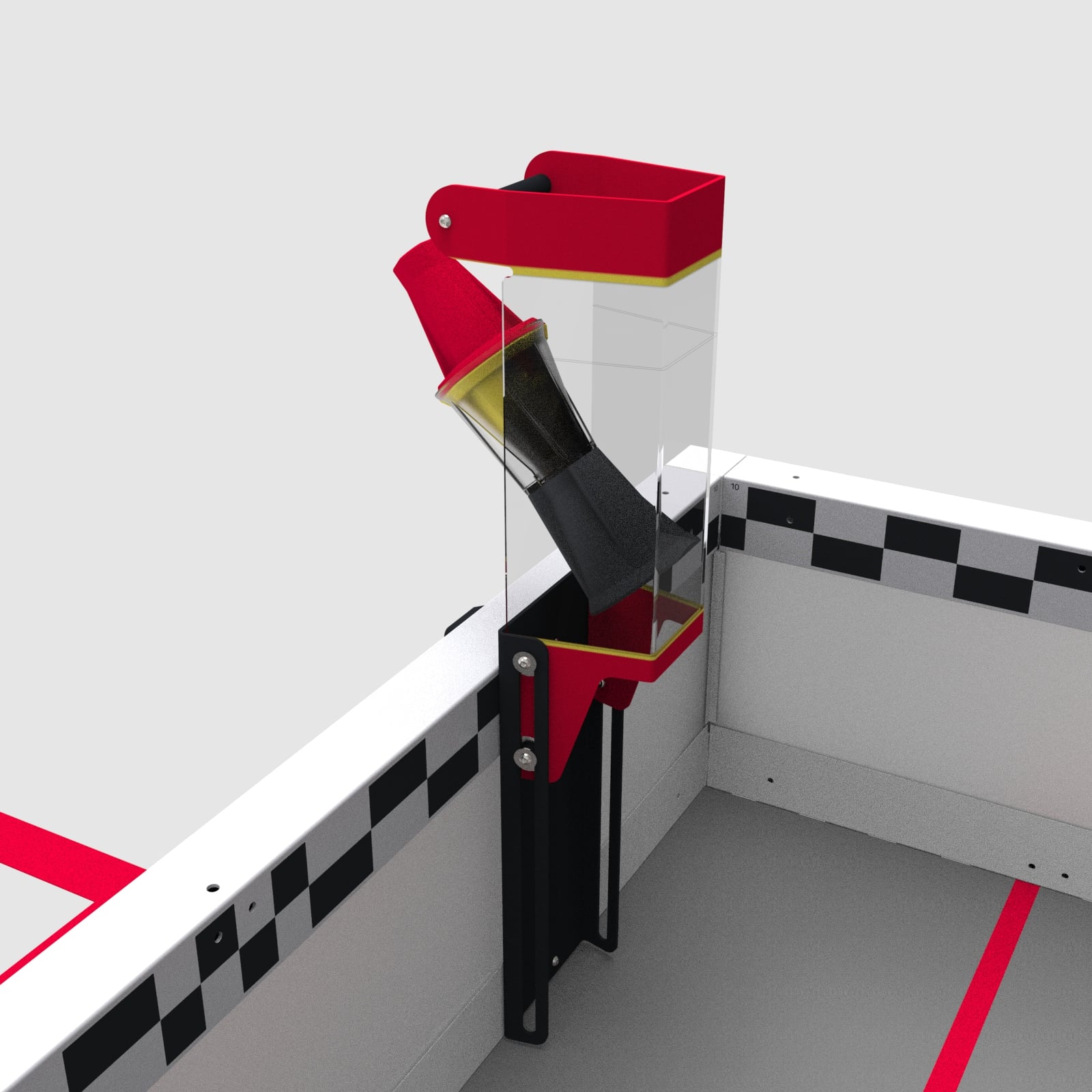
그림 SC5-1: 이 사분면의 토글이 빨간색으로 설정되어 있으므로 이 노란색 핀 절반은 빨간색 연합이 소유합니다.
그림 SC5-2:경기 종료 시 파란색 연합이 미드필드에 더 많은 로봇을 보유하고 있으므로 이 노란색 핀 절반은 파란색 연합의 소유입니다.
참고: 프리로드나 필드 주변과 같은 외부 영향을 사용하여 로봇의 시작 크기를 유지하는 것은 로봇이 이러한 영향 없이도 R3의 제약 조건을 만족하고 검사를 통과할 수 있는 경우에만 허용됩니다.
위반 사항:
이 규칙의 조건이 하나라도 충족되지 않으면 경기는 시작되지 않습니다. 로봇이 적시에 이러한 조건을 충족할 수 없는 경우 로봇은 필드에서 제거되고 상황이 수정될 때까지 규칙 <R2d> 및 GG2이 적용됩니다. 그들은 실격 처분을 받지는 않지만 경미한 위반을 받게 되며 경기에 참가할 수 없습니다.
이 규칙의 조항 A는 VEX U에 대해 다르게 적용됩니다. 규칙 VUG1 및 VUG3을 참조하십시오.
이 규칙은 VEX AI 로봇 경진대회에서는 다르게 적용됩니다. 규칙 VAIG4을 참조하십시오.
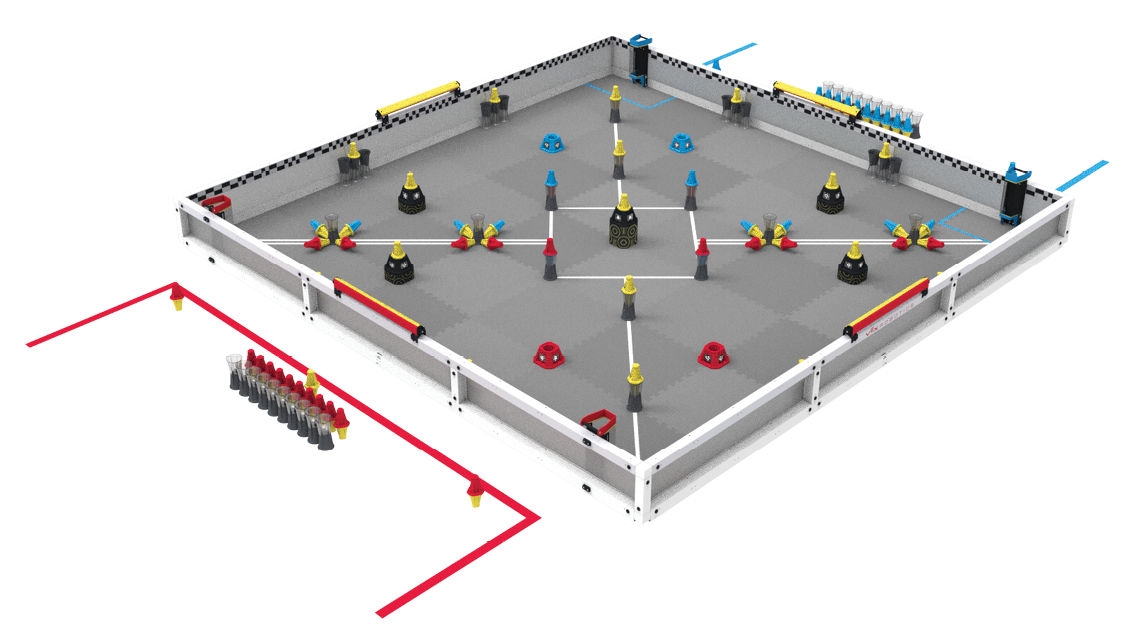
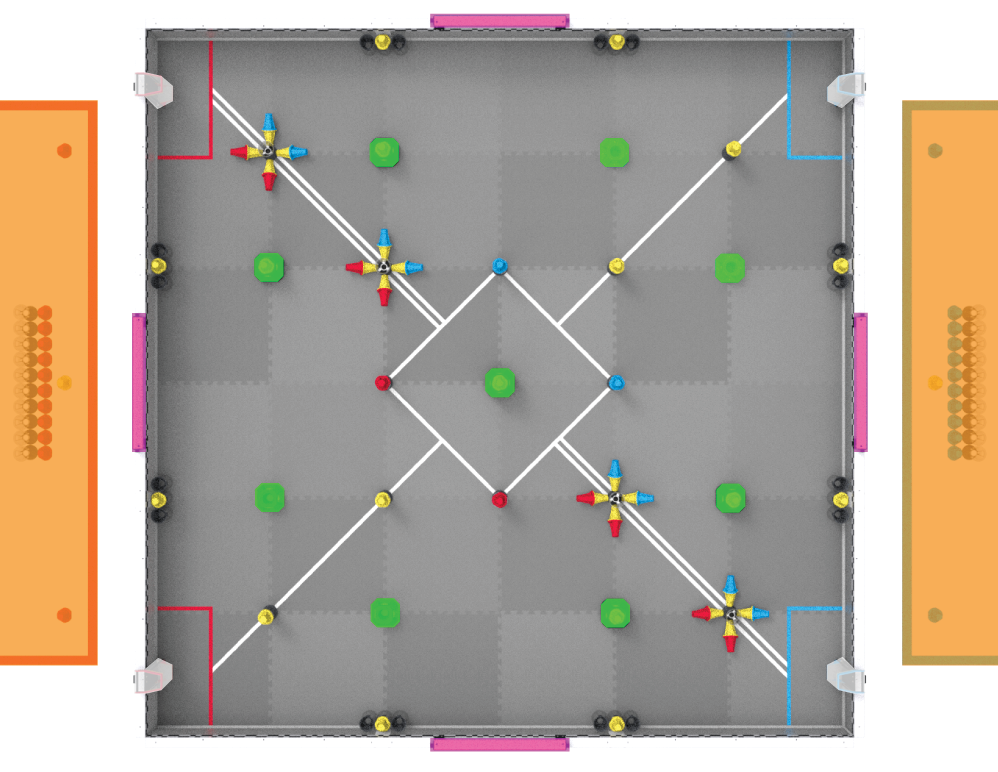
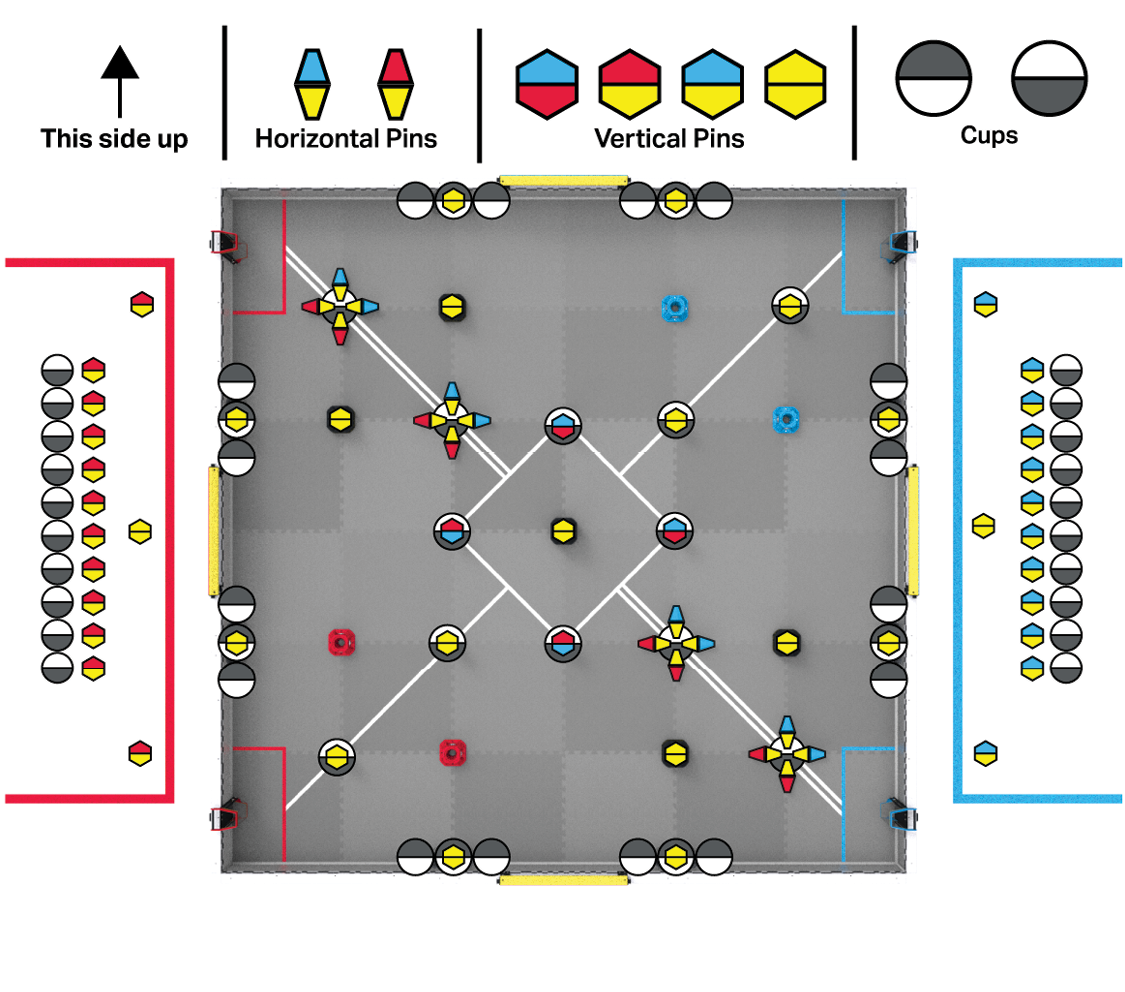
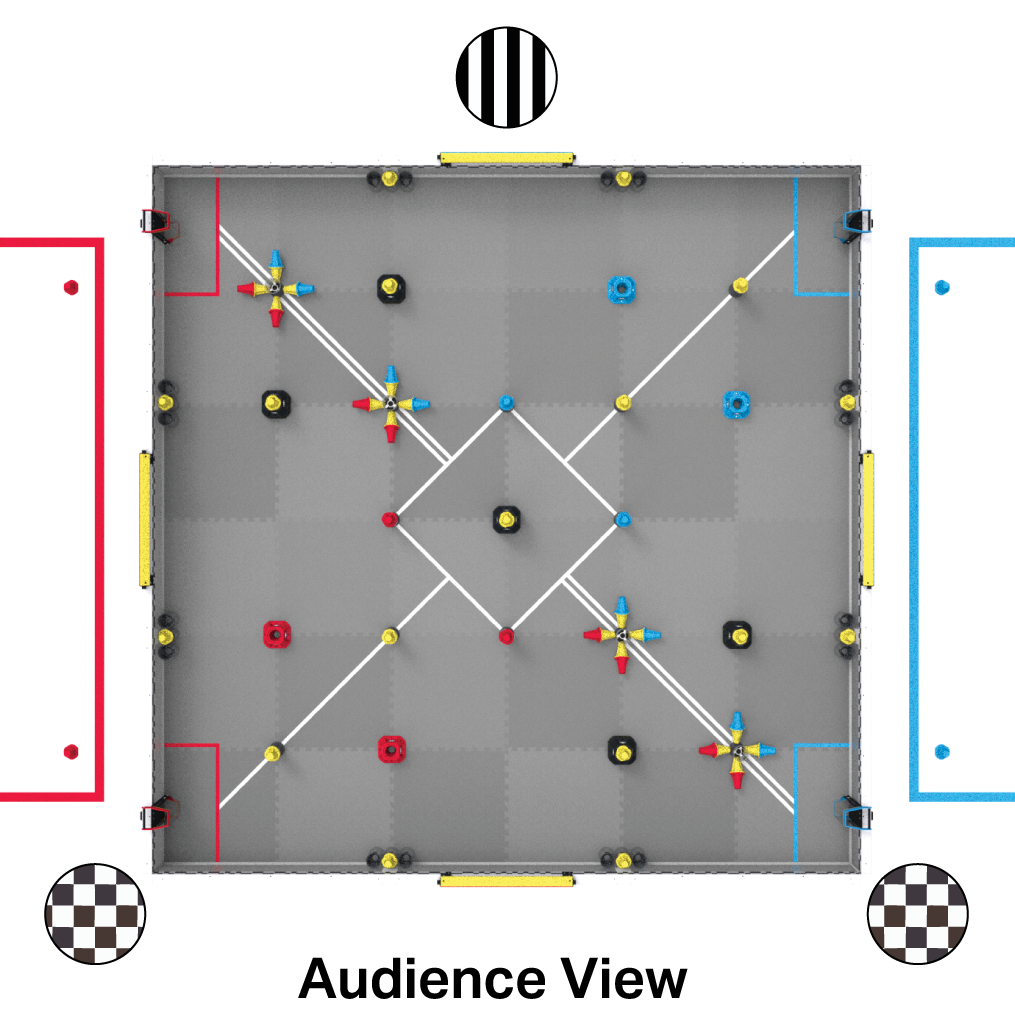
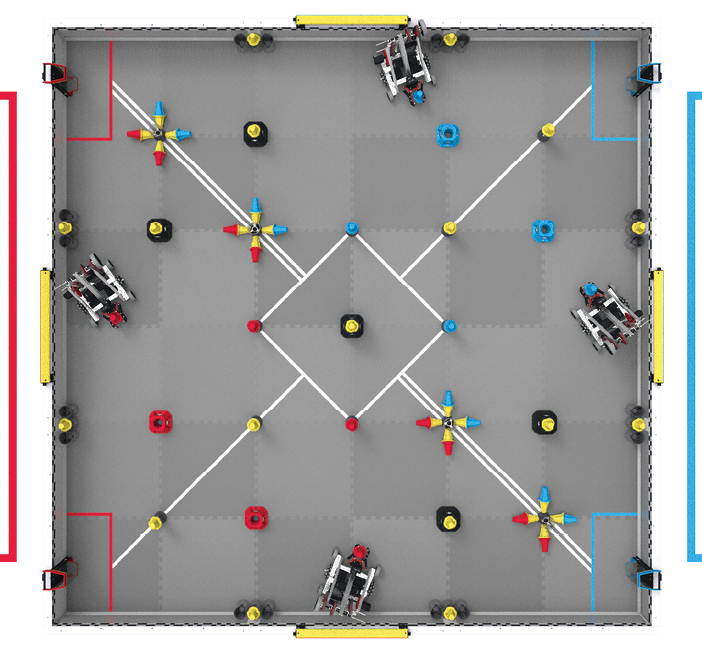
그림 SG-1:경기장의 위에서 본 모습으로, 네 대의 로봇이 정해진 출발 위치에 있습니다.
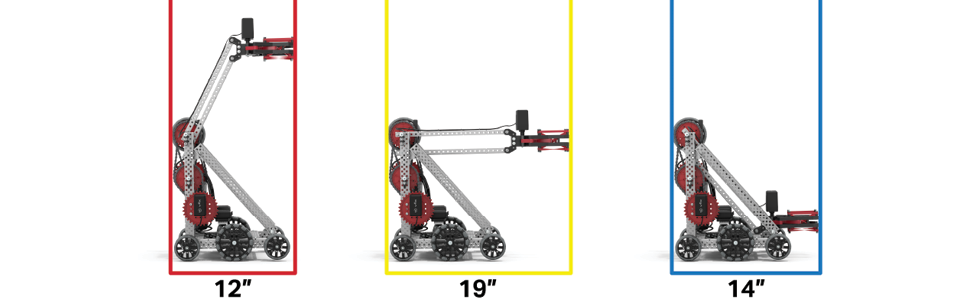
<SG2>수평 확장 제한이 있습니다.경기가 시작되면 로봇은 다음 기준에 따라 시작 크기 제한을 넘어 수평으로 확장할 수 있습니다.
경기 중 로봇의 크기는 너비 24인치, 길이 24인치를 초과할 수 없습니다 (24인치 x 24인치의 가로 정사각형 공간 내에 들어가야 합니다).
위반 사항:
경기 중에 발생하는 우발적/사소한 위반은 경미한 위반으로만 간주됩니다. 반복되는 경미한 위반은 극단적인 상황에서만 중대한 위반으로 확대되어야 합니다. 경미한 위반의 예는 다음과 같지만 이에 한정되지는 않습니다.
느슨한 전선
끊어진 케이블 타이/고무줄
전략적 이득에 사용되지 않는 휘어지거나 파손된 기계 부품
그림 SG-2: 수직 확장 과정에서 로봇의 크기가 수평 방향으로 어떻게 변할 수 있는지를 보여주는 그림입니다.
<SG3>수직 확장 제한이 있습니다.경기가 시작되면 로봇은 시작 크기 제한을 넘어 수직으로 확장할 수 있지만, 경기 중 어느 시점에서도 로봇의 전체 높이가 50인치를 초과할 수 없습니다(항상 50인치 수직 크기 상자 안에 들어갈 수 있어야 합니다).
<SG4> 득점용 물체는 경기장 안에 . 팀은 고의로 득점용 물체를 경기장 밖으로 가져갈 수 없습니다. 경기 중 필드를 벗어난 득점 오브젝트는 필드 타일 및 필드 경계선에 접촉한 상태로, 원래 위치 근처의 필드 요소, 득점 오브젝트 또는 로봇과 접촉하지 않은 상태로 필드로 반환됩니다. 자원봉사자는 가능한 한 빨리 득점 대상을 필드로 반환해야 하며 득점 대상 반환의 지연은 경기 영향 또는 리플레이의 원인으로 간주되어서는 안 됩니다.
<SG6>소유는 핀 하나와 컵 하나로 제한됩니다.로봇은 동시에 1개 이상의 핀을 소유할 수 없습니다. 로봇은 한 번에 (1)개 이상의 컵을 소유할 수 없습니다. 이 규칙의 위반에 있는 로봇은 초과된 점수 객체를 제거하려는 시도를 제외한 모든 작업을 즉시 중지해야 합니다.
초과 득점 객체를 제거할 수 없는 경우 합법적인 시작 위치로 돌아가야 합니다(SG1에 설명됨). 미드필드에서 경기를 종료하더라도 점수를 획득할 수 없으며, 초과된 득점 아이템을 소유한 동안에는 토글, 골대 또는 기타 득점 아이템과 상호 작용할 수 없습니다.
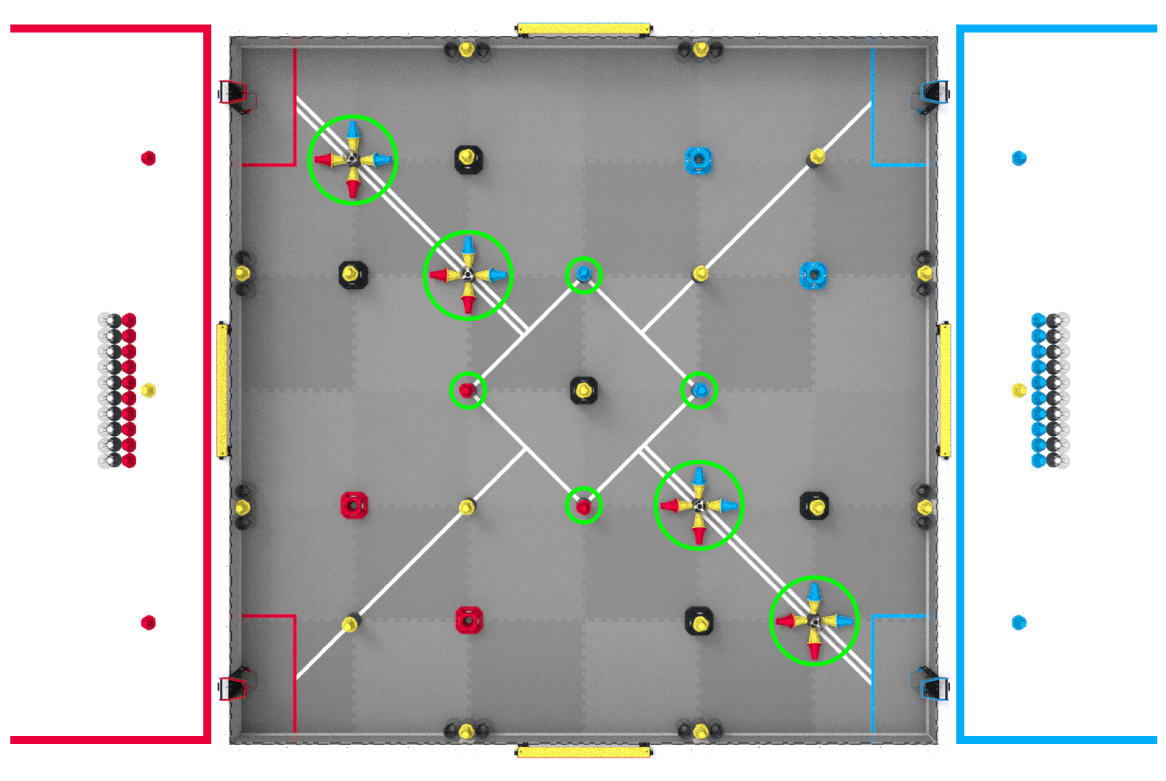
<SG7> 자율 주행 구역을 넘지 마시고, 상대방의 행동을 방해하지 . 자율 주행 시간 동안 로봇은 상대 진영의 자율 주행 구역에 있는 폼 타일, 득점 오브젝트 또는 필드 요소에 접촉할 수 없습니다.
자율 플레이 기간은 주로 공격에 집중해야 하며, 팀은 수비 방해보다는 득점과 전략적 움직임 실행에 주력해야 합니다. 팀은 다음을 포함하되 이에 국한되지 않는, 본질적으로 수비적인 행동을 피해야 합니다.
이 규칙의 모든 위반(중대 또는 경대)은 자율 보너스가 상대 동맹에게 부여되는 결과를 초래합니다. 자율 주행 라인 상호 작용으로 인해 발생할 수 있는 예외 사항은 <SG8b> 참조하십시오.
의도적, 전략적 또는 심각한 위반 (예: 자율 라인의 반대편 폼 타일과 접촉하는 동안 상대 로봇과 의도적으로 접촉하는 행위 또는 <SG7e> 에 설명된 상호 작용)은 중대한 위반으로 간주되며 경기에서 실격 처리되어야 합니다.
<SG7a>에 기술된 의도적인 방어 자율 전략은 주심의 재량에 따라 G1위반으로 기록될 수도 있습니다.
그림 SG-7: 이 점수 측정 대상물(녹색 원으로 표시)은 자율 주행 라인에 있는 것으로 간주됩니다.
<SG8>자율 주행 시간 동안 미드필드 및/또는 자율 주행 라인과 교전하는 것은 전적으로 본인의 책임입니다.경기 시작 시 자율 주행 라인에 위치한 미드필드 및/또는 득점 목표물과 교전하는 로봇은 상대 로봇 또한 동일한 행동을 할 수 있음을 인지해야 합니다. GG12 및 GG13에 따라 팀은 항상 로봇의 행동에 대한 책임을 집니다.
This is a question that, although general in nature, is related to a recent referee decision that I am unable to find any rule justifying.
Scenario:
A blue robot decides it is strategically beneficial for them to descore 4+ pins from their own alliance goal. This goal descored had a mix of yellow and blue pins scored on it (this was noted by the head referee). The unpenalized final score would be 103 blue to 56 red. There are no other relevant interactions in the match by either alliance that would call for an application of <SG9>, <SG10>, or any other penalizing rule.
<SG9> notes that opponent alliance goals are protected, with no mention of anything relating to non-opponent alliance goals, so <SG9> seems irrelevant here.
<SG10> notes that removing (directly or indirectly) game pieces from neutral goals has the potential to be a major violation. However this rule is about neutral goals, not an alliance's own alliance goals, so it also seems not applicable here.
There seems to be no other even moderately relevant rules to the legality of this decision by the blue alliance.
Would it be correct in this scenario to keep the final score as 103 blue to 56 red, and award blue the victory and advance them to the next round of the elimination bracket (assuming this is match R16 2-1)? If not, why? Are there any grounds in this scenario that would call for a disqualification?
Thank you for your time!
Answered by committeeSep 23, 2026
There is no rule preventing the removal of Scoring Objects from your own Alliance-colored Goals.
Red Robots are allowed to remove any and all Scoring Objects from red Alliance Goals.
Blue Robots are allowed to remove any and all Scoring Objects from blue Alliance Goals.
This remains true regardless of Pin color/Ownership.
<SG10> 배치된 득점 오브젝트는 직접적 또는 간접적 상호 작용을 통해 중립 골대에서 제거할 수 없습니다. 상호 작용의 예는 과 같습니다(이에 한정되지 않음).
골대에 쌓여 있는 득점용 물체를 건드려 일부 또는 전부를 골대 밖으로 떨어뜨리는 것. (직접)
상대 로봇을 골대에 쌓인 득점 목표물 쪽으로 밀어붙여 목표물 일부 또는 전부를 골대 밖으로 떨어뜨리는 것. (간접)
위반 사항:
경기 영향 계산의 목적상, 중립 골대에서 배치된 득점 오브젝트의 제거는 다음과 같이 평가되어야 합니다.
1개, 2개 또는 3개의 핀이 제거되는 상호작용의 경우, 해당 상호작용으로 제거된 각 핀은 10점의 가치를 갖는 것으로 간주해야 합니다.
4개 이상의 핀이 제거되는 상호작용의 경우, 해당 상호작용으로 제거된 핀들은 총 50점의 가치를 갖는 것으로 간주해야 합니다.
제거된 핀의 값은 각 독립적인 상호 작용/위반에 대해 결정됩니다. 여러 위반이 발생하면 각 위반에 할당된 포인트 값이 누적되어 누적적으로 매치 영향이 될 수 있습니다.
위반 연합의 최종 점수에서 이러한 점수 값을 빼면 경기 결과가 변경되는 경우 위반(s)은 경기 영향으로 간주되어야 합니다. (이 점수는 실제로 어느 팀의 최종 점수에서 차감되는 것이 아니라, 주심이 확인하는 절차일 뿐입니다.) 이러한 계산은 어느 동맹에 유리하게 경기 결과에 영향을 미치는 위반이 있는지 여부를 결정하기 전에 두 동맹 모두에 대해 동시에 고려해야 합니다.
참고: 주심은 경기 내내 각 골대에 꽂힌 핀의 개수를 일일이 추적할 수 없으며, 골대에서 핀이 제거될 경우 이전에 해당 골대에 꽂혀 있던 핀의 개수를 100% 정확하게 세는 것도 불가능합니다. 핀이 제거되는 모든 상황에서 주심은 제거된 핀의 개수를 최대한 정확하게 추측해야 하며, 팀은 주심의 집계가 완벽하지 않더라도 이를 받아들여야 합니다. (핀 1개, 2개 또는 3개를 정확하게 세는 것은 어렵습니다.) 3을 넘어서 세는 것은 더욱 신뢰성이 떨어지기 때문에 4개 이상의 핀이 제거되는 상호 작용에는 고정된 소수점 값이 적용됩니다.
SG10 states that scored objects may not be removed from neutral goals and violation of this rule would result in match affecting calculations of 10, 20, 30, or 50 points (subtracted from the offending alliance's final score).
RED robot is scoring yellow pins on a neutral goal and while placing the 6th pin, accidentally topples the stack of pins. RED had scored all of the yellow pins that were knocked off. Does RED receive the 50 point deduction when evaluating if it was match affecting?
RED robot has scored 5 red pins on a neutral goal and while placing the 6th red-colored pin, accidentally topples the stack of pins. Does RED still receive the 50 point deduction when evaluating if it was match affecting, even though the pins removed from the neutral goal were red pins?
RED robot has scored a mix of yellow and red pins on a neutral goal and while placing the 6th pin, accidentally topples the stack of pins. Let's say 3 yellow pins and 2 red pins were removed from the neutral goal. Does RED receive a 50 point deduction when evaluating if it was match affecting, based on the total number of pins that were removed from the neutral goal?
Answered by committeeSep 17, 2026
Remember, Head Referees only check to see if subtracting these values from the offending Alliance's score would change the outcome of the Match. These values are not actually subtracted from Alliance scores.
The red Robot caused the removal of Scoring Objects from the neutral Goal in all three scenarios, so red is the offending Alliance for all three scenarios. It does not matter which Alliance Placed the Scoring Objects in the neutral Goal or which Alliance they were Scored for.
We know that it's counterintuitive for a red Robot to be punished for removing red Pins from a neutral Goal, since doing so only hurts the red Alliance's score. However, it was decided that this color-agnostic approach to the Pins was needed to make calling <SG10> Violations more manageable for Head Referees. It's difficult enough to try to determine the number of Pins removed. We felt that trying to track additional details, such as which color Pins were visible in the stack, was too much to ask of Head Referees in these moments, and likely would've lead to excessive guesswork and more inconsistent punishments.
Q&A 3233
Clarification of [SG10] Match Affecting Calculation When Both Alliances Remove Pins From Neutral Goals in the Same Match
During a Hypothetical Head-to-Head Elimination match, the following occurs:
Blue 1 removes one Placed yellow Pin from the center neutral Goal in a single interaction.
Blue 2 has no relevant violations.
At a different point in the match, Red 1 removes three Placed yellow Pins from a different neutral Goal in a single interaction.
Red 2 has no relevant violations.
Assume that for this question, neither interaction is considered intentional, strategic, egregious, or a repeated Minor Violation.
The final scored result of the Match, before considering rule violations, is:
Red Alliance 42
Blue Alliance: 50
Rule [SG10] states that Placed Scoring Objects may not be removed from neutral Goals. Its Violation Notes state that, for Match Affecting calculations, an interaction removing 1–3 Pins is evaluated at 10 points per Pin, while an interaction removing 4+ Pins is evaluated at a combined value of 50 points. It further states that if subtracting this value from the offending Alliance’s final score would change the outcome of the Match, the Violation should be considered Match Affecting.
Applying this calculation separately:
Blue 1 removed 1 Pin, so Blue’s calculation would be 50 - 10 = 40. Since 40 is less than Red’s 42, Blue’s violation would appear to be Match Affecting.
Red 1 removed 3 Pins, so Red’s calculation would be 42 - 30 = 12. Since Red already lost the Match, Red’s violation would appear not to be Match Affecting.
Appendix C also states that a Violation cannot be Match Affecting if the offending Team did not win the Match, and that Match Affecting Violations are normally Major Violations.
Based on this, we would like clarification on the following:
This interpretation appears to create a situation where Blue could receive a Disqualification specifically because Blue won the Match.
Particularly, if Blue had instead finished with 41 points and lost the Match 42–41, Blue’s same one-Pin removal would appear not to be Match Affecting. At the same time, Red would then be the winning Alliance, and Red’s three-Pin removal would appear Match Affecting under the 30-point calculation, since 42 - 30 = 12, which is less than Blue’s 41, disqualifying them.
Is it therefore an intended consequence of [SG10] that, in this scenario, an Alliance could receive a more favorable Match result by finishing with a lower score and losing on the field rather than scoring additional points, winning on the field, and receiving a Disqualification?
In this double-violation instance, could both Alliances receive Disqualifications and the Elimination Match (e.g., QF 2-1) be played again (e.g., as QF 2-2) to determine the Alliance that moves on in the bracket?
When both Alliances violate [SG10] in the same match, is there any circumstance in which the violations should offset one another? Specifically, should the value of Blue 1’s 10-point [SG10] violation be subtracted from the value of Red 1’s 30-point [SG10] violation, resulting in a net 20-point violation value attributed to Red for the purpose of determining whether Red’s violation was Match Affecting? (In this case, this would result in Blue winning the Match, because subtracting 20 points from Red’s 42-point score for the match-affecting determination would not change the original Blue victory.)
Or, is the correct application of [SG10] in this scenario to evaluate each Alliance’s violation independently against the original 42–50 final score, resulting in Blue receiving a Major Violation / Disqualification while Red’s violation remains Minor?
We are primarily looking for clarification on how [SG10] and the definition of Match Affecting should be applied when both Alliances commit separate [SG10] violations in the same Match, especially when the Alliance with the smaller violation wins with the original, unadjusted score.
Thank you for your time.
Answered by committeeSep 18, 2026
This process for handling Match Affecting calculations now works differently than in the past, and we acknowledge that the current <SG10> Violation notes do not make this process clear. We will attempt to correct that in the next game manual update.
The calculations for SG10 Violations should first be taken into account for both Alliances at the same time, prior to determining whether any Violation affected the outcome of the Match in favor of one Alliance or the other.
SCENARIO #1-
Using your Elimination Match scenario, here's how to handle the Match Affecting calculations for these SG10 Violations:
Red Alliance: 42 (final score) - 30 (value of removing 3 Pins) = 12 points (simulated final score)
Blue Alliance: 50 (final score) - 10 (value of removing 1 Pin) = 40 points (simulated final score)
When comparing both the final scores and the simulated final scores, we can see that the blue Alliance would win the Match both before and after taking these calculations into account. Therefore, these Violations committed by the red and blue Alliances are not Match Affecting, and would instead be considered Minor Violations for both Alliances. Remember, these calculated values are not actually deducted from official Alliance scores, so the final score of the Match remains 50 (blue) to 42 (red).
SCENARIO #2-
Let's consider a different Elimination Match scenario, where the Violations affect the outcome of the Match in favor of one Alliance (red removes 2 Pins in a single interaction, and blue removes 4 Pins in a single interaction):
Red Alliance: 75 (final score) - 20 (value of removing 2 Pins) = 55 points (simulated final score)
Blue Alliance: 90 (final score) - 50 (value of removing 4 Pins) = 40 points (simulated final score)
The blue Alliance would win the Match before taking these calculations into account (shown by the final scores), but the red Alliance would win the Match after taking these calculations into account (shown by the simulated final scores). Therefore, the blue Alliance's more severe SG10 Violation was large enough to affect the outcome of the Match in their favor, which would result in a Match Affecting Violation (DQ) for the blue Alliance. The red Alliance's SG10 Violation would only be considered a Minor Violation in this case.
SCENARIO #3-
Consider an Elimination Match scenario where taking into account all Match Affecting calculations for both Alliances results in a virtual tie (red removes 3 Pins in a single interaction, and blue removes 1 Pin in a single interaction):
Red Alliance: 80 (final score) - 30 (value of removing 3 Pins) = 50 points (simulated final score)
Blue Alliance: 60 (final score) - 10 (value of removing 1 Pin) = 50 points (simulated final score)
The red Alliance would win the Match before taking these calculations into account (shown by the final scores), but the Alliances would tie the Match after taking these calculations into account (shown by the simulated final scores). In this special case, both Alliances would incur Match Affecting Violations, and both Alliances would be disqualified for the Match. (In Appendix C, the last bullet point listed under “Match Affecting“ will be revised in the next game manual update to remove any language that conflicts with this outcome. This answer takes precedence over any conflicting language within Appendix C regarding Match Affecting Violations.)
In the 2.0 manual, Appendix C - Rule Violations: "Match Affecting - A Violation which changes the winning and losing Alliance in the Match. Multiple Violations within a Match can cumulatively become Match Affecting."
This question presents scenarios where multiple match affecting violations occur in a single match and seeks clarity how to apply them.
Scenario 1
One robot, same goal: Blue1 descores two pins from a neutral goal, then later in the match Blue1 descores another pin from the same neutral goal.
Scenario 2
One robot, different goals: Blue1 descores two pins from a neutral goal, then later in the match Blue1 descores another pin from a different neutral goal.
Scenario 3
Two robots, same alliance: Blue1 descores two pins from a neutral goal, then later in the match Blue2 descores another pin from a different neutral goal.
In all of these scenarios, the match ends with the score of Blue 85, Red 60. How should these match affecting violations be cumulatively applied and does the guidance change if the match is in qualifications or eliminations?
Answered by committeeOct 7, 2026
Per <SG10> violation note #1, the value of removed Pins is determined for each independent interaction/violation. When multiple violations occur, the point values attributed to each violation may then stack.
For example, if Blue 1 removes one Pin from a neutral Goal, that interaction is valued at 10 pts. If Blue 1 later removes 3 additional Pins from a neutral Goal, that interaction is valued at 30 points. The cumulative value of these potentially match affecting violations would be 40 points. (Note: This is not evaluated as a single interaction resulting in the removal of 4+ Pins, which would be valued at 50 points. These were two separate interactions, and the points from each interaction stack. The Pin counts do not stack.)
In Elimination Matches, violations are tracked and shared for the Alliance, rather than each individual Robot. For example, if Blue 1 removed one Pin from a neutral Goal, that SG10 violation would be valued at 10 points. If Blue 2 removed 2 Pins from a neutral Goal, that SG10 violation would be valued at 20 points. These separate SG10 violations stack and are cumulatively valued at 30 points for the blue Alliance in this Elimination Match. If the blue Alliance were to win this Elimination Match by 30 points or less, the 30-point advantage gained via SG10 violations would be considered Match Affecting (Major Violation) in favor of the blue Alliance, and the blue Alliance would be disqualified for this Match.
In Qualification Matches, violations are tracked for each individual Robot, rather than shared across both Robots on an Alliance. Multiple violations committed by the same Robot will stack and be cumulatively applied for only that Robot. Any Violations committed by the other Robot on the Alliance, along with any Match Affecting calculations, are handled independently for each Robot. If Red 1 removed one Pin from a neutral Goal, that SG10 violation would be valued at 10 points. If Red 2 removed one Pin from a neutral Goal in one interaction (10 points) and removed 2 Pins from a neutral Goal in another interaction (20 points), Red 2's SG10 violations would be cumulatively valued at 30 points. Now, here are some different scenarios to consider how each Robot might be affected for this Qualification Match:
If the red Alliance were to win this Qualification Match by 10 points, both Red 1's SG10 violation (worth 10 points) and Red 2's SG10 violations (cumulatively worth 30 points) would independently be considered Match Affecting in favor of the red Alliance, and both red Alliance Robots would receive Major Violations and disqualifications for this Match.
If the red Alliance were to win this Qualification Match by 15 points, Red 1's SG10 violation (worth 10 points) would not be considered Match Affecting, and would result only in a Minor Violation. Red 2's SG10 violations (cumulatively worth 30 points) would be considered Match Affecting in favor of the red Alliance, and the Red 2 Robot would receive a Major Violation and disqualification for this Match.
If the red Alliance were to win this Qualification Match by 40 points, neither Red 1's SG10 violation (worth 10 points) nor Red 2's SG10 violations (cumulatively worth 30 points) would independently be considered Match Affecting, so both red Alliance Robots would only receive Minor Violations for this Match.
Q&A 3249
<SG9>, <SG10>, and Descoring an Alliance's Own Alliance Goal
This is a question that, although general in nature, is related to a recent referee decision that I am unable to find any rule justifying.
Scenario:
A blue robot decides it is strategically beneficial for them to descore 4+ pins from their own alliance goal. This goal descored had a mix of yellow and blue pins scored on it (this was noted by the head referee). The unpenalized final score would be 103 blue to 56 red. There are no other relevant interactions in the match by either alliance that would call for an application of <SG9>, <SG10>, or any other penalizing rule.
<SG9> notes that opponent alliance goals are protected, with no mention of anything relating to non-opponent alliance goals, so <SG9> seems irrelevant here.
<SG10> notes that removing (directly or indirectly) game pieces from neutral goals has the potential to be a major violation. However this rule is about neutral goals, not an alliance's own alliance goals, so it also seems not applicable here.
There seems to be no other even moderately relevant rules to the legality of this decision by the blue alliance.
Would it be correct in this scenario to keep the final score as 103 blue to 56 red, and award blue the victory and advance them to the next round of the elimination bracket (assuming this is match R16 2-1)? If not, why? Are there any grounds in this scenario that would call for a disqualification?
Thank you for your time!
Answered by committeeSep 23, 2026
There is no rule preventing the removal of Scoring Objects from your own Alliance-colored Goals.
Red Robots are allowed to remove any and all Scoring Objects from red Alliance Goals.
Blue Robots are allowed to remove any and all Scoring Objects from blue Alliance Goals.
This remains true regardless of Pin color/Ownership.
Q&A 3250
<SG10> Removal of Momentarily Placed Scoring Object
In the 2.0 manual, SC2 Placed Scoring Object criteria
a. A Pin is considered Placed if it meets all of the following criteria:
i. The Pin is partially or entirely nested with a Goal, or with a Cup that is partially or entirely nested with another Placed Pin.
ii. Each Goal and/or each half of a Cup nested with that Pin contains a maximum of one Pin half. (See Figure SC2-2.)
b. A Cup is considered Placed if it meets the following criteria:
i. The Cup is partially or entirely nested with a Placed Pin.
It is very common to see a robot holding a pin together with a cup in a claw. The robot tries to put this combination on another pin already in a goal. As they attempt to add these scoring objects, the pin on the goal is partially contained within the inner volume of the Cup. The robot then tries to open the claw, but fails (or is slightly misaligned) as they back away and those scoring objects fall to the tiles, but were at one point breaking an imaginary plane at the opening of a Cup.
Should that be counted as a score/descore and, possibly, match affecting considerations? Or simply just an unsuccessful scoring attempt in this interaction since it only broke the plane momentarily?
Answered by committeeSep 24, 2026
You describe a scenario in which a Robot attempts to Place additional Scoring Objects on a neutral Goal, which become momentarily Placed before falling off due to some fault of the Robot (such as misalignment, jerky movement, etc.).
This kind of scenario should be treated as an unsuccessful attempt to Place additional Scoring Objects, not as a removal of Placed Scoring Objects. Although these Scoring Objects were momentarily Placed, applying <SG10> here would be overly punitive and is not the intent of the rule.
However, if the Robot also removes any Scoring Objects that were already Placed on the Goal before this attempt, that would still be a Violation of <SG10>.
<SG11>운전팀 구성원은 다음 조건에 따라서만 로더를 통해 경기용 차량을 경기장으로 반입할 수 있습니다.
드라이브 팀 구성원은 소속 팀 색상의 로더를 통해 경기용 적재물을 투입할 수 있으며, 경기 중 운전자 통제 기간 동안에만 해당 로더를 조작(올림/내림)할 수 있습니다.
매치 로드는 로더의 상단 또는 후면을 통해 개별적으로 또는 함께 넣어 투입하거나 떨어뜨리는 방식으로만 넣을 수 있습니다.
매치 로드는 구동팀 구성원이 해제하기 전에, 매치 로드가 도입될 때 구동팀 구성원과 로봇 모두와 순간적으로 동시에 접촉할 수 있습니다. 매칭 로드가 해제되면 운전팀 구성원이 더 이상 해당 로드에 연락할 수 없습니다.
로더를 통해 경기용 차량을 필드에 투입할 때, 운전팀 구성원은 절대로 신체의 어떤 부분도 로더 플라스틱 하단 가장자리를 넘어서 내밀어서는 안 됩니다. 운전팀 구성원은 로더를 들어 올리는 동안 경기장 주변부를 들어 올리거나 당기지 않도록 주의해야 합니다. 경기 부하를 도입하는 동안 과도하거나 불필요하거나 안전하지 않은 행동은 주심의 재량에 따라 S1 및/또는 G1의 위반으로 간주될 수 있습니다.
경기 중간 지점에서 경기를 끝내려는 로봇은 상대 로봇과의 격렬한 상호작용을 예상해야 하며, 특히 수직으로 확장했을 때 얽히거나 넘어질 위험이 커진다는 점을 감수해야 합니다. 로봇이 미드필드와 접촉하거나 미드필드에 근접해 있을 때 상대 로봇이 밀거나 기울이거나 얽히게 되어 발생하는 부수적인 손상은 GG14의 위반으로 간주되지 않습니다. 고의적인 손상이나 위험한 메커니즘은 주심의 재량에 따라 여전히 S1 또는 G1의 위반으로 간주될 수 있습니다.
위반 사항:
이 규칙의 대부분의 위반은 경미한 위반으로 간주되어야 합니다. 그러나 반복되는 경미한 위반은 특히 여러 차례의 사전 경고 후에 위반이 발생한 경우 주심의 재량에 따라 중대한 위반으로 확대될 수 있습니다.
<S1>안전에 유의하세요.로봇 작동이나 팀 활동이 안전하지 않다고 판단되거나 경기장 요소, 득점 물체 또는 경기장에 손상을 입힌 경우, 주심의 재량에 따라 해당 팀은 경기 중단 및/또는 실격 처분을 받을 수 있습니다. 로봇은 다시 필드에 나가기 전에 규칙 R2에 설명된 대로 재검사를 받아야 합니다.
<S2>학생은 반드시 성인을 동반해야 합니다. VEX 로봇 경진대회에 참가하는 모든 학생은 책임 있는 성인의 감독을 받아야 합니다. 성인은 모든 규칙을 준수하고 학생 중심 정책을 위반하지 않도록 주의해야 하지만, 비상 상황 발생 시를 대비하여 행사 전 과정에 걸쳐 현장에 있어야 합니다. 이 규칙을 위반하면 이벤트에서 제외되고 추가 벌칙부과될 수 있습니다.
<S3>각 학생팀 구성원은 해당 대회 및 시즌에 대한 참가 동의서를 작성하여 제출해야 합니다. 참가 동의서가 제출되지 않은 학생팀 구성원은 대회에 참가할 수 없습니다.
<S4>경기장 안에 머무르세요.경기 중 로봇이 경기장을 완전히 벗어나면 해당 경기 종료 시까지 사용이 금지됩니다.
참고: 이 규칙의 목적은 일반적인 게임 플레이 중에 로봇이 실수로 경기장 경계를 넘어가는 메커니즘을 가지고 있다는 이유로 로봇에게 불이익을 주기 위한 것이 아닙니다.
<S5>안전 고글을 착용하십시오. 운전팀 구성원은 눈 보호 장비를 착용해야 합니다. 드라이브 팀의 모든 구성원은 경기 중 경기장에서 눈 보호 장비를 착용해야 합니다. 측면 보호대가 있고 깨지지 않는 렌즈가 장착된 안전 안경이나 기타 보안경을 착용하는 것이 좋습니다. 경기장 내부와 대기 구역에서는 모든 팀 구성원이 눈 보호 장비를 착용하는 것이 좋습니다.
<G1>참가자는 행동 강령을 준수해야 합니다. 모든 행사 참석자는 행동 강령에 명시된 지침을 준수해야 합니다.
위반 사항:
G1의 위반은 중대한 위반으로 간주될 수 있으며 사례별로 처리되어야 합니다. 여러 차례 무례하거나 무례한 행동으로 인해 G1주요 위반의 위험이 있는 팀은 일반적으로 “최종 경고”를 받게 되지만 주심은 이를 제공할 의무가 없습니다.
<G2>참가자는 학생 중심 정책을 따라야 합니다. 모든 행사 참석자는 학생 중심 정책에 명시된 지침을 준수해야 합니다.
위반 사항:
이 규칙의 잠재적 위반은 사례별로 검토됩니다. 정의에 따르면 이 규칙의 모든 위반은 성인이 제작하거나 프로그래밍한 로봇이 경기에서 점수를 얻는 즉시 경기 영향이 됩니다.
<G3>상식을 활용하세요. 이 문서에 있는 다양한 규칙을 읽고 적용할 때, VEX V5 로봇 경진대회에서는 항상 상식이 적용된다는 점을 명심하십시오.
<G4>학생은 학생 자격 정책 요건을 충족해야 합니다. 모든 학생 참가자는 해당 프로그램의 학생 자격 정책에 명시된 자격 요건을 충족해야 합니다.
위반 사항:
이 규칙의 위반에 있는 것으로 판단되는 팀은 VEX Robotics와 협력하여 추가 조사를 위해 심판 고문, 수석 심판 또는 이벤트 파트너에게 보고해야 합니다. 조사 결과에 따라 해당 팀은 향후 경기에서 제외되거나, 로봇 기술 경기 점수가 무효화되거나, 심사위원상 후보에서 제외될 수 있습니다.
이 규칙의 위반은 G1 및 G2에 언급된 바와 같이 VEX Robotics와 함께 사례별로 평가됩니다.
<G5>로봇 규칙을 실수로 위반하는 것과 고의로 위반하는 것에는 차이가 있습니다.로봇 규칙의 위반은 실수로든 고의로든 팀이 검사를 통과할 때까지 플레이할 수 없게 됩니다(<R2d> 에 따라).
그러나 동료 경쟁자보다 우위를 점하기 위해 의도적으로 또는 알고서 규칙을 우회하거나 위반하는 팀은 대회의 정신과 윤리를 위반하는 것입니다.
위반 사항:
경기 이점을 얻기 위해 로봇 규칙을 우회하는 팀은 해당 경기에서 즉시 실격 처리되어야 합니다.
<GG1>드라이브 팀 구성원만, 그리고 얼라이언스 스테이션에서만.경기 중에는 로봇은 R9 및 GG11에 따라 해당 팀의 드라이브 팀 구성원 및/또는 로봇 제어 시스템에서 실행되는 소프트웨어에 의해서만 작동될 수 있습니다. 팀은 각 로봇에 대해 최대 (3)명의 드라이브 팀원을 동맹 스테이션으로 보낼 수 있으며 해당 드라이브 팀원은 경기 기간 동안 동맹 스테이션에 머물러야 합니다.
연합 기지 내에서 모든 종류의 통신 장치를 사용하는 것. 통신 기능이 꺼진 헤드폰 이외의 기기(예: 비행기 모드인 휴대전화, 꺼진 무전기, 통신 기능이 비활성화된 스마트 안경)는 허용됩니다. 경기 후 토론 중에 번역 앱의 의사소통 기능을 활성화할 수 있습니다.
경기 중에는 경기장이 바닥이든 높은 곳이든 관계없이 어떠한 물체 위에 서거나 앉는 행위가 금지됩니다. 단, 공식적으로 승인된 편의 제공 요청에 따른 경우는 예외입니다.
경기 중 게임 난이도를 낮추기 위해 추가 장비를 가져오거나 사용하는 행위 (예: 로더에 득점 오브젝트를 정렬하거나 추가하는 장치).
경기 중 드라이브 팀 구성원이 구두 호출을 인지할 수 있도록 하기 위해(규칙 T1, G1, S1, G3 적용) 전원이 공급되는 헤드폰, 이어버드, 전자 장치에 연결된 패시브 이어피스 또는 오디오를 전송하는 기타 개인 액세서리/장치는 공식적으로 승인된 편의 요청에 따라 필요한 경우를 제외하고 얼라이언스 스테이션에서 착용/사용할 수 없습니다.
해당 경기의 드라이브 팀 멤버가 아닌 사람은 경기 중 드라이브 팀 멤버에게 지시, 명령 또는 조언을 할 수 없습니다. 그들은 밝고 긍정적인 격려를 해주는 것은 환영하지만, 경기 진행이나 전략에 영향을 미쳐서는 안 됩니다.
이 규칙은 VEX AI 로봇 경진대회에서는 다르게 적용됩니다. 규칙 VAIG2을 참조하십시오.
<GG2>팀의 로봇은 모든 경기에 참가해야 합니다.로봇이 작동하지 않더라도, 팀에 배정된 경기 시간에는 연합 기지 또는 경기장에 있어야 합니다. 로봇이 경기 전체 시간 동안 경기장에 없을 경우, 해당 팀은 “불참”으로 간주되어 승리 점수, 자율 주행 승리 점수, 자율 주행 점수 및 경기 일정 난이도 점수를 0점 받게 됩니다.
모든 팀은 예정된 예선 경기, 연합 선발 경기 및 결선 경기(연합 주장인 경우 또는 결선 경기에 참가할 연합으로 선정된 경우)에 참여해야 합니다. 예정된 경기나 동맹 선발에 참석하지 않는 것은 G1의 위반으로 간주될 수 있습니다. 예선 경기에 한 번도 참가하지 않은 팀은 심사위원 평가 대상에서 제외됩니다.
<GG3>경기장에 있는 로봇은 경기에 바로 투입될 수 있는 상태여야 합니다.팀이 로봇을 경기장에 배치할 때는 경기에 바로 투입될 수 있도록 준비해야 합니다(예: 배터리 충전, 시작 크기 제한 범위 내 크기, 해당 얼라이언스 색상의 번호판만 부착 등).
로봇은 즉시 경기장에 배치해야 합니다. 이를 반복적으로 위반할 경우 G1의 위반이 발생하거나 주심의 재량에 따라 로봇이 현재 경기에서 제외될 수 있습니다.
로봇이 경기 시작 시간을 지연시키는 경우, 주심과 행사 파트너의 재량에 따라 경기장에서 퇴장 조치될 수 있습니다. 로봇은 팀이 “불참”으로 평가받지 않도록 경기장에 남아 있을 수 있습니다(GG2 참조).
로봇이 경기 시작 전에 경기장에 배치되지 않으면, 해당 경기 중에 경기장에 배치할 수 없습니다.
VEX 공압 시스템을 사용하는 팀은 로봇을 경기장에 배치하기 전에 시스템을 충전해야 합니다.
스마트 필드 컨트롤을 사용하는 이벤트에서 로봇이 경기 시작 예정 시간 전에 스마트 필드 컨트롤에 성공적으로 연결하지 못하는 경우, 주심은 B항에 따라 해당 팀에게 로봇을 경기장에서 철수하도록 요청할 수 있습니다.
스마트 필드 컨트롤에 연결되었지만 필드 모니터에 ‘레거시 필드 컨트롤’ 오류가 표시되는 로봇은 스마트 필드 컨트롤에 성공적으로 연결된 것으로 간주되지 않으며, 경기 시작 시간을 지연시키는 경우 경기장에서 퇴장 조치될 수 있습니다.
<GG4>경기장 밖으로 손을 뻗지 마십시오.경기 중 드라이브 팀 구성원은 아래에 명시된 경우를 제외하고 경기장 경계의 3차원 공간 안으로 손을 뻗거나 경기장 요소, 로봇 또는 득점 물체와 의도적으로 접촉하는 것이 금지됩니다.
드라이브 팀 구성원은 규칙 SG11에 설명된 대로 경기 부하를 도입하는 동안 경기 중에 필드로 손을 뻗을 수 있습니다. 규칙 S1이 적용됩니다.
필드 요소 또는 득점 대상물의 시작 위치와 관련하여 우려 사항이 있는 경우 경기 전에 주심에게 문의해야 합니다. 팀 구성원은 절대로 득점 요소나 경기장 요소를 직접 조정할 수 없습니다.
필드 경계와의 접촉으로 인해 필드 경계가 필드 요소 또는 필드 내부의 객체와 접촉하게 되는 것과 같은 전이적 접촉은 이 규칙의 위반으로 간주될 수 있습니다.
드라이버 제어 기간 동안, 드라이브 팀 구성원은 경기 중 로봇이 전혀 움직이지 않았을 경우에만 경기장 안으로 손을 뻗어 자신의 로봇을 만질 수 있습니다. 다른 로봇과 같은 외부 힘으로 인한 움직임은 이 규칙에 따라 드라이브 팀 구성원이 자신의 로봇과 상호 작용하는 것을 방해해서는 안 됩니다. 이 경우 로봇을 만지는 것은 다음과 같은 이유로만 허용됩니다.
이 규칙은 VEX AI 로봇 경진대회에서는 다르게 적용됩니다. 규칙 VAIG2을 참조하십시오.
<GG5>경기 리플레이는 허용되지만 . 경기 리플레이(즉, 경기를 처음부터 다시 진행하는 것)는 이벤트 파트너와 주심의 동의가 있어야 하며, 극히 예외적인 상황에서만 허용됩니다. 경기 리플레이 요청이 필요한 몇 가지 예시 상황은 다음과 같습니다(단, 이는 모든 경우를 포함하는 목록은 아닙니다).
현장 제어를 통해 여러 로봇의 연결을 끊거나 기능을 비활성화할 수 있습니다. 참고로, 이는 모터가 과열되었거나 컨트롤러의 경쟁 포트 핀이 휘어져 간헐적인 연결 끊김 현상이 발생하는 로봇과 혼동되는 경우가 있습니다. 일반적으로, 실제 필드 오류는 한 번에 하나의 로봇에만 영향을 미치는 것이 아니라 양쪽 연합 모두에 동시에 영향을 미칩니다.
During a Hypothetical Head-to-Head Elimination match, the following occurs:
Blue 1 removes one Placed yellow Pin from the center neutral Goal in a single interaction.
Blue 2 has no relevant violations.
At a different point in the match, Red 1 removes three Placed yellow Pins from a different neutral Goal in a single interaction.
Red 2 has no relevant violations.
Assume that for this question, neither interaction is considered intentional, strategic, egregious, or a repeated Minor Violation.
The final scored result of the Match, before considering rule violations, is:
Red Alliance 42
Blue Alliance: 50
Rule [SG10] states that Placed Scoring Objects may not be removed from neutral Goals. Its Violation Notes state that, for Match Affecting calculations, an interaction removing 1–3 Pins is evaluated at 10 points per Pin, while an interaction removing 4+ Pins is evaluated at a combined value of 50 points. It further states that if subtracting this value from the offending Alliance’s final score would change the outcome of the Match, the Violation should be considered Match Affecting.
Applying this calculation separately:
Blue 1 removed 1 Pin, so Blue’s calculation would be 50 - 10 = 40. Since 40 is less than Red’s 42, Blue’s violation would appear to be Match Affecting.
Red 1 removed 3 Pins, so Red’s calculation would be 42 - 30 = 12. Since Red already lost the Match, Red’s violation would appear not to be Match Affecting.
Appendix C also states that a Violation cannot be Match Affecting if the offending Team did not win the Match, and that Match Affecting Violations are normally Major Violations.
Based on this, we would like clarification on the following:
This interpretation appears to create a situation where Blue could receive a Disqualification specifically because Blue won the Match.
Particularly, if Blue had instead finished with 41 points and lost the Match 42–41, Blue’s same one-Pin removal would appear not to be Match Affecting. At the same time, Red would then be the winning Alliance, and Red’s three-Pin removal would appear Match Affecting under the 30-point calculation, since 42 - 30 = 12, which is less than Blue’s 41, disqualifying them.
Is it therefore an intended consequence of [SG10] that, in this scenario, an Alliance could receive a more favorable Match result by finishing with a lower score and losing on the field rather than scoring additional points, winning on the field, and receiving a Disqualification?
In this double-violation instance, could both Alliances receive Disqualifications and the Elimination Match (e.g., QF 2-1) be played again (e.g., as QF 2-2) to determine the Alliance that moves on in the bracket?
When both Alliances violate [SG10] in the same match, is there any circumstance in which the violations should offset one another? Specifically, should the value of Blue 1’s 10-point [SG10] violation be subtracted from the value of Red 1’s 30-point [SG10] violation, resulting in a net 20-point violation value attributed to Red for the purpose of determining whether Red’s violation was Match Affecting? (In this case, this would result in Blue winning the Match, because subtracting 20 points from Red’s 42-point score for the match-affecting determination would not change the original Blue victory.)
Or, is the correct application of [SG10] in this scenario to evaluate each Alliance’s violation independently against the original 42–50 final score, resulting in Blue receiving a Major Violation / Disqualification while Red’s violation remains Minor?
We are primarily looking for clarification on how [SG10] and the definition of Match Affecting should be applied when both Alliances commit separate [SG10] violations in the same Match, especially when the Alliance with the smaller violation wins with the original, unadjusted score.
Thank you for your time.
Answered by committeeSep 18, 2026
This process for handling Match Affecting calculations now works differently than in the past, and we acknowledge that the current <SG10> Violation notes do not make this process clear. We will attempt to correct that in the next game manual update.
The calculations for SG10 Violations should first be taken into account for both Alliances at the same time, prior to determining whether any Violation affected the outcome of the Match in favor of one Alliance or the other.
SCENARIO #1-
Using your Elimination Match scenario, here's how to handle the Match Affecting calculations for these SG10 Violations:
Red Alliance: 42 (final score) - 30 (value of removing 3 Pins) = 12 points (simulated final score)
Blue Alliance: 50 (final score) - 10 (value of removing 1 Pin) = 40 points (simulated final score)
When comparing both the final scores and the simulated final scores, we can see that the blue Alliance would win the Match both before and after taking these calculations into account. Therefore, these Violations committed by the red and blue Alliances are not Match Affecting, and would instead be considered Minor Violations for both Alliances. Remember, these calculated values are not actually deducted from official Alliance scores, so the final score of the Match remains 50 (blue) to 42 (red).
SCENARIO #2-
Let's consider a different Elimination Match scenario, where the Violations affect the outcome of the Match in favor of one Alliance (red removes 2 Pins in a single interaction, and blue removes 4 Pins in a single interaction):
Red Alliance: 75 (final score) - 20 (value of removing 2 Pins) = 55 points (simulated final score)
Blue Alliance: 90 (final score) - 50 (value of removing 4 Pins) = 40 points (simulated final score)
The blue Alliance would win the Match before taking these calculations into account (shown by the final scores), but the red Alliance would win the Match after taking these calculations into account (shown by the simulated final scores). Therefore, the blue Alliance's more severe SG10 Violation was large enough to affect the outcome of the Match in their favor, which would result in a Match Affecting Violation (DQ) for the blue Alliance. The red Alliance's SG10 Violation would only be considered a Minor Violation in this case.
SCENARIO #3-
Consider an Elimination Match scenario where taking into account all Match Affecting calculations for both Alliances results in a virtual tie (red removes 3 Pins in a single interaction, and blue removes 1 Pin in a single interaction):
Red Alliance: 80 (final score) - 30 (value of removing 3 Pins) = 50 points (simulated final score)
Blue Alliance: 60 (final score) - 10 (value of removing 1 Pin) = 50 points (simulated final score)
The red Alliance would win the Match before taking these calculations into account (shown by the final scores), but the Alliances would tie the Match after taking these calculations into account (shown by the simulated final scores). In this special case, both Alliances would incur Match Affecting Violations, and both Alliances would be disqualified for the Match. (In Appendix C, the last bullet point listed under “Match Affecting“ will be revised in the next game manual update to remove any language that conflicts with this outcome. This answer takes precedence over any conflicting language within Appendix C regarding Match Affecting Violations.)
<GG7>타임아웃. 각 탈락 연합은 탈락 토너먼트 진행 중 요청할 수 있는 3분간의 타임아웃을 한 번 갖습니다. 타임아웃은 얼라이언스의 다음 경기 시간에 적용됩니다. 동맹은 탈락전 사이에 타임아웃을 요청해야 합니다. 경기 도중, 다른 동맹의 경기 중, 또는 탈락 후에는 타임아웃을 사용할 수 없습니다. 예선전 일정 동안에는 타임아웃이 없습니다.
동맹이 추가 시간이 정당하게 필요한 경우, 동맹의 타임아웃 요청은 절대 거부되어서는 안 됩니다.
<GG8>로봇은 경기 중 고의로 부품을 분리하거나 기계 장치 경기장에 남겨두어서는 안 됩니다.
참고: 의도치 않게 분리된 부품은 경미한 위반이며 더 이상 “로봇의 일부”로 간주되지 않으며 로봇 접촉 또는 위치(예: 점수) 또는 로봇 크기와 관련된 규칙의 목적상 무시되어야 합니다.
위반 사항:
이 규칙의 중대한 위반은 로봇이 의도적으로 이를 위반하도록 설계되어서는 안 되므로 드물어야 합니다. 경미한 위반은 대개 게임 플레이 중에 로봇이 손상되어 발생하는 경우이며, 예를 들어 바퀴가 빠지는 경우 등이 있습니다.
<GG9>로봇을 필드에 걸거나 얽히게 하지 마십시오.로봇은 필드의 어떤 요소에도 의도적으로 잡거나, 걸거나, 부착하거나, 얽히게 해서는 안 됩니다. 필드 요소의 여러 면에 작용하여 해당 필드 요소에 고정되거나 걸리도록 하는 메커니즘을 사용하는 전략은 금지됩니다. 이 규칙의 목적은 팀들이 의도치 않게 경기장을 손상시키거나, 경기장에 묶이거나 얽히는 것을 방지하는 것입니다.
가능한 한 주심은 실제 위반을 방지하기 위해 발생하기 전에 잠재적 위반에 대해 팀에게 알려야 합니다. 로봇이 문제를 피하거나 해결하기 위해 즉시 조치를 취하고 주심이 문제가 경기에 영향을 미치지 않았다고 판단하는 경우 위반을 기록해서는 안 됩니다.
<GG10>레드 얼라이언스는 마지막 순위로 경기를 진행할 수 있습니다. 레드 얼라이언스는 예선전과 결선전에서 로봇을 경기장 맨 마지막에 배치할 권리가 있습니다. 팀이 로봇을 경기장에 배치한 후에는 경기 일정 지연을 방지하기 위해 경기 시작 전까지 로봇의 위치를 조정해서는 안 됩니다. GG3이 적용됩니다. 팀이 로봇을 배치한 후 위치를 변경하기로 선택하면 상대 팀에게도 즉시 로봇의 위치를 변경할 기회가 주어집니다.
이 규칙은 VEX AI 로봇 경진대회에서는 다르게 적용됩니다. 규칙 VAIG1을 참조하십시오.
<GG11> 컨트롤러는 경기장에 연결된 상태를 유지해야 합니다. 각 경기가 시작되기 전에 팀 구성원은 V5 컨트롤러를 경기장 제어 시스템에 연결해야 합니다. 이 케이블은 경기가 진행되는 동안 계속 연결되어 있어야 하며, 드라이브 팀 구성원이 로봇을 회수해도 좋다는 “안전 확인” 신호가 나올 때까지 제거할 수 없습니다. 필드 제어 시스템 옵션에 대한 자세한 내용은 T8을 참조하세요.
위반 사항:
이 규칙의 목적은 로봇이 토너먼트 소프트웨어에서 보내는 명령을 준수하도록 하는 것입니다. 이벤트 파트너 또는 기타 이벤트 기술 직원이 현장에 있고 지원하는 가운데 경기 중 문제 해결을 돕기 위해 일시적으로 케이블을 제거하는 것은 위반으로 간주되지 않습니다.
<GG12> 자율 주행이란 “인간의 개입 “을 의미합니다. 자율 주행 기간 동안, 드라이브 팀 구성원은 직간접적으로 로봇과 어떠한 방식으로도 상호 작용할 수 없습니다. 여기에는 다음 사항들이 포함될 수 있지만, 이에 국한되지는 않습니다.
V5 컨트롤러의 모든 컨트롤을 활성화하는 방법
현장 연결을 뽑거나 기타 방식으로 수동으로 간섭하는 행위
센서(비전 센서 포함)를 수동으로 작동시키는 행위(만지지 않고 작동시키는 경우 포함)
참고: 극단적인 경우, 주심의 허가를 받아 팀은 자율 주행 시간 동안 V5 컨트롤러의 전원 버튼을 길게 눌러 로봇을 비활성화할 수 있습니다. 이 예외는 심각한 안전 또는 손상 관련 상황에만 적용됩니다. 전략적 목적을 위해 자율 루틴을 비활성화하는 것은 여전히 GG12의 위반으로 간주됩니다.
이 규칙은 VEX AI 로봇 경진대회에서는 다르게 적용됩니다. 규칙 VAIG2을 참조하십시오.
<GG13> 주행 기간에도 모든 규칙이 적용됩니다. 팀은 자율 주행 기간을 포함하여 항상 로봇의 행동에 대한 책임을 져야 합니다. 자율 기간 동안 발생한 모든 위반(중대 또는 경대)은 자율 보너스가 상대 연합에 자동으로 부여되고 위반한 팀의 연합은 자율 승리 포인트를 받을 자격이 없게 됩니다.
일반적으로 자율 기간 동안 발생하는 SG 규칙의 사소한 위반은 자율 기간의 결과에만 영향을 미쳐야 합니다(즉, 동맹이 자율 보너스를 획득하거나 자율 승리 포인트를 얻을 수 없음). 이벤트 중에 위반이 반복되었는지 여부를 판단할 때 고려해서는 안 됩니다.
주심이 자율 기간 동안 SG 또는 GG 규칙의 위반이 우발적/상황적이라기보다는 의도적/전략적이라고 판단하는 경우, 이는 경미한 위반 또는 중대한 위반으로 기록되어야 하며 이벤트 중에 위반이 반복되었는지 여부를 판단할 때 고려되어야 합니다.
<GG14>다른 로봇을 파괴하지 마십시오.하지만, 상대의 방어에 대비하십시오. 상대 로봇을 파괴, 손상, 전복시키거나 얽히게 하는 것만을 목적으로 하는 전략은 VEX V5 로봇 경진대회의 취지에 부합하지 않으며 허용되지 않습니다.
VEX V5 Override는 공격적인 게임 플레이를 목표로 설계되었습니다. 수비적 또는 파괴적 전략에만 참여하는 팀은 이 규칙에 의해 암시되는 보호를 받지 못합니다(참조 GG15). 하지만 파괴적이거나 불법적인 전략을 포함하지 않는 수비적인 플레이는 여전히 이 규칙의 취지에 부합합니다.
VEX V5 Override는 상호작용형 게임으로 설계되었습니다. 일부 우발적인 기울어짐, 얽힘 및 손상은 위반 없이 정상적인 게임 플레이의 일부로 발생할 수 있습니다. 해당 상호작용이 우발적인지 의도적인지는 주심의 재량에 달려 있습니다.
팀은 자율 주행 기간을 포함하여 로봇의 모든 행동에 대해 항상 책임을 져야 합니다. 이는 무모하게 운전하거나 잠재적으로 피해를 야기하는 팀뿐만 아니라 로봇의 휠베이스가 작거나 불안정한 팀에게도 적용됩니다. 팀은 로봇이 쉽게 넘어지거나 가벼운 접촉에도 손상되지 않도록 설계해야 합니다.
이 규칙의 주요 위반은 경기 영향일 필요가 없습니다. 고의적이거나 심각한 전복, 얽힘 또는 손상은 주심의 재량에 따라 중대 위반으로 간주될 수 있습니다.
경기 또는 토너먼트 내에서 반복되는 위반은 주심의 재량에 따라 G1 및/또는 S1의 위반으로 간주될 수 있습니다.
<GG15>판단이 필요한 경우 공격 로봇은 “의심의 여지 없이 유리한 입장”을 취합니다. 주심이 수비 로봇과 공격 로봇 간의 파괴적인 상호 작용이나 의심스러운 위반을 초래하는 상호 작용에 대해 판단을 내려야 하는 경우 심판은 공격 로봇에게 유리하게 결정합니다. 이는 자율 기간 동안에도 적용됩니다(참조 <SG7a>).
<GG16>상대방에게 벌칙을 강요할 수 없습니다. 상대 로봇이 규칙을 어기게 하는 행위는 허용되지 않으며 상대 로봇에 대한 위반으로 이어지지 않습니다.
위반 사항:
대부분의 경우 팀이 상대방이 규칙을 어기도록 유도하면 주심은 상대방에게 벌칙을 부과하지 않고 위반을 유도한 팀에 대해서는 경미한 위반으로 간주됩니다. 그러나 강제된 상황이 위반을 강요한 팀에게 유리하게 경기 영향이 되면 위반을 강요한 팀에 대해 중대한 위반으로 간주됩니다.
홀딩 카운트가 종료된 후, 로봇은 동일한 로봇을 5초 동안 다시 홀딩할 수 없습니다. 만약 팀이 5초 이내에 동일한 로봇을 다시 홀딩하는 경우, 원래 홀딩 카운트는 종료된 시점부터 다시 시작됩니다. 주심은 홀딩 반칙 카운트가 끝난 후 손가락으로 5초를 세어 보여주고, 홀딩 반칙이 해제되면 손을 흔들어 종료 신호를 보내야 합니다.
두 로봇이 협력하여 동시에 상대를 포위하는 경우, 포위 횟수는 두 로봇 모두에게 적용될 수 있습니다. 따라서 두 로봇이 번갈아가며 포위하는 것이 합법적일 수 있지만 위험합니다.
위반 사항:
홀딩 위반이 경기에 영향을 미쳤는지 여부를 판단할 때, 을 포함하여 경기의 전체 맥락과 두 로봇의 행동을 모두 고려해야 합니다. 홀드의 처음 3초는 합법적인 게임 플레이이며 위반이 아니므로 홀드의 연장된 부분만 고려해야 합니다. 홀딩은 본질적으로 방어적인 행위이므로 판단이 필요한 경우 규칙 GG15도 고려될 수 있습니다.
<GG18>점수 획득 오브젝트를 사용하여 게임을 플레이하세요. 점수 획득 오브젝트는 로봇 메커니즘으로 시도할 경우 불법적인 동작을 수행하는 데 사용할 수 없습니다. 만약 로봇 메커니즘 대신 스코어링 오브젝트를 사용하여 규칙 위반이 발생한 경우, 해당 규칙 위반은 로봇 메커니즘에 의해 발생한 것처럼 평가되어야 합니다. 예시에는 다음이 포함되지만 이에 한정되지는 않습니다.
이 규칙의 목적은 팀이 득점 도구를 “장갑”처럼 사용하여 “로봇은 특정 행동을 할 수 없다”는 규칙을 우회하는 것을 금지하는 것입니다. 이 규칙은 점수 측정 대상과 로봇 간의 모든 상호 작용을 마치 로봇과의 상호 작용인 것처럼 동일한 강도로 조사해야 한다는 극단적인 문자 그대로의 해석을 의도한 것이 아닙니다.