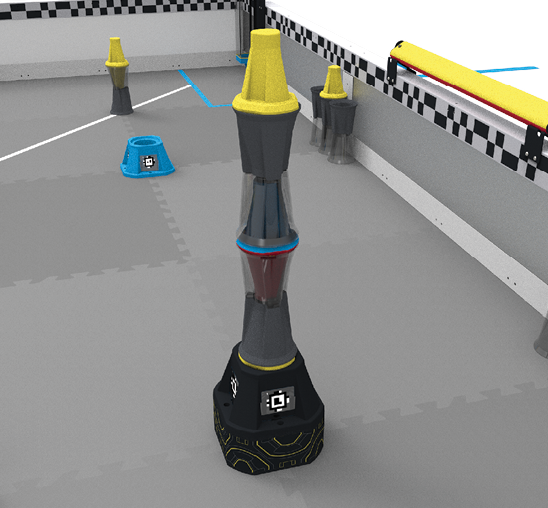
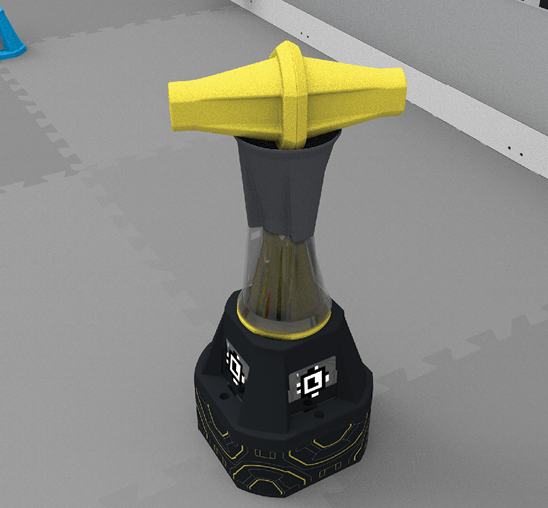
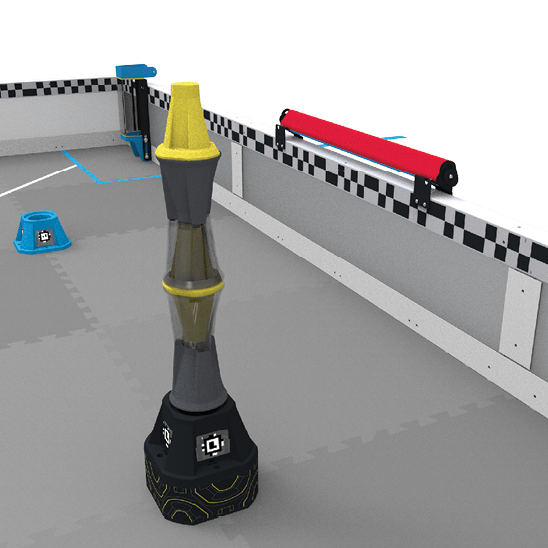
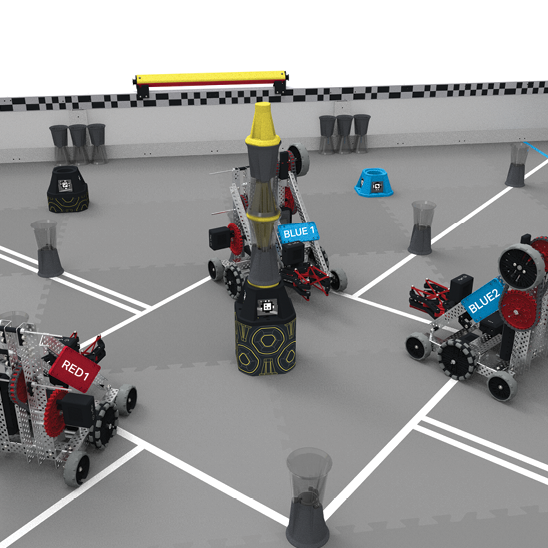
In the 2.0 manual, Appendix C - Rule Violations: "Match Affecting - A Violation which changes the winning and losing Alliance in the Match. Multiple Violations within a Match can cumulatively become Match Affecting."
This question presents scenarios where multiple match affecting violations occur in a single match and seeks clarity how to apply them.
Scenario 1
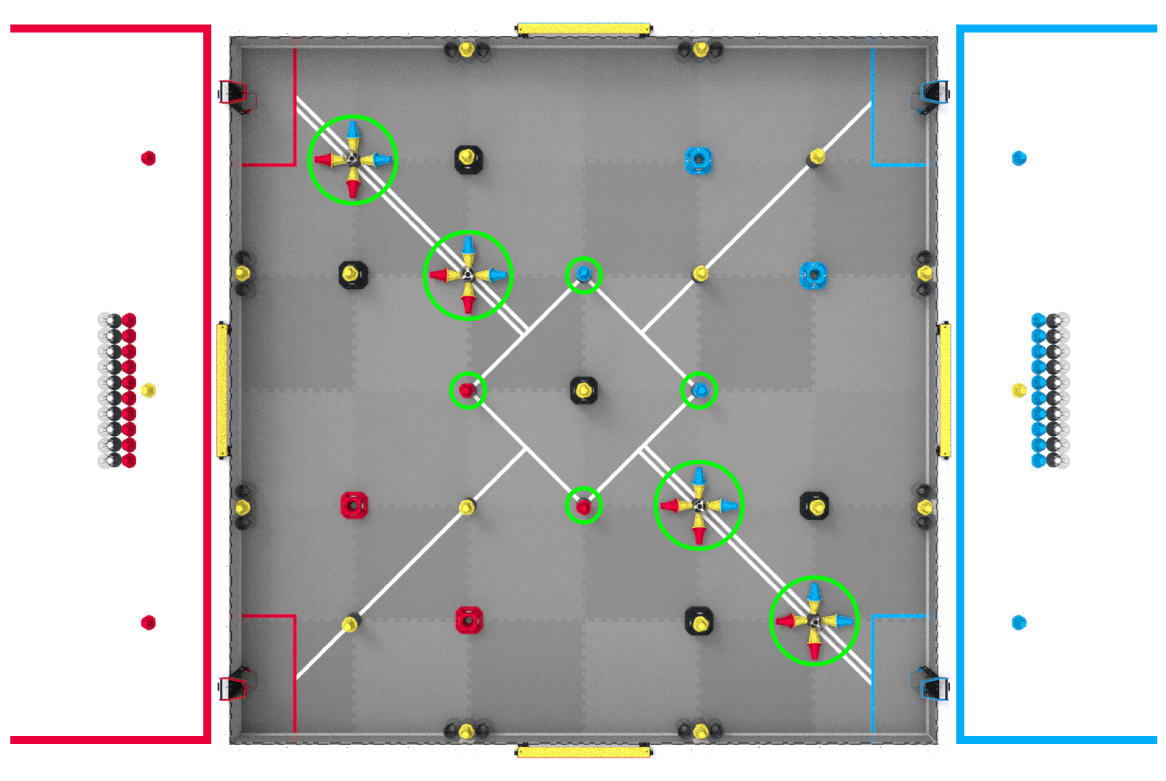
One robot, same goal: Blue1 descores two pins from a neutral goal, then later in the match Blue1 descores another pin from the same neutral goal.
Scenario 2
One robot, different goals: Blue1 descores two pins from a neutral goal, then later in the match Blue1 descores another pin from a different neutral goal.
Scenario 3
Two robots, same alliance: Blue1 descores two pins from a neutral goal, then later in the match Blue2 descores another pin from a different neutral goal.
In all of these scenarios, the match ends with the score of Blue 85, Red 60. How should these match affecting violations be cumulatively applied and does the guidance change if the match is in qualifications or eliminations?
Answered by committeeOct 7, 2026
Per <SG10> violation note #1, the value of removed Pins is determined for each independent interaction/violation. When multiple violations occur, the point values attributed to each violation may then stack.
For example, if Blue 1 removes one Pin from a neutral Goal, that interaction is valued at 10 pts. If Blue 1 later removes 3 additional Pins from a neutral Goal, that interaction is valued at 30 points. The cumulative value of these potentially match affecting violations would be 40 points. (Note: This is not evaluated as a single interaction resulting in the removal of 4+ Pins, which would be valued at 50 points. These were two separate interactions, and the points from each interaction stack. The Pin counts do not stack.)
In Elimination Matches, violations are tracked and shared for the Alliance, rather than each individual Robot. For example, if Blue 1 removed one Pin from a neutral Goal, that SG10 violation would be valued at 10 points. If Blue 2 removed 2 Pins from a neutral Goal, that SG10 violation would be valued at 20 points. These separate SG10 violations stack and are cumulatively valued at 30 points for the blue Alliance in this Elimination Match. If the blue Alliance were to win this Elimination Match by 30 points or less, the 30-point advantage gained via SG10 violations would be considered Match Affecting (Major Violation) in favor of the blue Alliance, and the blue Alliance would be disqualified for this Match.
In Qualification Matches, violations are tracked for each individual Robot, rather than shared across both Robots on an Alliance. Multiple violations committed by the same Robot will stack and be cumulatively applied for only that Robot. Any Violations committed by the other Robot on the Alliance, along with any Match Affecting calculations, are handled independently for each Robot. If Red 1 removed one Pin from a neutral Goal, that SG10 violation would be valued at 10 points. If Red 2 removed one Pin from a neutral Goal in one interaction (10 points) and removed 2 Pins from a neutral Goal in another interaction (20 points), Red 2's SG10 violations would be cumulatively valued at 30 points. Now, here are some different scenarios to consider how each Robot might be affected for this Qualification Match:
If the red Alliance were to win this Qualification Match by 10 points, both Red 1's SG10 violation (worth 10 points) and Red 2's SG10 violations (cumulatively worth 30 points) would independently be considered Match Affecting in favor of the red Alliance, and both red Alliance Robots would receive Major Violations and disqualifications for this Match.
If the red Alliance were to win this Qualification Match by 15 points, Red 1's SG10 violation (worth 10 points) would not be considered Match Affecting, and would result only in a Minor Violation. Red 2's SG10 violations (cumulatively worth 30 points) would be considered Match Affecting in favor of the red Alliance, and the Red 2 Robot would receive a Major Violation and disqualification for this Match.
If the red Alliance were to win this Qualification Match by 40 points, neither Red 1's SG10 violation (worth 10 points) nor Red 2's SG10 violations (cumulatively worth 30 points) would independently be considered Match Affecting, so both red Alliance Robots would only receive Minor Violations for this Match.
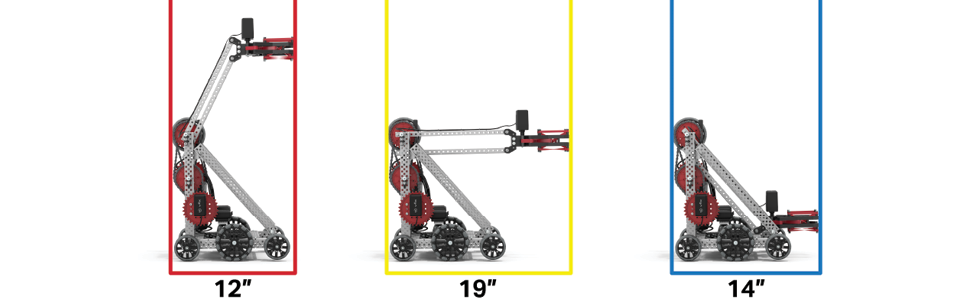
<SG2>Horizontal expansion is limited. Once the Match begins, Robots may expand horizontally beyond the starting size limit within the following criteria:
The Robot can never be larger than 24” wide or 24” long at any point during the Match (must fit within a 24”x24” square horizontal footprint).
Violation Notes:
Incidental/insignificant infractions that occur during a Match are only considered Minor Violations. Repeated Minor Violations should only escalate to a Major Violation in extreme circumstances. Examples of Minor Violations include, but are not limited to:
Loose wires
Broken zip ties / rubber bands
Bent or broken mechanical components that are not used for strategic gain
Figure SG-2: A demonstration of how the size of the Robot may change horizontally through the course of a vertical expansion.
This is a question that, although general in nature, is related to a recent referee decision that I am unable to find any rule justifying.
Scenario:
A blue robot decides it is strategically beneficial for them to descore 4+ pins from their own alliance goal. This goal descored had a mix of yellow and blue pins scored on it (this was noted by the head referee). The unpenalized final score would be 103 blue to 56 red. There are no other relevant interactions in the match by either alliance that would call for an application of <SG9>, <SG10>, or any other penalizing rule.
<SG9> notes that opponent alliance goals are protected, with no mention of anything relating to non-opponent alliance goals, so <SG9> seems irrelevant here.
<SG10> notes that removing (directly or indirectly) game pieces from neutral goals has the potential to be a major violation. However this rule is about neutral goals, not an alliance's own alliance goals, so it also seems not applicable here.
There seems to be no other even moderately relevant rules to the legality of this decision by the blue alliance.
Would it be correct in this scenario to keep the final score as 103 blue to 56 red, and award blue the victory and advance them to the next round of the elimination bracket (assuming this is match R16 2-1)? If not, why? Are there any grounds in this scenario that would call for a disqualification?
Thank you for your time!
Answered by committeeSep 23, 2026
There is no rule preventing the removal of Scoring Objects from your own Alliance-colored Goals.
Red Robots are allowed to remove any and all Scoring Objects from red Alliance Goals.
Blue Robots are allowed to remove any and all Scoring Objects from blue Alliance Goals.
This remains true regardless of Pin color/Ownership.
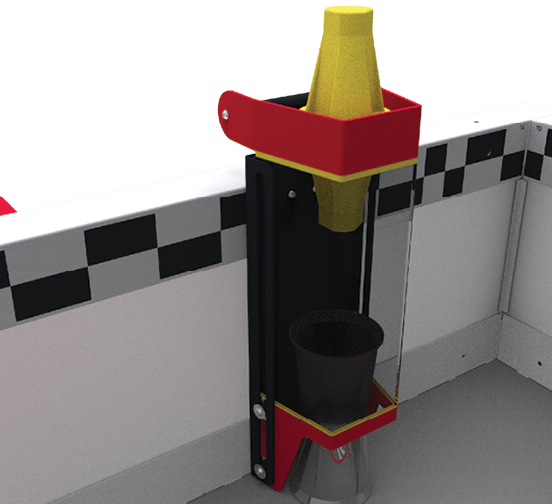
SG10 states that scored objects may not be removed from neutral goals and violation of this rule would result in match affecting calculations of 10, 20, 30, or 50 points (subtracted from the offending alliance's final score).
RED robot is scoring yellow pins on a neutral goal and while placing the 6th pin, accidentally topples the stack of pins. RED had scored all of the yellow pins that were knocked off. Does RED receive the 50 point deduction when evaluating if it was match affecting?
RED robot has scored 5 red pins on a neutral goal and while placing the 6th red-colored pin, accidentally topples the stack of pins. Does RED still receive the 50 point deduction when evaluating if it was match affecting, even though the pins removed from the neutral goal were red pins?
RED robot has scored a mix of yellow and red pins on a neutral goal and while placing the 6th pin, accidentally topples the stack of pins. Let's say 3 yellow pins and 2 red pins were removed from the neutral goal. Does RED receive a 50 point deduction when evaluating if it was match affecting, based on the total number of pins that were removed from the neutral goal?
Answered by committeeSep 17, 2026
Remember, Head Referees only check to see if subtracting these values from the offending Alliance's score would change the outcome of the Match. These values are not actually subtracted from Alliance scores.
The red Robot caused the removal of Scoring Objects from the neutral Goal in all three scenarios, so red is the offending Alliance for all three scenarios. It does not matter which Alliance Placed the Scoring Objects in the neutral Goal or which Alliance they were Scored for.
We know that it's counterintuitive for a red Robot to be punished for removing red Pins from a neutral Goal, since doing so only hurts the red Alliance's score. However, it was decided that this color-agnostic approach to the Pins was needed to make calling <SG10> Violations more manageable for Head Referees. It's difficult enough to try to determine the number of Pins removed. We felt that trying to track additional details, such as which color Pins were visible in the stack, was too much to ask of Head Referees in these moments, and likely would've lead to excessive guesswork and more inconsistent punishments.
Q&A 3233
Clarification of [SG10] Match Affecting Calculation When Both Alliances Remove Pins From Neutral Goals in the Same Match
During a Hypothetical Head-to-Head Elimination match, the following occurs:
Blue 1 removes one Placed yellow Pin from the center neutral Goal in a single interaction.
Blue 2 has no relevant violations.
At a different point in the match, Red 1 removes three Placed yellow Pins from a different neutral Goal in a single interaction.
Red 2 has no relevant violations.
Assume that for this question, neither interaction is considered intentional, strategic, egregious, or a repeated Minor Violation.
The final scored result of the Match, before considering rule violations, is:
Red Alliance 42
Blue Alliance: 50
Rule [SG10] states that Placed Scoring Objects may not be removed from neutral Goals. Its Violation Notes state that, for Match Affecting calculations, an interaction removing 1–3 Pins is evaluated at 10 points per Pin, while an interaction removing 4+ Pins is evaluated at a combined value of 50 points. It further states that if subtracting this value from the offending Alliance’s final score would change the outcome of the Match, the Violation should be considered Match Affecting.
Applying this calculation separately:
Blue 1 removed 1 Pin, so Blue’s calculation would be 50 - 10 = 40. Since 40 is less than Red’s 42, Blue’s violation would appear to be Match Affecting.
Red 1 removed 3 Pins, so Red’s calculation would be 42 - 30 = 12. Since Red already lost the Match, Red’s violation would appear not to be Match Affecting.
Appendix C also states that a Violation cannot be Match Affecting if the offending Team did not win the Match, and that Match Affecting Violations are normally Major Violations.
Based on this, we would like clarification on the following:
This interpretation appears to create a situation where Blue could receive a Disqualification specifically because Blue won the Match.
Particularly, if Blue had instead finished with 41 points and lost the Match 42–41, Blue’s same one-Pin removal would appear not to be Match Affecting. At the same time, Red would then be the winning Alliance, and Red’s three-Pin removal would appear Match Affecting under the 30-point calculation, since 42 - 30 = 12, which is less than Blue’s 41, disqualifying them.
Is it therefore an intended consequence of [SG10] that, in this scenario, an Alliance could receive a more favorable Match result by finishing with a lower score and losing on the field rather than scoring additional points, winning on the field, and receiving a Disqualification?
In this double-violation instance, could both Alliances receive Disqualifications and the Elimination Match (e.g., QF 2-1) be played again (e.g., as QF 2-2) to determine the Alliance that moves on in the bracket?
When both Alliances violate [SG10] in the same match, is there any circumstance in which the violations should offset one another? Specifically, should the value of Blue 1’s 10-point [SG10] violation be subtracted from the value of Red 1’s 30-point [SG10] violation, resulting in a net 20-point violation value attributed to Red for the purpose of determining whether Red’s violation was Match Affecting? (In this case, this would result in Blue winning the Match, because subtracting 20 points from Red’s 42-point score for the match-affecting determination would not change the original Blue victory.)
Or, is the correct application of [SG10] in this scenario to evaluate each Alliance’s violation independently against the original 42–50 final score, resulting in Blue receiving a Major Violation / Disqualification while Red’s violation remains Minor?
We are primarily looking for clarification on how [SG10] and the definition of Match Affecting should be applied when both Alliances commit separate [SG10] violations in the same Match, especially when the Alliance with the smaller violation wins with the original, unadjusted score.
Thank you for your time.
Answered by committeeSep 18, 2026
This process for handling Match Affecting calculations now works differently than in the past, and we acknowledge that the current <SG10> Violation notes do not make this process clear. We will attempt to correct that in the next game manual update.
The calculations for SG10 Violations should first be taken into account for both Alliances at the same time, prior to determining whether any Violation affected the outcome of the Match in favor of one Alliance or the other.
SCENARIO #1-
Using your Elimination Match scenario, here's how to handle the Match Affecting calculations for these SG10 Violations:
Red Alliance: 42 (final score) - 30 (value of removing 3 Pins) = 12 points (simulated final score)
Blue Alliance: 50 (final score) - 10 (value of removing 1 Pin) = 40 points (simulated final score)
When comparing both the final scores and the simulated final scores, we can see that the blue Alliance would win the Match both before and after taking these calculations into account. Therefore, these Violations committed by the red and blue Alliances are not Match Affecting, and would instead be considered Minor Violations for both Alliances. Remember, these calculated values are not actually deducted from official Alliance scores, so the final score of the Match remains 50 (blue) to 42 (red).
SCENARIO #2-
Let's consider a different Elimination Match scenario, where the Violations affect the outcome of the Match in favor of one Alliance (red removes 2 Pins in a single interaction, and blue removes 4 Pins in a single interaction):
Red Alliance: 75 (final score) - 20 (value of removing 2 Pins) = 55 points (simulated final score)
Blue Alliance: 90 (final score) - 50 (value of removing 4 Pins) = 40 points (simulated final score)
The blue Alliance would win the Match before taking these calculations into account (shown by the final scores), but the red Alliance would win the Match after taking these calculations into account (shown by the simulated final scores). Therefore, the blue Alliance's more severe SG10 Violation was large enough to affect the outcome of the Match in their favor, which would result in a Match Affecting Violation (DQ) for the blue Alliance. The red Alliance's SG10 Violation would only be considered a Minor Violation in this case.
SCENARIO #3-
Consider an Elimination Match scenario where taking into account all Match Affecting calculations for both Alliances results in a virtual tie (red removes 3 Pins in a single interaction, and blue removes 1 Pin in a single interaction):
Red Alliance: 80 (final score) - 30 (value of removing 3 Pins) = 50 points (simulated final score)
Blue Alliance: 60 (final score) - 10 (value of removing 1 Pin) = 50 points (simulated final score)
The red Alliance would win the Match before taking these calculations into account (shown by the final scores), but the Alliances would tie the Match after taking these calculations into account (shown by the simulated final scores). In this special case, both Alliances would incur Match Affecting Violations, and both Alliances would be disqualified for the Match. (In Appendix C, the last bullet point listed under “Match Affecting“ will be revised in the next game manual update to remove any language that conflicts with this outcome. This answer takes precedence over any conflicting language within Appendix C regarding Match Affecting Violations.)
In the 2.0 manual, Appendix C - Rule Violations: "Match Affecting - A Violation which changes the winning and losing Alliance in the Match. Multiple Violations within a Match can cumulatively become Match Affecting."
This question presents scenarios where multiple match affecting violations occur in a single match and seeks clarity how to apply them.
Scenario 1
One robot, same goal: Blue1 descores two pins from a neutral goal, then later in the match Blue1 descores another pin from the same neutral goal.
Scenario 2
One robot, different goals: Blue1 descores two pins from a neutral goal, then later in the match Blue1 descores another pin from a different neutral goal.
Scenario 3
Two robots, same alliance: Blue1 descores two pins from a neutral goal, then later in the match Blue2 descores another pin from a different neutral goal.
In all of these scenarios, the match ends with the score of Blue 85, Red 60. How should these match affecting violations be cumulatively applied and does the guidance change if the match is in qualifications or eliminations?
Answered by committeeOct 7, 2026
Per <SG10> violation note #1, the value of removed Pins is determined for each independent interaction/violation. When multiple violations occur, the point values attributed to each violation may then stack.
For example, if Blue 1 removes one Pin from a neutral Goal, that interaction is valued at 10 pts. If Blue 1 later removes 3 additional Pins from a neutral Goal, that interaction is valued at 30 points. The cumulative value of these potentially match affecting violations would be 40 points. (Note: This is not evaluated as a single interaction resulting in the removal of 4+ Pins, which would be valued at 50 points. These were two separate interactions, and the points from each interaction stack. The Pin counts do not stack.)
In Elimination Matches, violations are tracked and shared for the Alliance, rather than each individual Robot. For example, if Blue 1 removed one Pin from a neutral Goal, that SG10 violation would be valued at 10 points. If Blue 2 removed 2 Pins from a neutral Goal, that SG10 violation would be valued at 20 points. These separate SG10 violations stack and are cumulatively valued at 30 points for the blue Alliance in this Elimination Match. If the blue Alliance were to win this Elimination Match by 30 points or less, the 30-point advantage gained via SG10 violations would be considered Match Affecting (Major Violation) in favor of the blue Alliance, and the blue Alliance would be disqualified for this Match.
In Qualification Matches, violations are tracked for each individual Robot, rather than shared across both Robots on an Alliance. Multiple violations committed by the same Robot will stack and be cumulatively applied for only that Robot. Any Violations committed by the other Robot on the Alliance, along with any Match Affecting calculations, are handled independently for each Robot. If Red 1 removed one Pin from a neutral Goal, that SG10 violation would be valued at 10 points. If Red 2 removed one Pin from a neutral Goal in one interaction (10 points) and removed 2 Pins from a neutral Goal in another interaction (20 points), Red 2's SG10 violations would be cumulatively valued at 30 points. Now, here are some different scenarios to consider how each Robot might be affected for this Qualification Match:
If the red Alliance were to win this Qualification Match by 10 points, both Red 1's SG10 violation (worth 10 points) and Red 2's SG10 violations (cumulatively worth 30 points) would independently be considered Match Affecting in favor of the red Alliance, and both red Alliance Robots would receive Major Violations and disqualifications for this Match.
If the red Alliance were to win this Qualification Match by 15 points, Red 1's SG10 violation (worth 10 points) would not be considered Match Affecting, and would result only in a Minor Violation. Red 2's SG10 violations (cumulatively worth 30 points) would be considered Match Affecting in favor of the red Alliance, and the Red 2 Robot would receive a Major Violation and disqualification for this Match.
If the red Alliance were to win this Qualification Match by 40 points, neither Red 1's SG10 violation (worth 10 points) nor Red 2's SG10 violations (cumulatively worth 30 points) would independently be considered Match Affecting, so both red Alliance Robots would only receive Minor Violations for this Match.
Q&A 3249
<SG9>, <SG10>, and Descoring an Alliance's Own Alliance Goal
This is a question that, although general in nature, is related to a recent referee decision that I am unable to find any rule justifying.
Scenario:
A blue robot decides it is strategically beneficial for them to descore 4+ pins from their own alliance goal. This goal descored had a mix of yellow and blue pins scored on it (this was noted by the head referee). The unpenalized final score would be 103 blue to 56 red. There are no other relevant interactions in the match by either alliance that would call for an application of <SG9>, <SG10>, or any other penalizing rule.
<SG9> notes that opponent alliance goals are protected, with no mention of anything relating to non-opponent alliance goals, so <SG9> seems irrelevant here.
<SG10> notes that removing (directly or indirectly) game pieces from neutral goals has the potential to be a major violation. However this rule is about neutral goals, not an alliance's own alliance goals, so it also seems not applicable here.
There seems to be no other even moderately relevant rules to the legality of this decision by the blue alliance.
Would it be correct in this scenario to keep the final score as 103 blue to 56 red, and award blue the victory and advance them to the next round of the elimination bracket (assuming this is match R16 2-1)? If not, why? Are there any grounds in this scenario that would call for a disqualification?
Thank you for your time!
Answered by committeeSep 23, 2026
There is no rule preventing the removal of Scoring Objects from your own Alliance-colored Goals.
Red Robots are allowed to remove any and all Scoring Objects from red Alliance Goals.
Blue Robots are allowed to remove any and all Scoring Objects from blue Alliance Goals.
This remains true regardless of Pin color/Ownership.
Q&A 3250
<SG10> Removal of Momentarily Placed Scoring Object
In the 2.0 manual, SC2 Placed Scoring Object criteria
a. A Pin is considered Placed if it meets all of the following criteria:
i. The Pin is partially or entirely nested with a Goal, or with a Cup that is partially or entirely nested with another Placed Pin.
ii. Each Goal and/or each half of a Cup nested with that Pin contains a maximum of one Pin half. (See Figure SC2-2.)
b. A Cup is considered Placed if it meets the following criteria:
i. The Cup is partially or entirely nested with a Placed Pin.
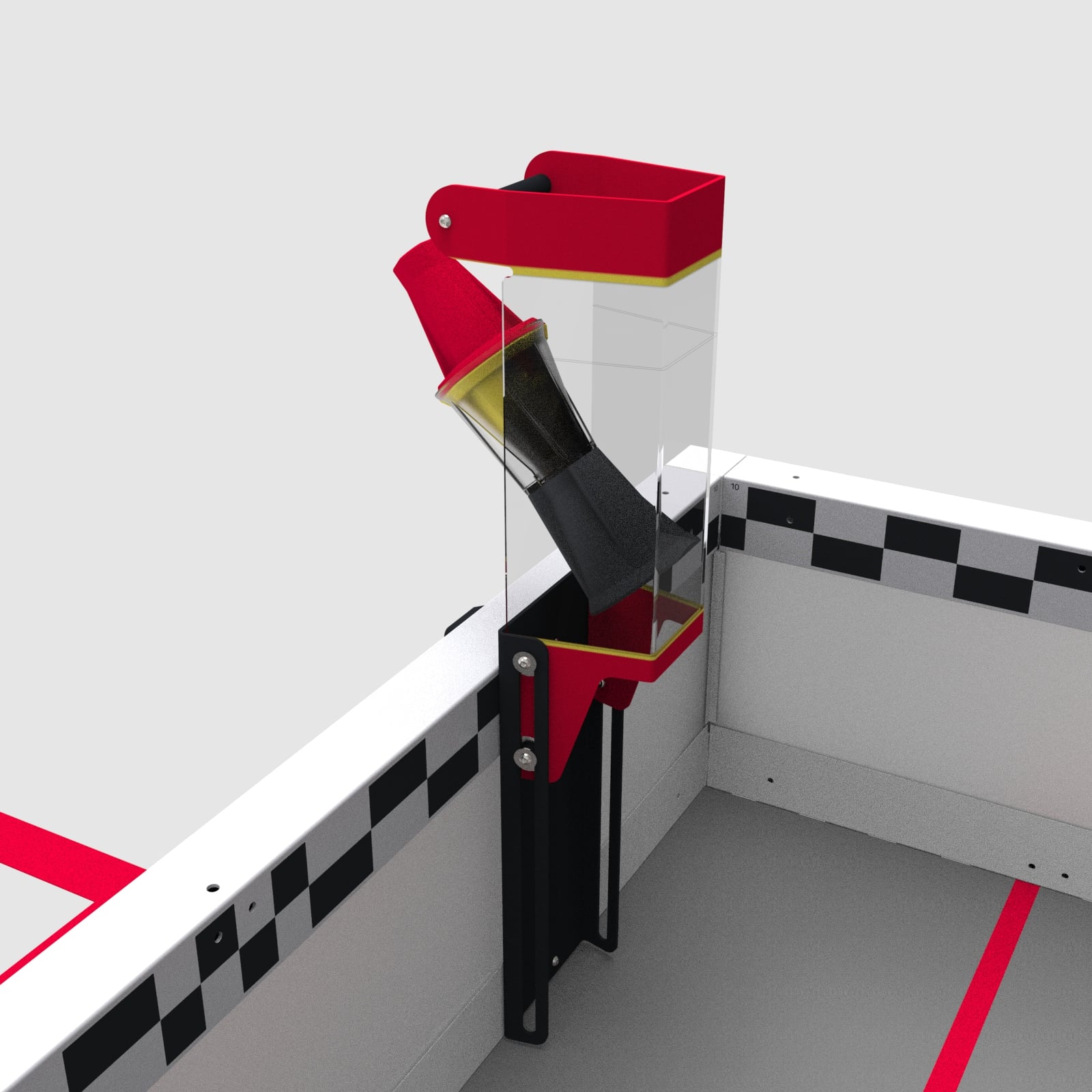
It is very common to see a robot holding a pin together with a cup in a claw. The robot tries to put this combination on another pin already in a goal. As they attempt to add these scoring objects, the pin on the goal is partially contained within the inner volume of the Cup. The robot then tries to open the claw, but fails (or is slightly misaligned) as they back away and those scoring objects fall to the tiles, but were at one point breaking an imaginary plane at the opening of a Cup.
Should that be counted as a score/descore and, possibly, match affecting considerations? Or simply just an unsuccessful scoring attempt in this interaction since it only broke the plane momentarily?
Answered by committeeSep 24, 2026
You describe a scenario in which a Robot attempts to Place additional Scoring Objects on a neutral Goal, which become momentarily Placed before falling off due to some fault of the Robot (such as misalignment, jerky movement, etc.).
This kind of scenario should be treated as an unsuccessful attempt to Place additional Scoring Objects, not as a removal of Placed Scoring Objects. Although these Scoring Objects were momentarily Placed, applying <SG10> here would be overly punitive and is not the intent of the rule.
However, if the Robot also removes any Scoring Objects that were already Placed on the Goal before this attempt, that would still be a Violation of <SG10>.
หากการแข่งขันใช้ระบบควบคุมสนามอัจฉริยะ (Smart Field Control) และหุ่นยนต์ไม่สามารถเชื่อมต่อกับระบบควบคุมสนามอัจฉริยะได้สำเร็จก่อนเวลาเริ่มการแข่งขันตามกำหนด กรรมการผู้ตัดสินหลักอาจขอให้ทีมนำหุ่นยนต์ออกจากสนามตามข้อ B
หุ่นยนต์ที่เชื่อมต่อกับระบบควบคุมสนามอัจฉริยะ (Smart Field Control) แต่แสดงข้อผิดพลาด ‘ระบบควบคุมสนามแบบดั้งเดิม’ (Legacy Field Control) บนจอภาพในสนาม จะไม่ถือว่าเชื่อมต่อกับระบบควบคุมสนามอัจฉริยะสำเร็จ และอาจถูกนำออกจากสนามหากทำให้การเริ่มการแข่งขันล่าช้ากว่ากำหนด
During a Hypothetical Head-to-Head Elimination match, the following occurs:
Blue 1 removes one Placed yellow Pin from the center neutral Goal in a single interaction.
Blue 2 has no relevant violations.
At a different point in the match, Red 1 removes three Placed yellow Pins from a different neutral Goal in a single interaction.
Red 2 has no relevant violations.
Assume that for this question, neither interaction is considered intentional, strategic, egregious, or a repeated Minor Violation.
The final scored result of the Match, before considering rule violations, is:
Red Alliance 42
Blue Alliance: 50
Rule [SG10] states that Placed Scoring Objects may not be removed from neutral Goals. Its Violation Notes state that, for Match Affecting calculations, an interaction removing 1–3 Pins is evaluated at 10 points per Pin, while an interaction removing 4+ Pins is evaluated at a combined value of 50 points. It further states that if subtracting this value from the offending Alliance’s final score would change the outcome of the Match, the Violation should be considered Match Affecting.
Applying this calculation separately:
Blue 1 removed 1 Pin, so Blue’s calculation would be 50 - 10 = 40. Since 40 is less than Red’s 42, Blue’s violation would appear to be Match Affecting.
Red 1 removed 3 Pins, so Red’s calculation would be 42 - 30 = 12. Since Red already lost the Match, Red’s violation would appear not to be Match Affecting.
Appendix C also states that a Violation cannot be Match Affecting if the offending Team did not win the Match, and that Match Affecting Violations are normally Major Violations.
Based on this, we would like clarification on the following:
This interpretation appears to create a situation where Blue could receive a Disqualification specifically because Blue won the Match.
Particularly, if Blue had instead finished with 41 points and lost the Match 42–41, Blue’s same one-Pin removal would appear not to be Match Affecting. At the same time, Red would then be the winning Alliance, and Red’s three-Pin removal would appear Match Affecting under the 30-point calculation, since 42 - 30 = 12, which is less than Blue’s 41, disqualifying them.
Is it therefore an intended consequence of [SG10] that, in this scenario, an Alliance could receive a more favorable Match result by finishing with a lower score and losing on the field rather than scoring additional points, winning on the field, and receiving a Disqualification?
In this double-violation instance, could both Alliances receive Disqualifications and the Elimination Match (e.g., QF 2-1) be played again (e.g., as QF 2-2) to determine the Alliance that moves on in the bracket?
When both Alliances violate [SG10] in the same match, is there any circumstance in which the violations should offset one another? Specifically, should the value of Blue 1’s 10-point [SG10] violation be subtracted from the value of Red 1’s 30-point [SG10] violation, resulting in a net 20-point violation value attributed to Red for the purpose of determining whether Red’s violation was Match Affecting? (In this case, this would result in Blue winning the Match, because subtracting 20 points from Red’s 42-point score for the match-affecting determination would not change the original Blue victory.)
Or, is the correct application of [SG10] in this scenario to evaluate each Alliance’s violation independently against the original 42–50 final score, resulting in Blue receiving a Major Violation / Disqualification while Red’s violation remains Minor?
We are primarily looking for clarification on how [SG10] and the definition of Match Affecting should be applied when both Alliances commit separate [SG10] violations in the same Match, especially when the Alliance with the smaller violation wins with the original, unadjusted score.
Thank you for your time.
Answered by committeeSep 18, 2026
This process for handling Match Affecting calculations now works differently than in the past, and we acknowledge that the current <SG10> Violation notes do not make this process clear. We will attempt to correct that in the next game manual update.
The calculations for SG10 Violations should first be taken into account for both Alliances at the same time, prior to determining whether any Violation affected the outcome of the Match in favor of one Alliance or the other.
SCENARIO #1-
Using your Elimination Match scenario, here's how to handle the Match Affecting calculations for these SG10 Violations:
Red Alliance: 42 (final score) - 30 (value of removing 3 Pins) = 12 points (simulated final score)
Blue Alliance: 50 (final score) - 10 (value of removing 1 Pin) = 40 points (simulated final score)
When comparing both the final scores and the simulated final scores, we can see that the blue Alliance would win the Match both before and after taking these calculations into account. Therefore, these Violations committed by the red and blue Alliances are not Match Affecting, and would instead be considered Minor Violations for both Alliances. Remember, these calculated values are not actually deducted from official Alliance scores, so the final score of the Match remains 50 (blue) to 42 (red).
SCENARIO #2-
Let's consider a different Elimination Match scenario, where the Violations affect the outcome of the Match in favor of one Alliance (red removes 2 Pins in a single interaction, and blue removes 4 Pins in a single interaction):
Red Alliance: 75 (final score) - 20 (value of removing 2 Pins) = 55 points (simulated final score)
Blue Alliance: 90 (final score) - 50 (value of removing 4 Pins) = 40 points (simulated final score)
The blue Alliance would win the Match before taking these calculations into account (shown by the final scores), but the red Alliance would win the Match after taking these calculations into account (shown by the simulated final scores). Therefore, the blue Alliance's more severe SG10 Violation was large enough to affect the outcome of the Match in their favor, which would result in a Match Affecting Violation (DQ) for the blue Alliance. The red Alliance's SG10 Violation would only be considered a Minor Violation in this case.
SCENARIO #3-
Consider an Elimination Match scenario where taking into account all Match Affecting calculations for both Alliances results in a virtual tie (red removes 3 Pins in a single interaction, and blue removes 1 Pin in a single interaction):
Red Alliance: 80 (final score) - 30 (value of removing 3 Pins) = 50 points (simulated final score)
Blue Alliance: 60 (final score) - 10 (value of removing 1 Pin) = 50 points (simulated final score)
The red Alliance would win the Match before taking these calculations into account (shown by the final scores), but the Alliances would tie the Match after taking these calculations into account (shown by the simulated final scores). In this special case, both Alliances would incur Match Affecting Violations, and both Alliances would be disqualified for the Match. (In Appendix C, the last bullet point listed under “Match Affecting“ will be revised in the next game manual update to remove any language that conflicts with this outcome. This answer takes precedence over any conflicting language within Appendix C regarding Match Affecting Violations.)